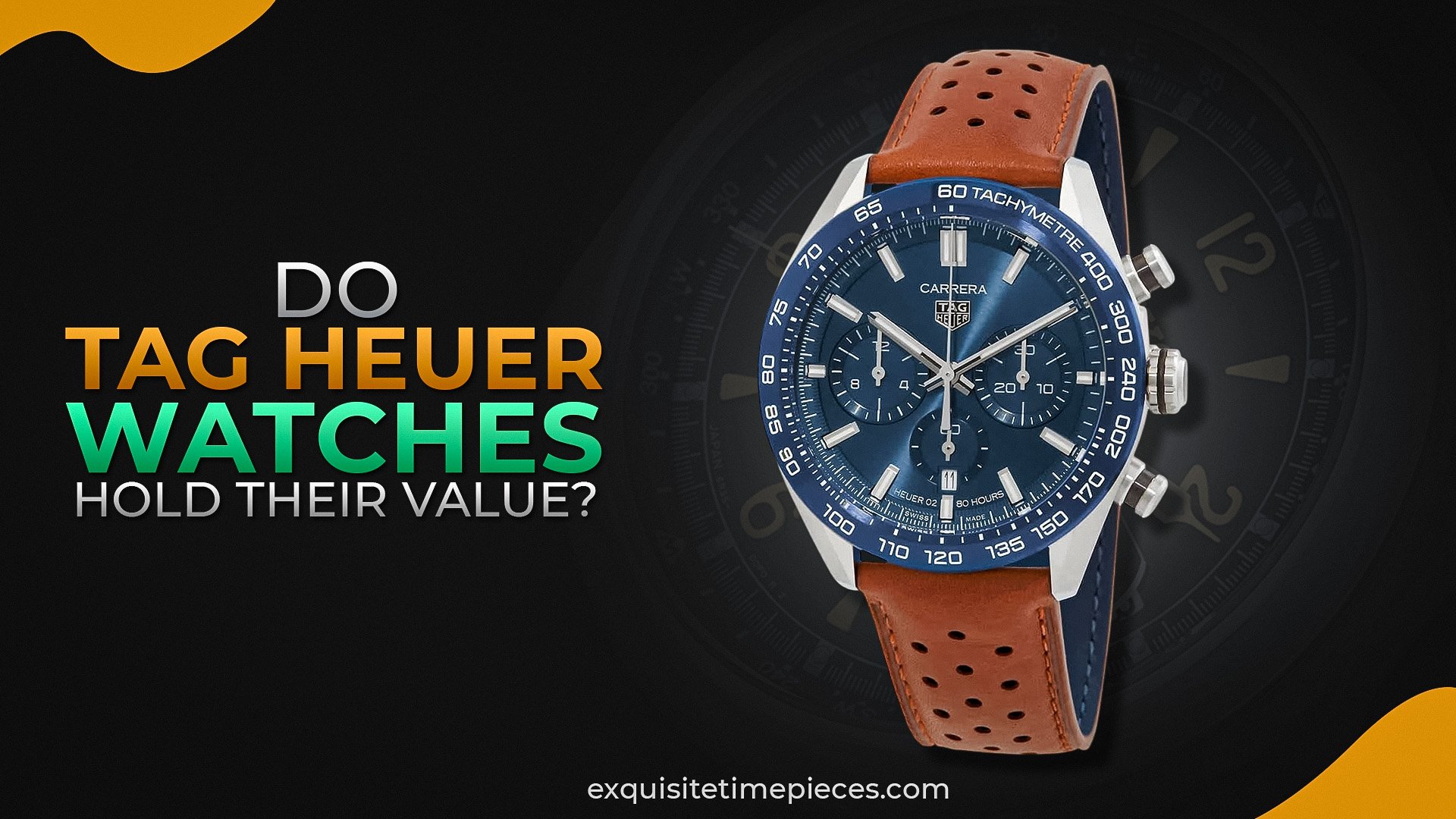
TAG Heuer, the Swiss watchmaker renowned for entry-level excellence and a certain square racer, has etched its name in the annals of horology. Crafting timepieces that straddle the realms of tradition and innovation, TAG Heuer combines heritage with contemporary aesthetics, creating affordable luxury timepieces and wrist-bound marvels coveted by connoisseurs.
But, beyond their exquisite craftsmanship and market appeal, I’ll be delving into the realm of investment here, where the long-term value of these watches reveals itself.
Drawing from a tapestry of industry knowledge and scrutiny of market trends, I’ll examine the characteristics that underpin TAG Heuer’s allure as an investment. From their long-standing reputation, impeccable build quality, and celebrated partnerships with motorsports and beyond, I’ll be exploring how the various factors of TAG Heuer timepieces intertwine to shape their value.
About TAG Heuer Watches
With a heritage steeped in horological superiority, this Swiss brand has been crafting exceptional timepieces since its inception in 1860. TAG Heuer‘s story begins with Edouard Heuer, a visionary watchmaker who had an uncanny ability to push the boundaries of chronometric innovation in his time. Heuer’s relentless pursuit of accuracy led to groundbreaking developments, including the invention of the oscillating pinion in 1887, a revolutionary mechanism still used in mechanical chronographs today.
I’d be remiss if I didn’t mention some of TAG’s most iconic and renowned watches. The Monaco, introduced in 1969, became an instant classic with its bold square case and avant-garde design. If you like it, you love it, and if you don’t, you can’t stand it. Such is the power of the Monaco.
Thanks to its association with Steve McQueen through his iconic role in the film “Le Mans,” the Monaco has become a symbol of racing heritage and timeless style. The Carrera is another notable timepiece that has captured the imagination of watch enthusiasts worldwide. Launched in 1963, the Carrera embodied Heuer’s passion for motorsports.
Its sleek design, legible dial, and robust chronograph functionality made it a favorite among racing aficionados and watch connoisseurs alike. Given that it’s generally not a bank-busting watch (although it can be, depending on certain variables), the Carrera is still one of TAG’s most successful releases to date.
What might be clear at this point is that TAG Heuer’s enduring partnerships with motorsports have played a pivotal role in shaping its identity. From the Monaco’s association with the prestigious Monaco Grand Prix to the Carrera’s deep ties with the exhilarating world of Formula 1, TAG Heuer’s watches embody the spirit of speed, precision, and high-performance engineering.
In an industry where tradition meets innovation, TAG Heuer does a good job of combining the best of both worlds. Their ability to honor their horological legacy while pushing the boundaries of technology is a testament to their exceptional craftsmanship and forward-thinking mindset.
Whether you’re a racing enthusiast, a connoisseur of fine timepieces, or simply someone who appreciates the artistry that goes into watchmaking, TAG Heuer offers an unrivaled experience, particularly in terms of value for money. Let’s look at whether that value holds over time, though…
The Role of In-House Movements in Value Retention
In-house movements offer unique features and intricacies that are original to the brand they serve. TAG Heuer’s movements offer a longer power reserve than typical ETA movements, and they elevate the brand’s sense of prestige, often playing a large role in why buyers are drawn to the watch itself.
After all, if a watch has an in-house movement, it will typically be one of the most unique features of the entire piece, as it will often be the only truly original tool the watch has at its disposal. Unique movements vary in rarity, with some being far scarcer, therefore demanding higher value. Some of the older TAG Heuer movements—providing they hold their value—can go for quite a lot.
In the watch industry, exclusivity sells. Watches with unique movements are more coveted simply because of how people will look at you if they know what you’re wearing. More precise and complex pieces will naturally draw anyone who is looking for that extra flavor in their piece.
TAG Heuer has reinforced their reputation as elite watchmakers partially because of their movements. If a brand can find its spark and design a movement that is truly original, you will often see that brand hold itself to a much higher standard, which influences the public’s opinion as well.
What Makes Luxury Watches Hold Their Value?
Like most watch nerds, I’m interested in unraveling the intricacies of timepiece investments, so I’ve taken it upon myself to dissect TAG’s value over time and shed light on the factors that contribute to value retention in their creations. This can be spread over a few key areas:
Brand Recognition: The Pillar of Prestige
When it comes to luxury watches, brand recognition reigns supreme. Renowned watchhouses with a storied history and a legacy of excellence often command higher prices and retain their value over time. Brands like Rolex, Patek Philippe, and Audemars Piguet have established themselves as stalwarts of luxury horology, and their timepieces consistently exhibit strong resale value, partly as a result of this.
The prestige associated with these brands stems from a combination of factors, including a commitment to impeccable craftsmanship, rigorous quality control, and a rich heritage that resonates with collectors and enthusiasts. TAG Heuer has been around for a long time, and few people are able to say they’ve never heard of the brand, in all honesty.
This is where it gets curious, though – despite TAG’s ubiquity as a brand name in high-end watchmaking, their reputation doesn’t inspire as much consumer confidence as most of their Swiss peers. Perhaps this is because TAG Heuer is generally considered less luxurious than the aforementioned brands, if only subconsciously, despite their horological breakthroughs and pioneering designs.
The price point has something to do with that – most TAG watches cost far less than even mid-range Rolexes, excluding them from the perceived upper echelons of watchmaking by dint of the fact that they’re cheaper.
Iconic Design: Transcending Trends
Beyond brand recognition, striking design plays a pivotal role in maintaining the value of luxury watches. Timepieces that boast enduring aesthetics, free from fleeting trends, tend to hold their value more effectively. These designs encapsulate a harmonious blend of form and function, standing the test of time.
Consider the elegance of the Rolex Submariner, with its iconic Oyster case and robust construction. Or the enduring appeal of the Patek Philippe Nautilus, characterized by its distinctive porthole-inspired design. These watches possess a visual language that transcends passing fads, ensuring their desirability remains intact, generation after generation.
TAG Heuer’s Monaco is a great example of this, as are a few of the brand’s vintage offerings (which we’ll get to later). The Monaco virtually cordoned off the square watch market upon release, and to this day, there’s not a square watch article you’ll find worth its salt that doesn’t mention at least one iteration of the quadrilateral ticker. Safe to say, it’s a high-selling piece for TAG, and it certainly has better value retention than many of their other models.
Rarity: Owning The Unattainable
The principle of supply and demand holds true in the world of luxury watches, where scarcity often begets value. Limited editions, discontinued models, or watches with unique complications inherently possess an allure that appeals to collectors and investors. We want what we can’t have, and once we have it, everyone else wants it more.
Limited production runs, such as the Audemars Piguet Royal Oak Offshore LeBron James, or vintage timepieces like the Omega Speedmaster Moonwatch, are highly sought after due to their exclusivity and rarity. The finite nature of these watches creates a sense of urgency among enthusiasts, driving prices upward and ensuring their value remains resilient.
Additionally, the presence of rare complications, such as tourbillons or minute repeaters, adds to the desirability and value retention of luxury watches. These intricate mechanisms require exceptional skill and expertise to manufacture, making them highly coveted among connoisseurs who appreciate the mastery behind their creations.
Do TAG Heuer Watches Hold Their Value?
When it comes to brand recognition, TAG Heuer stands tall, having carved a prominent niche in the industry since its founding in 1860. While it’s true that most TAG Heuer watches don’t hold their value as well as some of their luxury counterparts, the brand’s iconic models have proven to be exceptions to the rule.
Take, for instance, the legendary Monaco. This bold and distinctive timepiece exhibits stronger value retention compared to other TAG Heuer models, new or old. Look a bit closer, and you’ll notice that special iterations of the Monaco, such as the 18k gold reference CW5140, retain their value far better than others and, indeed, are bonafide horological gems among collectors.
With that being said, true collectors are movement geeks, and the simple fact that TAG Heuer outsources its movements is one that definitely detracts from the brand’s overall reputation and, consequently, from the long-term value of their watches.
In terms of watch design, TAG Heuer has established a reputation for creating timepieces that blend classic elegance with contemporary flair. Their commitment to striking aesthetics contributes to the allure of their watches but is that enough for the aftermarket in a world where good-looking watches are more accessible than ever?
While not all models share the same value retention, those with enduring classic designs, like the Carrera 1153B (known as the Jagger – you guess why) and the Autavia, have shown a better track record in retaining their value over time.
TAG Heuer’s limited editions and discontinued models tend to generate greater demand among collectors, bolstering their value. For example, the TAG Heuer Monaco Gulf Special Edition has become a sought-after timepiece due to its scarcity and unparalleled aesthetic elements. Likewise, the Autavia CBE2114 collaboration with Calibre 11, being a model that evokes musings of the Daytona, still fetches a pretty penny.
It is worth noting that while some TAG Heuer watches may experience depreciation in value, others exhibit a stronger hold. Vintage Heuer models, particularly those from the 1960s and 1970s, have benefitted from an upward trajectory in value appreciation due to their historical significance and collector appeal.
Important to note, however, is the fact that many of the rarest watches under the TAG umbrella were made when the brand was just ‘Heuer’, before TAG’s 1985 takeover. While not all TAG Heuer watches hold their value, as well as some luxury counterparts, the brand’s iconic models and vintage pieces have demonstrated stronger value retention.
The Monaco, Carrera, and Autavia stand out as examples of watches that generally hold their value better within the TAG Heuer lineup. With this being said, I wouldn’t recommend many TAG Heuer watches to someone looking for a timepiece as an investment.
Do TAG Heuer Watches Appreciate In Value?
Given that TAG Heuer is, despite the hate, a distinguished Swiss watchmaker with a rich heritage, it’s understandable why the brand has captured the hearts of enthusiasts and casual wearers alike. While watches made by some luxury watch brands have gained a reputation for being expensive investments, the story for TAG Heuer watches is slightly different.
Unlike those of certain haute horologists, TAG Heuer’s watches generally do not experience substantial appreciation in value. They are often considered entry-level luxury watches designed to be accessible and enjoyed by a wider audience. TAG takes pride in this, and they know what they’re doing. Remember – to the company, the aftermarket means little.
They make their bread on the factory floor, so while their watches may not appreciate in value over time, this fact says little about the quality and aptitude of TAG Heuer’s tickers. One factor to consider when assessing the investment potential of TAG Heuer watches is the brand’s iconic models.
Previously mentioned models, be they vintage or off-the-rack, have achieved cult status among collectors, and their value has seen some appreciation over time. The enduring appeal of these models, along with their historical significance and unique designs, contributes to their desirability in the market.
Furthermore, limited editions and special collaborations can be worth exploring for potential investment opportunities. TAG Heuer has released limited-run watches tied to significant events or partnerships, and their scarcity can drive up demand and, subsequently, value.
However, it is essential to conduct thorough research and assess the market dynamics before considering such timepieces as investment assets. The Jo Siffert Carrera is a good example in this category, as are many of the Heuer chronographs from the ‘40s and ‘50s, particularly those made from precious metals.
When it comes to investing in watches, it’s crucial to approach the endeavor from a well-informed perspective. The luxury watch market is subject to various factors of change, including shifting trends, brand reputation, and consumer preferences.
While TAG Heuer watches may not offer the same level of appreciation as some high-end luxury brands, they can still provide their owners joy, style, and craftsmanship. Furthermore, some of TAG Heuer’s newer watches, many of which include high-tech materials and intricate movements, may project greater value appreciation in decades to come.
The current state of the TAG aftermarket doesn’t necessarily determine what it will look like in 10 years. Ultimately, whether a TAG Heuer watch proves to be a good investment depends on one’s goals and expectations. If you’re seeking substantial appreciation in value right now, there are certainly other brands that present more favorable opportunities.
What About Vintage TAG Heuer Watches?
Vintage watches inhabit a world of their own. A place where style and technology transcend generations for the sake of timelessness. When it comes to vintage TAG Heuer watches, the story takes a captivating turn.
The vintage Carrera and Monaco models, born during the era when TAG Heuer was still Heuer, hold a special place in the hearts of watch connoisseurs. These iconic timepieces showcase the brand’s pioneering spirit, pushing boundaries with their forward-thinking design and engineering prowess.
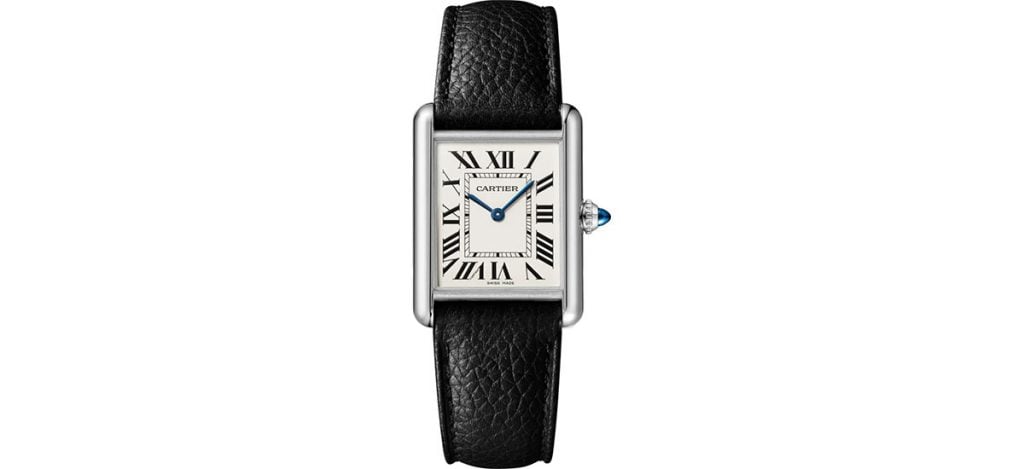
The Carrera, with its clean lines and race-inspired aesthetic, became an instant classic. The Monaco competes only with Cartier’s Tank for the title of ‘Most Recognisable Square Watch Of All Time’.
These vintage Heuer watches not only embody an era of horological innovation but has also proven to be lucrative investments. As the market for vintage watches continues to grow, collectors seek out such coveted timepieces, driving up their value. Heuer’s Triple Date Chronograph and Carerra 2448S are great representations of how the brand’s vintage watches have held their luster and financial appeal over decades.
However, venturing into the world of vintage watches requires a discerning eye and a comprehensive understanding of the market. Factors such as condition, authenticity, and provenance play a crucial role in determining the value of a vintage TAG Heuer timepiece.
Thorough research, consultation with experts, and a keen sense of rarity can help identify the hidden gems among the vintage offerings. If you’re not willing to put in some work to ensure the veracity of your purchase, it’s highly likely that you’ll end up with a vintage TAG that’s worth less than what you paid, so be vigilant and above all, patient.
TAG Heuer – A Final Evaluation
In the realm of horological investments, the value retention of TAG Heuer watches may not rival some high-end luxury brands. However, certain models, such as the iconic Monaco, Carrera, and limited editions, have shown the potential for better value retention. While TAG Heuer watches offer accessible luxury and contemporary designs, it is important to approach them as an investment with realistic expectations.
Vintage TAG Heuer watches, especially those from the era when the brand was known as Heuer, have witnessed a surge in value appreciation, becoming hidden gems sought after by collectors. Ultimately, the value of a TAG Heuer watch extends beyond monetary gains, encompassing the craftsmanship, design, and personal enjoyment it brings to its owner.
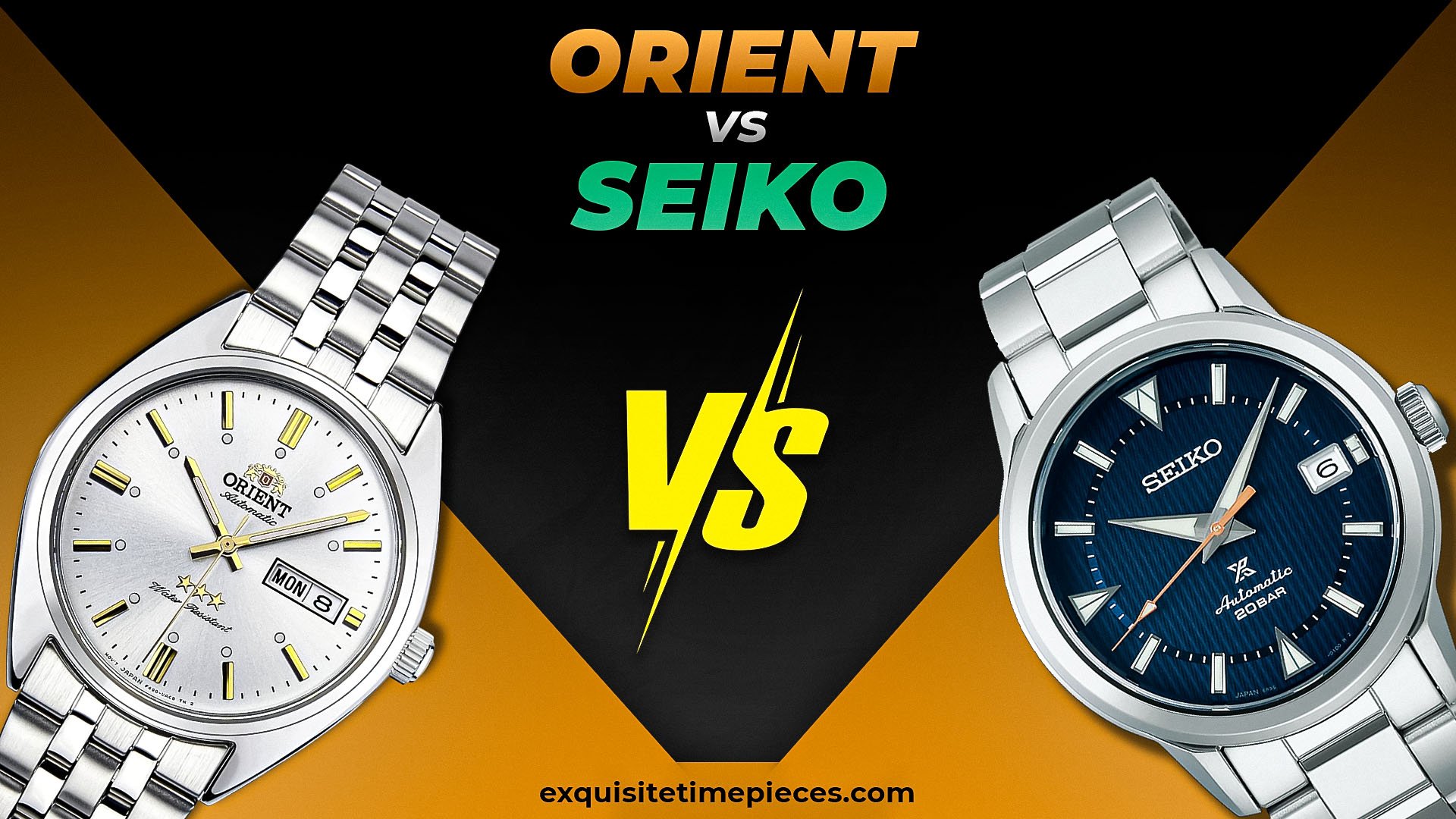
Welcome to another knock-down, drag-out battle here on Exquisite Timepieces. Today, we pit two strong value-based Japanese brands against each other.
If you’re looking for a great timepiece that mashes up ruggedness and durability at an accessible price point, your best offers will be from Seiko and Orient. Together with Citizen, Seiko, and Orient make up the three top Asian watch brands and are known all over the globe.
Apart from offering the best entry-level choices on the market, they are both respected for providing exquisitely styled watches that are precise, accurate, and reliable.
Will the maker of exceptional value-for-money watches (Orient) be able to beat the reigning Japanese champion (Seiko)? Let’s find out!
About Orient Watches
Orient is a Japanese watch manufacturer with roots stretching back to 1901. 1901 was the year Shogoro Yoshida started ‘Yoshida Watch Shop’ in Ueno, Taito, Tokyo, Japan. The young merchant began by selling imported watches, and by 1912, the business had expanded to a point where Yoshida began producing gold wristwatch cases.
Fast forward to 1920, and Yoshida moved on to producing table clocks and gauges. By 1934, the company, now “Toyo Tokei Manufacturing”, began manufacturing wristwatches. The business expanded, and in 1936, there was a need to move to a larger base which led to the building of the Hino factory in Hino, Tokyo, Japan.
The young brand continued production in this location successfully until 1949, when it shut down due to the economic meltdown following World War II. Hope came alive once more, and Toyo Tokei Manufacturing was brought back to life in 1950 under the name Tama Keiki Company. The name was changed to Orient Watch Company Limited a year later, and the first Orient Star went on sale immediately.
The watch quickly gained popularity among top luxury watches, giving Orient Watch Company Limited an expanded reach and visibility. Other important watches released during this era include the “Fineness”, the world’s thinnest automatic timepiece that featured a day and date calendar function in 1967, the “Dynamic” in 1956, and the “Grand Prix 100” in 1964.
The company survived the quartz crisis in the 1970s, and about three decades later, the Orient Technical Center (OTC) was founded to assemble high-end watches in Ugo, Ogachi, Akita, Japan.
The proud Japanese craftsmanship of exquisite watchmaking continued, and Orient Watch Company eventually became a functional subsidiary of the Seiko-Epson Corporation in 2017.
About Seiko Watches
Seiko’s story begins in 1881 with a 21-year-old entrepreneur, Kintarō Hattori, opening a watch and jewelry shop. The store, which he called “K. Hattori”, was located in Ginza, Tokyo. He also began to sell and repair watches and clocks, a skill he learned from working as a clockmaker apprentice when he was 13 years old.
His business grew very quickly, and just four years after its establishment, he began importing exclusive timepieces and machinery for wholesalers who needed these items from foreign trading companies. His close partnership with various international trading firms gave him access to Western (imported) timepieces and machinery that were not available elsewhere then.
Due to the rarity of the imported timepieces and machinery, his business grew exponentially, so that in 1892, eleven years after he founded “K. Hattori”, the ‘Seikosha’ factory was established.
It was in Seikosha, which roughly means “Exquisite House” in Japanese, that Kintaro Hattori began the production of his first clocks.
By 1895, the young brand launched its first in-house pocket watch, “The Timekeeper”, and all through the 1890s, the success of Seikosha’s watch business heightened. The production of the Timekeeper was a vital step and laid the foundation for Japan’s first-ever wristwatch, without which the future of Seiko would have been very different.
Kintarō Hattori, who had resolved to always be ‘one step ahead’, embarked on the difficult task of producing Japan’s first-ever wristwatch, and he succeeded. By 1913, the first Japanese-made wristwatch, ‘the Laurel’, hit the market, and even though at that time only about 30 watches could be made in a day, Kintaro had established a lead on the rest.
In 1924, one year after the Great Kanto earthquake, the company created the first Seiko-branded wristwatch. It was in the same year that Seikosha changed its trademark to “Seiko”; by 1929, Japan’s National Railway adopted its pocket watch as the official “Railway Watch”.
Successful production, and in 1956, Seiko released “The Automatic”, which was Japan’s first automatic wristwatch. Quartz technology was developed during the early 1960s so that by 1964, Seiko was equipped with 1,278 timing devices as it served as the Official Timer of the 18th Olympiad in Tokyo.
The world’s first commercial quartz wristwatch, “the Astron”, went on sale in 1969, positioning Seiko as one of the top leaders in the Horological world. Many other firsts followed, such as the first digital watch with a stopwatch function and the first diver’s timepiece with a titanium case, amongst others.
Today, Seiko is recognized as Japan’s most iconic watch brand that has earned the love and respect of enthusiasts and casual wearers all over the world.
Orient vs Seiko Watches: The Battle of Two Iconic Japanese Watch Brands
One thing Orient and Seiko have in common is their capacity to produce reliable timepieces at affordable prices. Their impressive range as watchmakers have made them a beloved favorite of watch wearers all over the world. For a giant watchmaker with over 100 years of exquisite craftsmanship, Seiko still isn’t ashamed to produce in the budget realm.
Meanwhile, Orient has long occupied the spotlight for offering some of the best affordable mechanical watches, rivaling Seiko. It’s not often these well-respected Japanese watchmakers get put head to head, but they both offer fantastic, entry-level timepieces for anyone and everyone.
If you’re searching for excellent watches labeled as quality, precise, accurate, and reliable for under $500, few are better choices than those offered by Seiko or Orient. That said, let’s move on to compare both brands.
What are the pros and cons of Orient and Seiko?
Seiko has more movement options and more advanced technologies. Quartz watches are what they are most famous for, and their diver watches have become known as the go-to brand for divers due to their ISO certification.
They are, however, much more expensive than Orient. Compared to Seiko, Orient pieces are nearly half the price, which cannot be overlooked.
The quality of Orient dive watches is far outmatched, but their premium builds have gotten a lot of traction for disrupting the trend of mainstream brands like Seiko, who have dominated the luxury market for so long.
The Orient star collection, in particular, is what I would look at if you are interested in seeing for yourself the high level these watchmakers operate on. Pros for Seiko would include versatility and quality, both in their movement and their design.
Pro’s for Orient would be the pricing—which would also be a Seiko con. And the cons of Orient would be that their diver’s cannot hope to compete. But, I will say, if you are a fan of diver’s but don’t plan to go traverse high water-pressure area’s then Orient diver’s would be just fine.
Brand Recognition
Brand recognition is the extent to which users of a commodity can correctly identify the characteristics of the product or service offered by the producers by just viewing the product or service’s logo. In short, it means how “aware” individuals are that your brand exists.
Although Seiko and Orient are similar in terms of their offerings and attract just about the same target audience, their identities are not, and this is one of the areas where they differ largely.
Let’s start with Seiko. In September 2015, Seiko was recognized as ‘Brand of the Year’ at the World Branding Forum at Kensington Palace in London. The 2015-2016 award was given to the watchmaking legend in the watches category. This is something huge because the judging system was unique.
A total of 2,600 brands from 35 countries were nominated, and the winner was selected using a three-part process. The measures involved brand valuation by the World Branding Forum (a global organization dedicated to advancing standards in the branding industry), a consumer research project, and an online vote by the public.
Seiko was selected alongside prestigious brands like Apple, Louis Vuitton, Mercedes Benz, and Google for having built a good reputation and trust amongst enthusiasts across the globe.
This is not exactly the case for Orient. Even though the brand is widely known for being among the most affordable watch producers with a wide variety of offerings, Seiko stays on top when it comes to brand recognition.
Orient watches are well-known and highly sought-after in many Asian countries but not across the globe like Seiko.
Model Variety
Both Seiko and Orient are among some of the most versatile watch brands in the world. When it comes to model variety, expect to find a large number of elegant watches distributed into various collections based on functionality, focus, or theme.
For Seiko, there are about seven iconic models that comprise high-quality watches, which all emphasize legibility and a well-balanced design.
The first most popular model is Seiko Prospex. Seiko Prospex is a remarkable collection of durable watches for sports lovers and adventure seekers under the sea, on land, or in the sky. It consists of multiple sub-collections for a variety of uses, including dive watches that feature outstanding water resistance ratings of 1000 meters.
Next is Seiko Presage. Seiko Presage is a retro-inspired dress watch collection that represents the pure aesthetic virtue of Japanese culture and blends a good dose of vintage personality with it.
The third model from the Japanese giant watchmaker is the famous Seiko Astron. This collection features versatile and stylish watches that are eco-friendly with solar-powered functionality.
Up next is King Seiko. King Seiko is the brand’s high-end watch lineup that blends exquisite elegance with Seiko’s usual well-attested commitment to quality and reliability.
Seiko 5 Sports follows, and here you will find rugged and everyday tool watches that are highly affordable yet offer the highest quality of materials and style. The watches are athletic, built to last in extreme environments, and packed with cutting-edge technology, making them extremely popular.
Orient is best known for models that can be broadly categorized into tool watches and dress watches. This means that the brand focuses more on professional timepieces and also produces elegant watches for those who love to dress up.
Like Seiko, Orient’s catalog is massive, with profound diversity. Watches from the brand occupy almost every price point. The Orient Mako collection is the most popular and consists of sports/dive watches.
The Orient Star houses impressive complications and is also where you’ll find dress watches that beautifully combine Japanese craftsmanship and elegance.
The Bambino line has affordable dress watches, while the Defender collection has rugged field watches. Suffice it to say that just like Seiko, there is an Orient for everyone, so both brands have extensive catalogs.
However, Seiko is more innovative and customer-focused, so again, we see Seiko beating Orient in this category with a wide array of enchanting watches. Despite the diversity of the timepieces, however, there are foundational qualities that tie all of the watches together.
Build Quality & Durability
Both Seiko and Orient have a reputation for offering high-quality, stylish, and reliable timepieces. When it comes to materials, both brands use a variety of elements to make their watches. You may not find gold, diamonds, and other precious stones in Seiko or Orient watches often, but you won’t be disappointed in what you see.
Seiko uses precious metals such as palladium, platinum, ruthenium, titanium, yellow gold, white gold, and gold fillings for its high-end watches. Many of the standard watches from the brand use regular metals like stainless steel, aluminum, and chromium, depending on the model.
Alloys such as bronze are also often used for dive watches, and PVD coating is often applied to selected timepieces for color maintenance. Non-metals like ceramics, plastics, and rubber can also be found in a large number of its offerings.
Orient watches are also designed to last a lifetime, and the quality can be seen in the materials used by the brand.
Depending on the model, Orient watches are made of durable materials like silicon, which is solid but lightweight and non-magnetic, polyurethane, stainless steel, gold, bronze, aluminum, leather, rubber, and ceramic.
Both brands also use different types of crystal glass in their watches to protect the dial from damage. Seiko’s Hardlex crystal can be found in many entry-level timepieces, while sapphire glass is used for higher-priced watches. Orient uses mineral glass for some of its lower-end timepieces and sapphire crystal for mid to high-end watches.
Overall, both brands use the best materials for each price range which offers quality and precision.
Various levels of water resistance are provided by Seiko and Orient for their watches. The basic water resistance rating for dive watches from both Seiko and Orient is around 200 meters, while the dress watches are splashproof.
It’s not uncommon to find watches with up to 1,000 meters of water resistance, however. Examples are the rare Orient King Diver with 1,000 meters of water resistance and the Gradient Blue “Tuna” from Seiko, also with a water-resistant rating of 1000 meters.
Movements
When it comes to movements, both watches have built a reputation for accurate calibers, but Seiko, as usual, is a step ahead. Seiko watches are known to use three different kinds of movements, namely:
Quartz movements:
Seiko is recognized as the pioneer of quartz watches, and over the years, the brand has worked to improve the efficiency and quality of all its quartz watches.
Seiko’s quartz watches are reported to have an accuracy of +/- 10 seconds per year to show how much the brand has focused on superior quality. Quartz watches are battery-powered and utilize electronic oscillators through a small quartz crystal that vibrates at a particular frequency and powers the watch. They require minimal servicing than their mechanical counterparts.
Spring Drive movements:
Spring Drive movement is a unique watch movement produced by Epson in Shiojiri. It works by combining the high rotational force of a mechanical watch with the advanced precision integrated circuit (IC) control system of an electronic watch.
It is of higher quality than some mechanical watches because it offers a power reserve of 72 hours in opposition to the standard 40-hour power reserve. Spring drive movements can be wound manually or automatically.
Kinetic movements:
Seiko kinetic movements utilize a small mechanism on the back of the caliber that converts the energy from the spinning of the wearer’s wrist into electrical energy, which is stored in a rechargeable battery. It is one of the more eco-friendly movements from the brand and includes calibers 5D44 and 9T82.
Mechanical and automatic movements:
Seiko’s mechanical movements utilize energy powered by gears and springs that are wound periodically. Automatic movements, on the other hand, use a self-winding mechanism. This means it operates as a result of the energy from the natural motion of the wearer’s wrist.
Unlike mechanical watches, you won’t need to manually wind an automatic watch. Examples of automatic movements can be found in the 4R family, such as Caliber 4R15, 4R16, etc.
Orient, on the other hand, has earned the respect of many aficionados and collectors globally because it designs and makes all its movements in-house.
Not only has the Japanese watch brand been making its movements, but Orient has also been upgrading them with avant-garde technicalities as the years run by.
Worth noting is the caliber 46 series. This series of movements happen to be one of the most popular in-house movements found in many entry-level timepieces. However, as expected, Orient has improved this movement, replacing it with the F6 series, which guarantees an average accuracy of -15/+25 seconds per day.
Many of Orient’s watches, including popular models like the Mako II and Ray I, feature the caliber F6. The movement has a power reserve of 40 hours with hacking and hand winding,
Price & Availability
The prices of Seiko and Orient watches vary widely. The average price of a Seiko begins from as cheap as $100 but moves on to as high as $10,000 and beyond. Orient has also built a reputation for producing high-quality watches at very affordable prices.
Even with its in-house movements, a Ray II diving watch or a dress watch from the Bambino collection can be purchased for more than $250. The Mako ll costs more than these and is priced at around $350.
Other affordable offerings are the quartz-powered chronograph, with prices starting at around $170. The Orient Star collection, however, commands higher prices that begin from $500 to over $2,000 for intricately skeletonized models.
Both Orient and Seiko watches are readily available and can be obtained from their authorized dealers across the globe or on the second-hand market.
Resale Value
Resale value is the monetary worth that an item holds over the course of its life, more like the price which can be realized from it when sold in the future.
When it comes to resale value, both brands do not increase in value. Once you leave the store with a new piece, you can be sure that its value has gone down by at least 40%.
However, there are exceptions, as a few anniversary and milestone watches from Seiko are known to hold and/or increase in value over time. Also, if you are lucky enough to own a limited edition from Seiko, you should know that what you have is virtually guaranteed to hold its value.
Generally, if you are searching for a timepiece to resell in the future to earn an extra grand, Orient and Seiko are not the brands to look for. But, as I said, if the watches are from a limited edition or belonged to a widely loved and adored series that was discontinued, then expect the prices to appreciate by over 20%.
Orient vs Seiko Watches: Top Models Comparison
Both Orient and Seiko offer outstanding timepieces with distinct advantages. The top models we will compare are similar, and all demonstrate exquisite craftsmanship with superlative aesthetic sensibility.
Seiko has a passion for pushing boundaries and is the originator of Japan’s horology culture. Orient, on the other hand, is respected for its low-cost in-house mechanical watches that display high-end inventions. Can Orient’s best timepieces stand up to Seiko’s mastery of the watchmaking industry?
Let’s find out!
Orient Kamasu vs Seiko Turtle
If there was any entry-level watch apart from the discontinued Seiko SKX that shook the watch community by storm, the Orient Kamasu is the one. Easily dubbed the value king of rugged timepieces, the Kamasu is one of the most impressive offerings from the Orient.
The watch is packed with impressive features that are hard to get at its price range of around $200 to $300. Some of these remarkable specifications are the water resistance rating of 200 meters, an in-house movement with hacking and hand winding, and a sapphire crystal.
The watch is adored for its incredible value considering the great build quality that punches way above its price point. It is also quite visually distinct, with vibrant sunburst dials presented in various colors that evoke nostalgic feelings that the SKX once did.
The Kamasu comes in a 41.5mm stainless steel case with a brushed finish on the top and polished surfaces on the sides. The versatile diameter makes it wear very comfortably on various wrists, while the fitting height of 13 mm gives it the heft a dive watch should come with.
It features a unidirectional bezel with an aluminum insert and smooth 120-click bezel action, which makes it quite easy to rotate. A flat sapphire crystal (yes, sapphire crystal!) protects the dial of the Kamasu, and this is a feature you won’t find on Seiko watches in the same price range.
The killer dials all come with a very pleasant handset and applied indices that appear to be floating above the dial. The watch is powered by the Caliber F6922, an in-house hacking and hand-winding movement with approximately 40 hours of power reserve.
The Seiko Turtle, on the other hand, first appeared in Japan under the name 6306 in 1976. It was nicknamed “Turtle” by the Seiko fanbase because the case of the 6306 has a sort of “cushion-shaped” oval case.
The watch came and faded into oblivion like the SKX until 2016, when the cushion-shaped Turtle resurfaced in the Prospex collection as the SRP series.
The watch features an upgraded automatic movement, a crown located at 4 o’clock, and an increased water resistance rating from 150 to 200 meters.
The diameter of the stainless steel case is comparatively large at 44.3mm with several 45-mm variants known as King Turtle. However, the soft curves and relatively short lug-to-lug distance make the watch wear quite comfortably.
There are a couple of dial options available to suit different tastes and gorgeous bezel colors like black, dark blue, blue and orange, and blue and red in circulation.
Seiko Turtle watches are powered by Seiko’s automatic 4R36, but there is a special edition, the 1970 Diver’s Re-Creation limited edition Ref. SLA033, which is powered by Seiko’s caliber 8L35.
Other special editions like the Blue Lagoon, launched in 2017, the Orange Turtle Diver Nemo, released in 2018, and 2020’s Save the Ocean model exist to cater to the needs of collectors.
All Seiko Turtle versions have a water resistance rating of 200 meters, and depending on the reference, you can acquire them with rubber straps or a stainless steel bracelet with Seiko’s Diver Extender function.
Comparing these two high-quality watches is similar to comparing the two brands all over again. Both are great watches with similar features. The Caliber 4R36 and F6922 provide approximately 40 hours of power reserve each, and the two are robust dive watches with 200 meters of water resistance.
What gives the Kamasu an edge over the Turtle model is the use of sapphire crystal and the fact that it is slightly cheaper than the Turtle.
If you want a robust dive watch that can survive serious adventures with dashing aesthetics, the Orient Kamasu is your best choice. Go for the Seiko Turtle if you want a popular and practical timepiece that can stand up to the challenges and stressors of everyday life.
Orient Kamasu
Seiko Turtle
Case Size
41.5 mm
44.3 mm
Materials
316L stainless steel
316L stainless steel
Water Resistance
200 m (20 bar, 656 ft)
200 m (20 bar, 656 ft)
Movement
Caliber F6922 (40 hours of power reserve)
Caliber 4R36 (40 hours of power reserve)
Strap
Steel bracelet
Stainless steel bracelets with practical extender function/ Rubber strap
Additional Features
Sapphire crystal
Limited Editions, Excellent lume
MSRP
$200
$350
Orient Bambino vs Seiko Presage Cocktail Time
The Bambino collection has been the flagship model of Orient for years. It features some of the most refined timepieces produced by the brand.
It also mainly contains classic watches with excellent designs reflecting Japanese craftsmanship. As one of the best-selling collections, the Bambino features well-made retro dress watches with numerous design options for men and women.
The enthralling timepieces come in various sizes ranging from 40.5mm for men’s models to 36.4mm for women’s wristwatches.
The watch case is made from 316L stainless steel and comes in a smooth round form with a thin sloping bezel. A steeply domed mineral crystal is used to protect the dial.
The height of the watch is around 11mm to 12.5mm for newer models and is perfectly structured to appear visually thinner than the dimensions suggest. A wide variety of dial options are available and range from Bauhaus-style to skeletonized dials.
There are also some classical models with clean and balanced Roman numerals and a railroad minute track on the periphery. All the dials are legible, but not all feature luminescent material for low-light legibility; however, quality construction, balanced layout, and beautiful sunburst dials are just some of the few elements that unite them.
Each model also features a modestly sized date display with chamfered edges at 3 o’clock. The depth rating of these timepieces is only about 30 meters, so they are just splashproof and should not be used for swimming.
The Bambino boasts a solid in-house movement, the automatic caliber F6724. Older models used the 48743, but it was upgraded and now features a stop-seconds mechanism and a manual winding option.
Meanwhile, the Seiko Presage Cocktail Time series is a collection that takes style to a whole new level. The very first timepiece from the line debuted in 2010 as a limited edition and was only available in Japan. Nevertheless, the Cocktail Time was silently reintroduced in the Presage line in 2016 and was made available globally.
The name of the watch is taken from a bar in Tokyo owned by Shinobu Ishigaki, and his outstanding methods and flavors served as inspiration for the watch designs. Timepieces in the Cocktail Time series feature stainless steel cases that measure a fitting 40.5mm in diameter with a variety of sunburst dials that gives off a distinct sparkling effect.
Enchanting (and tasteful) dial varieties like ice blue, champagne, and chocolate brown add to the diversity of the line. Narrow tapered hour markers adorn the face of all the Cocktail Time dials evoking the stem of a cocktail glass. The watches are powered by movements from the caliber 4R family found in many entry-level dress and dive watches from Seiko.
Again it is hard to pick a clear winner between the Bambino and Presage Cocktail Time as both models feature classic dress watches with in-house calibers and refined designs. However, the Bambino is ahead in terms of offering excellent value for money as a new piece can be gotten for around $170 to $200, while prices for the Cocktail Time start around $550.
Special attention has been given to designing the dials of the Cocktail Time, leading to a superlative aesthetical allure compared to the Bambino. But the latter has countless interesting varieties and configurations to choose from. Both models are great for those looking to own an impressive dress watch to rock for a formal meeting or casual gathering.
Orient Bambino
Seiko Presage Cocktail Time
Case Size
40.5mm
40.5mm
Materials
316L stainless steel
316L stainless steel
Water Resistance
Splashproof (30 meters)
50 Meters
Movement
Calibre F6724
Calibre 4R57
Strap
Leather Strap
Leather (calfskin)
Additional Features
Multiple versions & models
See-through case back, Some of the best dial finishing for the price
MSRP
$170 to $200
$550 to $900
Orient Defender II vs Seiko 5 Field Sports Style
The Defender II is the second generation of the Defender model from Orient. As the name implies, the watch is an authentic field watch rugged enough to withstand adverse conditions and versatile enough for the no-frills outdoor lifestyle.
The Defender model, like many other field watches, draws its inspiration from vintage military timepieces and is rendered in a relatively simple design with a genuine military air. The focus is all on functionality and improved legibility, and the dial is specially constructed to allow the wearer to read the time in one glance long after the sun sets over the mountains.
It is tough, durable, and well-made yet affordable and thus offers exceptional value for money.
The watches are presented in stainless steel with PVD treatment in some cases. The measurement of the case is about 42mm, with a lug-to-lug of 49.5mm and a thickness of approximately 12mm.
Each one is completely satin-brushed to achieve a tool-like appearance and has a relatively large crown at 3 o’clock without crown guards. This makes it easy to grip and operate with gloves on.
The watches are all water-resistant to a depth of 100 meters and use mineral crystals to protect the dial. Though it’s not ideal for diving, it can comfortably handle swimming and splashes.
Only a few dial options are available, and all of them focus strongly on legibility. The perimeter of the dials features a sloped chapter ring on which the 60-minute markers are printed, giving the watch depth and character.
Right where the chapter ring ends, the second markers are printed. The dial features applied hour markers which have a rectangular shape. The hour markers and handset are large and heavily lumed, and a neat date window sits at the 3 o’clock position.
The Defender ll is powered by the automatic in-house Orient caliber F6B22 which provides a power reserve of approximately 40 hours.
The Seiko 5 is a well-known collection built on five established standards. The brand states on its website that the five core elements include water resistance, automatic winding, durable construction, screw-down crown, and day-date function.
The Sports Style model is a sub-series that is home to incredible sports watches with automatic in-house movements. Apart from having very accessible price points, the timepieces are built to be rugged and reliable. Like the Defender II, the utilitarian design approach and versatility of the Style model make it suitable for just about any occasion.
The dial design is customary for a tool watch; extremely legible with large hour markers and a handset generously applied with Seiko’s LumiBrite. Like other models, different dial colors and straps are available, and the timepieces here are further segmented into field and pilot’s watches.
The case diameter starts from 39mm (for example, the Ref. SRPG27K1) to 42.5mm (e.g. the SRPD59). Similar to the Orient Defender II, the Seiko 5 Field Sports Style is fitted with a low maintenance movement; the 4R36 with a daily accuracy between +45 and -35 seconds.
It is also water resistant to a depth of 100 meters and features a mineral crystal like the Defender II, so there’s no difference apart from the fact that the Seiko 5 Field Sports Style is more recognized and popular. At the same time, the Defender II offers a greater value for money. Both watches are ideal for serious adventurers searching for a rugged and superbly functional field watch.
Orient Defender II
Seiko 5 Field Sports Style
Case Size
42mm
42.5mm
Materials
Stainless Steel
Stainless Steel
Water Resistance
100 meters/10ATM/330 feet
100 meters/10ATM/330 feet
Movement
Orient Caliber F6B22
Caliber 4R36
Strap
Stainless Steel
Stainless steel bracelets with practical extender function
Additional Features
Day-date display, 12/24 hours display.
Several models with different dial & strap options
MSRP
$170
$325
Orient Neo 70s Panda vs Seiko Solar Chronograph SSC769
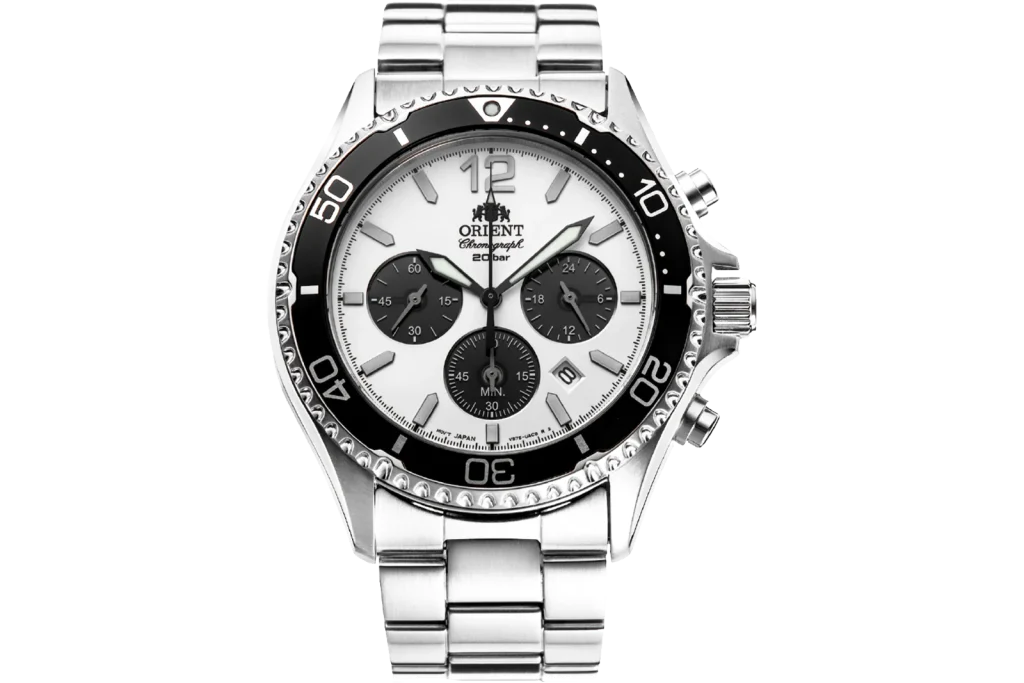
The Orient Neo 70s Panda is a retro-inspired timepiece with a sporty flair. The watch is one of the best budget panda chronographs that combines functionality and classical design features, but the panda dial makes it extremely appealing.
The dial is pure and clean, with an angled chapter ring on the periphery where the seconds are printed. Three perfectly symmetrical chronograph sub-dials (24 hours, a 60-minute chronograph timer, and a second) at 3, 6, and 9 o’clock positions keep the watch balanced and unique.
The date window between 4 and 5 o’clock keeps the dial uncluttered while the baton hour markers and handset add to the aesthetical allure. The watch has a depth rating of 100 meters of water resistance and is powered by a solar meca-quartz movement.
This means the movement is powered and charged directly from sunlight and can hold a charge for up to 6 months. The accuracy of quartz is also one of the unique features of the Neo 70s Panda, as it is very precise. Its accuracy rating per month is within +/- 15 seconds. The watch measures 42mm in diameter, including the crown with a 48mm lug-to-lug measurement and a height of 12 mm.
It is water-resistant to a depth of 100 meters and comes on a stainless steel bracelet.
Moving forward, the Seiko Solar Chronograph SSC769 inherits the iconic designs and aesthetics of the Speedtimer series from the 1960s. The watch is fantastic, and everyone who loves motorsport will be captivated by the racing vibes it gives off.
The dimensions are fitting like the Neo 70s Panda. The round stainless steel case measures 41mm in diameter and has a height of 12mm. Unlike the Neo 70s Panda, the Solar Chronograph SSC769 features a sapphire crystal. The quartz solar watch is powered by the Caliber V172 with an accuracy rating of +/- 15 seconds per month.
The quartz movement has some practical benefits and can hold a charge for up to 6 months. Both watches are priced at around $300.
Orient Neo 70s Panda
Seiko Solar Chronograph SSC769
Case Size
42mm
41mm
Materials
Stainless Steel
Stainless Steel
Water Resistance
100 meters/10ATM/330 feet
100 meters/10ATM/330 feet
Movement
Quartz (± 15 seconds/month accuracy, 6 months power reserve)
Quartz, Caliber V172
Strap
Stainless Steel Bracelet
Stainless Steel Bracelet
Additional Features
Chronograph function
Chronograph, Tachymeter, Sapphire crystal
MSRP
$240
$350
Orient Maestro vs Seiko 5 SKX Sports Style SRPE
The Orient Maestro is one of the most minimalistic watches out there that is available in a variety of dial colors. Much like the Bambino, the Maestro is an everyday dress watch with an enchanting beauty.
It debuted in 2019 and features affordable watches with great build quality and durable movements. The Orient Maestro is presented in a sleek 40mm stainless steel case with a thickness of 11.9mm and a lug-to-lug size of 46.1mm. The case is fully polished and features a thin bezel with a medium-sized push/pull crown at 3 o’clock.
It is water resistant to a depth of 100 meters, which means it is suitable for everyday use as you can go swimming and snorkeling with it. The dial is clean, legible, and uncluttered with applied rectangular hour markers and slim mirror-polished hands.
Few variants are available, including some sunburst versions, which play with light beautifully and render a vibrant appearance to the watch. There is a subtle date window at 3 o’clock in all models and a mineral crystal above the dial.
It is powered by the in-house automatic Orient caliber F6722 visible through the transparent case back.
Like the Orient Maestro, the Seiko 5 SKX Sports Style SRPE is a versatile, reliable, and utilitarian watch made for just about any occasion. Seiko decided to bring back everything we loved about the SKX (including the accessible price), and the SRPE model added a dash of elegance to all that.
The watches here are presented on a stainless steel case that measures 40mm in diameter with a height of 11.5mm and a lug-to-lug distance of 44mm. The general aesthetics of the watches is consistent with that of the average Seiko field watch.
The dials feature dot hour markers interrupted by rectangular indices at 6 and 9 o’clock and a triangle at 12, while a day-date display is located at 3 o’clock. The main difference between the watch from Seiko and that from Orient is purely cosmetic, as they are both built with durability and strength in mind.
If you are looking for a “beater” watch that keeps utility in the spotlight rather than delicate finesse, the Orient Maestro is the better option two.
If, however, you want an everyday tool watch with ample lume for enhanced readability, the Seiko 5 SKX Sports Style SRPE comes in recommended. The SRPE is also more widely recognized, but, all in all, both watches are designed to tell time accurately in adverse environments or whilst on the move.
Orient Maestro
Seiko 5 SKX Sports Style SRPE
Case Size
40mm
40mm
Material
Stainless Steel
Stainless Steel
Water Resistance
100m/10ATM/330 feet
100m/10ATM/330 feet
Movement
Caliber F6722
Caliber 4R36
Strap
Stainless Steel Bracelet
Stainless Steel Bracelet
Additional Features
Exhibition case back
See-through & Screw case back
MSRP
$170
$295
Conclusion
Seiko and Orient are outstanding Japanese brands offering some of the best value in watches. As you can see from the in-depth comparison, both brands take advantage of modern technology and avant-garde designs to create timepieces, so their strengths overlap. That said, it’s just a matter of preference, for this battle has no clear winner. My advice? Add both brands to your collection!
Monster, Turtle, Tuna, Sumo, Samurai, Arnie…all of these are popular nicknames attributed to Seiko watches and are a testament to just how much the Japanese Giant Watchmaker has a strong cultural presence. But Shogun? That’s one we haven’t heard of recently.
Left to obscurity and sometimes the domestic market, the Seiko Shogun has been walking in the shadow of other successful dive watches from the brand’s vast portfolio since its first appearance in 2008.
We all know that the aliases proliferating online for Seiko watches all have deeper meanings, and Shogun is not without significance either. Japanese for “military ruler”, the nickname Shogun was bestowed upon the robust diver by Seiko’s fanbase to echo the imposing presence and dominating spirit of the watch.
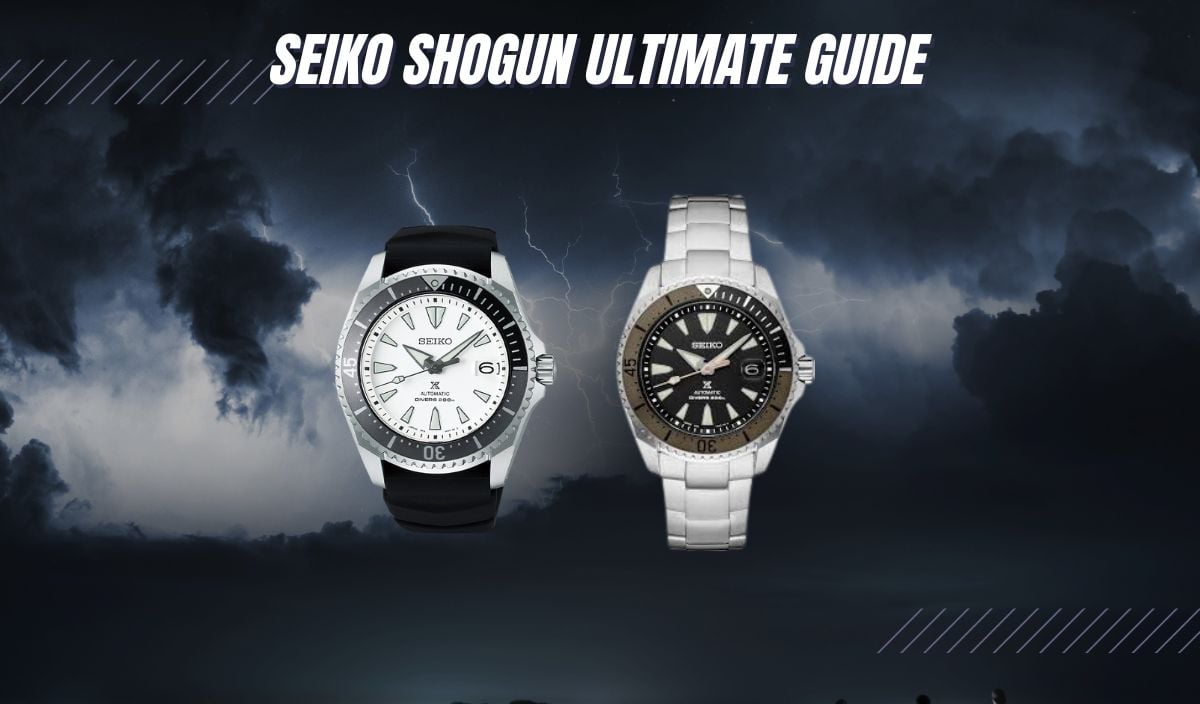
From the history and origin of the Seiko Shogun all the way to the iconic generations that followed its release, here is an ultimate guide to one of the most ultra-robust and accessible divers of all time.
About Seiko Dive Watches
Seiko is a brand that is respected for its commitment to producing some of the best entry-level divers in the market that has charmed collectors for decades. The story of Seiko’s diver’s line of watches can be traced to the 1960s with the Tokyo Olympics.
There was a need to produce a high-performing timepiece to help the Japanese watchmaker compete with the Swiss brands hence the launch of the first dive watch from Seiko, the 6217 (62MAS), in 1965. It doubled as the first Japanese dive watch ever with a 150-meter water resistance rating.
Before this launch, Seiko had introduced a series of pre-divers, such as a few in the Seiko Sportsmatic SilverWave collection, with 50 and 30-meter water resistance. The 62MAS, however, is recognized as the brand’s signature entry into the realm of true divers.
The first version had a small crown with reference 6217-8000 and a short production span of only 90 days. An improved version (Ref. 6217-8001) with a larger crown was released the same year.
The watch featured all the necessary dive watch elements, including luminous hands and markers, a bi-directional rotating bezel, domed plexiglass, a date window, and a low-beat automatic movement ticking at 18,000bph.
It quickly gained popularity and was a good competitor in the dive watch market until 1967, when the 6215-8000 came on board. It was the brand’s first 300-meter professional model with a Hardlex crystal and a screw-down crown.
A year later, the 6105 model, a hotly sought-after iteration, followed. The 6105-8110, or Captain Willard, is famously worn by Martin Sheen in “Apocalypse Now”. It introduced the cushion case shape, which appears to be square with rounded sides and can be seen in the SRP collection today.
Research and development continued as the years went by, and many iconic divers with a cult following were released. Seiko divers hold a special place in the hearts of many watch enthusiasts and continue to offer excellent performance and durability at accessible price points.
History & Origin of The Seiko “Shogun”
Immediately after its debut in 2008, the Seiko “Shogun”, officially the Ref. SBDC007, attained legendary status in the Horological sphere. The history of the iconic dive watch is themed around community involvement and a display of exceptional craftsmanship from Seiko.
The nickname was bestowed upon the divers’ from an adoring international public. It began with the watch’s description as a “full battle armor” with “crisp lines” that evoked imagery of a warrior under attack.
The trend continued, and like a pop out of the woodwork, Shogun was embraced by Seiko’s fanbase because of the imposing presence of the timepiece due to the armor-like elements of the case. The nickname quickly spread and became deeply ingrained in the watch’s identity, representing the dive watch’s comfort, character, value, and charm.
The Shogun is presented in a 44mm titanium case which, although lighter than steel, is highly capable of withstanding an impact without distortion.
Coming from the Seiko Prospex line, the watch is powered by the caliber 6R15 movement, which guarantees accurate timekeeping and boasts a 50-hour power reserve with hacking and manual winding functions.
The Story of the Seiko Shogun attests to the commitment and passion of a caring community. Its alluring design, combined with excellence, undoubtedly guaranteed it a spot in watchmaking history.
The deeper we uncover the Seiko Shogun, the more we face outstanding testaments of unique features and enduring appeal. With all these in perspective, there’s no argument that the Seiko Shogun is an iconic timepiece with a track record of excellence.
Seiko “Shogun” First Generation
The first generation of the Seiko Shogun was released in 2008. The SBDC007, along with its orange variant SBDC009 were the two dive watches to first appear in Seiko’s catalog. Let’s take a closer look at the SBDC007.
The Case & Bracelet
The case of the SBDC007 had large dimensions. It measured 44mm in diameter (without the crown) and was 13.3mm thick, with a lug-to-lug distance of 50.75mm. Titanium was used for both the case and the bracelet, making the watch lightweight and providing a high level of resistance to corrosion and outstanding durability.
The classic elements defining the Shogun’s distinctive feature were first evident in the case of the SBDC007, as it featured a muscular angularity with razor-sharp transitions.
The sharp dynamism of the watch can be noticed in crown protection, robust shoulders, angled inner lugs, deeply notched bezel, and flowing bevel along the circumference of the case that results in four flawless angles where the steeply angled lug descends.
The case is brushed on top while the sides are polished, and the screw-down crown is signed with a simple S. The screw-in case back is also polished and has a few specs engraved in it as well as the Seiko Divers Tsunami logo.
The titanium bracelet features a three-fold clasp with a secure lock, a diver’s extension, and a push-button release.
The Dial
The dial of the SBDC007 is presented in black with applied dot markers. The black surface is matte-finished, making the applied hour markers stand out all the more elegantly. At 12 o’clock, you will notice the usual inverted triangle or arrow with a line in the middle.
At 6 o’clock, there’s an italicized “Automatic” inscription, followed by “SCUBA” and then “200m” underneath it, keeping the symmetry quite balanced. Again the 6 and 9 o’clock markers are presented in sword-tip shapes that match the minute hand, while the hour hand is a reflection of the 12 o’clock marker.
There’s a neat date window at 3 o’clock and both hands and indices have been filled with Seiko’s proprietary Lumi Brite for excellent legibility in low-light conditions. The unidirectional bezel is executed in titanium and is a bit aggressive, with sharp sand-blasted knurling that gives it exceptional grip capabilities.
Movement
Under the hood of the SBDC007 is Seiko’s in-house 6R15 movement. The movement, which is just a step below most of the mainstream “high-beat” movements from Seiko, was produced in 2005. It is an upgrade from its predecessor, the 7S26, as it adds the hand winding and hacking mechanism to it.
It operates with 23 jewels and beats at a frequency of 21,600 vibrations per hour, keeping the second’s hand sweeping gracefully across the dial. It provides a power reserve of approximately 50 hours and is relatively accurate at +25/-15 seconds per day. The caliber 6R15 is a premium workforce and was made popular by Seiko’s SARB series, Seiko’s “Sumo”, “Alpinist”, and “62MAS Re-edition” watches.
Water Resistance
The SBDC007 is water resistant to 200 meters or 660 feet, making it a proper dive tool. This means it can be used for scuba diving and will comfortably keep accurate time when worn for other recreational water sports.
Other Models Of The First Generation
The other models of the first generation include the SBDC009 and SBDC029 and two limited editions, SPB057 and SPB099.
While the SBDC007 was popularly termed the “Black Shogun,” with its sleek and timeless design, the SBDC009 was referred to as the “Orange Shogun” because its vibrant color commanded a bold statement.
Moreover, due to Seiko’s commitment to continual innovation, loyalists eagerly awaited subsequent iterations. So, in 2015, Seiko ignited the passion of its dedicated fan base by introducing the Black Shogun Prospex (ref: SBDC029) to a zealous group of brand loyalists.
The SBDC029 was pretty much a relaunch of the SBDC007 with little changes on the dial. Compared to the SBDC007, the dial of the SBDC029 had different dial inscriptions. It featured the Prospex “X” logo in addition to the word “Automatic”, but this time, all capitalized.
Beneath that, you’ll see “DIVER’S 200m” neatly spelled out. Recall that the SBDC007 had an italicized “Automatic” inscription with the word “SCUBA” (not Diver’s) and then “200m” underneath it.
To cater to the desires of watch collectors, Seiko introduced limited editions of the Shogun designed exclusively for Thailand. Some of these editions were the Zimbe Shogun (ref: SPB057) and the Zimbe Red Shogun (ref: SPB099), released in 2017 and 2019, respectively.
Zimbe is a word coined from the Japanese name “Jinbe Zame”, meaning “whale shark”. The movement, case material, and layout of the dial are the same, but again, there are a few tweaks.
The dials have a graduating scheme, and the words ‘Automatic’ at 6 o’clock have been replaced with “Limited Edition”. The SPB057J and SPB099 also feature sapphire crystals with anti-reflective coating, as well as cyclops over the date window at 3 o’clock.
Seiko “Shogun” Second Generation
The second generation of the Seiko Shogun was launched in 2020 under the reference numbers SPB191J1 and SPB189J1. The mission of this launch was to replace its predecessor with enhanced reliability and functionality, so the main upgrade is more technical than visual.
That said, the Seiko Prospex Shogun SPB191J1 and SPB189J1 watches retain the core personality of the SBDC007 while incorporating some of the brand’s newest materials and technologies.
For dimensions, they measure 43.5mm in diameter (so still large yet able to sit comfortably), 51mm from lug to lug, and 13.3mm in thickness. The titanium case has the same angular lugs and strong shoulders with sharp crown protections for the screw-down crown.
The case is further finished with Seiko’s super-hard coating for additional robustness. The watches still deliver all the elements of the Shogun we have come to love, such as remarkable legibility and a 200-meter water resistance rating.
Both feature a sharp-toothed unidirectional bezel like that of their predecessors with a titanium insert. The bezel of the Shogun SPB191J1 is two-toned and presented in black and anthracite, while the SPB189J1 variant has a distinctive black and bronze layout.
Unlike the first Shogun generation, the Prospex Shogun SPB191J1 and SPB189J1 models have an upgraded sapphire crystal, which has a better scratch resistance than the Hardlex crystal found in the first generation.
The dials of the second generation also appear smoother and more rounded, resembling those on the Seiko Monster, and boast elegant triangle-shaped markers (no dots this time around) with more rounded hands.
We highlighted earlier that the main difference is more technical, which is evident in the movement mechanism. The second generation features the updated 6R35 caliber with 24 jewels and an impressive 70-hour power reserve. In contrast, the first generation uses 6R15 caliber with 23 jewels and a 50-hour power reserve.
While both movements offer hacking functionality and manual winding, the major improvement can be seen in the power reserve as the 6R35 provides 20 hours more than the 6R15.
Ultimately, the second-generation Shogun watches stand out in more ways than one. The various tweaks on the dial enhance legibility, while the improved power reserve makes it a better choice for watch enthusiasts.
Seiko “Shogun” vs Other Seiko Dive Watches
Seiko has been at the forefront of new technologies and designs since Kintarō Hattori released the brand’s first pocket watch, the Seikosha Timekeeper, in 1895.
The Seiko Shogun and other Seiko dive watches adhere to the brand’s high standards for the manufacturing of divers, garnering acclaim from professional divers all over the globe. However, the brand offers different types of diver’s watches at different price points.
Currently, there are over 120 models of divers in the Seiko Prospex collection, from mechanical watches to the solar-powered Prospex PADI Chronographs. Let’s see how the Seiko “Shogun” compares against other Seiko Dive Watches.
1. Quality
Even though Seiko has always focused on creating affordable dive watches, its watchmaking expertise and its proprietary technology have made it synonymous with high quality and expert craftsmanship.
There may be more style and functionality at almost every hundred-dollar increment when it comes to the watches in its catalog. But you can be sure that each one is made of high-quality raw materials, and the Shogun is no exception.
All Seiko divers undergo a series of stringent lab tests to prove quality, reliability, and durability before they are released to the general public. So the Shogun, like other dive watches, is designed to last long. The protective glass of the more recent release is made up of high-grade sapphire, while the older iterations feature Hardlex crystal.
Titanium, which is about 40% lighter than stainless steel but just as durable against impacts with similar technical and physical qualities, also gives the Shogun an edge over other dive watches from the brand.
Divers with nickel sensitivity will find the Shogun a preferable option because of the use of titanium. But, all in all, the quality is up to par with premium dive watches at the cutting edge of technology.
2. Legibility
Seiko dive watches are known for their straightforward, thoughtful, and highly legible design. Lume is always generously applied to the hands and indices with a high level of finishing on the hands and markers that not only play with the light for aesthetic purposes but also heighten the legibility of the watch.
The Shogun like many other dive watches has Seiko’s LumiBrite on the dial which glows brightly in the dark and will keep the timepiece highly legible at depths of 200 meters underwater. LumiBrite is a tremendously improved luminous paint that is completely free of radioactive elements and quickly absorbs light energy on exposure to it which it stores and emits in the dark.
Visibility is enhanced in every detail, and the bold markers and handset of the Shogun are a testament to this. Add that to an uncluttered dial, and you have a timepiece with no compromise or distracting ornamentation, a feature of every dive watch from the Seiko.
3. Movement
Seiko dive watches use three different movement variations. First, we have automatic or mechanical movements (such as the 6R35 in the Shogun) which are self-winding and work by harnessing the kinetic energy from the wearer’s natural movements.
Some other dive watches utilize quartz. This means they are powered by a battery that transfers an electric current via the quartz crystal, thus creating vibration and oscillation. The electric pulse from this oscillating movement then powers a small electric motor that turns the gears in the watch.
The last set of dive watches uses solar energy and works by converting light energy into electrical energy, which it stores in the rechargeable battery and ultimately uses to power the watch. The first generation of the Shogun used the 6R15 caliber, while the second generation is powered by the 6R35 caliber.
The latter is an evolution of the 6R15 movement and is found in many mid-range Prospex watches. Even though it’s not a very accurate movement, it is robust, reliable, easy to service, and offers great value for money. Quartz divers win in terms of accuracy and convenience.
Even though the 6R15 and 6R35 of the Shogun serve their purpose and count as a reliable power horses, the accuracy is poor. You will find them in dive watches that typically span the $300-$600 range, including famous dive watches like the ‘Sumo’ (Seiko SPB103J1) and the Seiko Prospex Recreation (Ref. SPB053J1).
4. Design
When compared with other dive watches from Seiko, the Shogun utilizes the same layout but adds something a little extra. The element of beauty in The Shogun can be found in the interplay of sharp angles and flat surfaces that interact beautifully with light and shadow to create a striking aesthetic effect.
When you look at the SPB189 & SPB191, you can see the standard divers watch feature with rounded sides and integrated lugs but the sharp lines and resilience of the Shogun are quite distinctive.
Seiko knows better than to change a proven recipe, so every feature in the Prospex collection that is loved can be seen here. I mean the overall design (which is close to that of a Samurai watch), the reasonable price, and of course, the overall performance.
So there are no major differences, only little tweaks here and there that make the watch appear more angular, creating a beautiful contrast, light on one side and shadow on the other to create an element of beauty.
At the core, the Shogun is just like other dive watches from Seiko with a polished and brushed case, screwed case back, a screw-down crown (both guaranteeing a 200m water resistance), and a highly legible dial.
5. Price
In terms of value for money, the Seiko Shogun holds its ground against other Seiko dive watches. When comparing prices, the Seiko Shogun is competitively priced within the dive watch market.
The Seiko Monster, for instance, starts at around $250. The Seiko Samurai is priced at about $525, while the Seiko Turtle hovers around the $400 mark. The Seiko Tuna series, known for its durability, can range in price from $300 to over $800, depending on the model and condition.
While these other dive watches have unique features and price points, the Seiko Shogun remains compelling.
The Seiko Shogun stands out on its own merits, but it is one of the most expensive entry-level dive watches from the Japanese Giant Watchmaker because titanium is used for the case and strap. Titanium watches are generally more expensive than stainless steel.
Even though the latter is abundant and readily available, it is more difficult to process and costs more to purchase and repair hence the higher price.
Whether you’re a sports enthusiast, an adventure seeker, or simply appreciate a high-quality dive watch, the Seiko Shogun offers a compelling package that will impress you; however, prepare to spend a bit more for it.
Should You Buy A Seiko “Shogun”?
The Shogun is a timepiece that commands instant attention. Depending on the vendor and model, you can get the Shogun anywhere from $1,200 to $3,500 for a brand-new model, and it’s no longer news that its titanium case sets it apart from other watches in the Seiko Prospex collection. Here are four reasons why you should consider adding Seiko Shogun to your collection.
The value is just incredible.
The Shogun is a watch synonymous with excellent quality, fit, and finish. You will instantly recognize the high quality when you hold it in your hands. The watch is designed to be robust, reliable, and dependable.
It is built using high-quality materials.
Titanium is one of the strongest materials out there, with a higher strength-to-density ratio when compared to stainless steel. The robustness of the case and bracelet of the Shogun will ensure longevity and durability, making it a watch you could wear every day for years without the slightest sign of getting worn out. From the onset, Seiko has never sacrificed durability in the making of any component, including the movement, which doesn’t change with the Shogun.
Enhanced legibility in every detail.
From the hands to the hour markers and bezel, the high level of legibility can be seen in almost every detail. If you want a durable watch for underwater exploration, you need to be able to read it. Seiko knows this, and the Shogun will always remain one of the most legible divers. A generous application of Lumibrite on the hands, indexes, and bezel means that time can be read correctly from any angle and at any depth, adding to the watch’s appeal.
200 meters of water resistance.
The water resistance rating of the Shogun makes the dive watch reliable and suitable for the sport it is named for and for a great many underwater adventures. It can also be worn during sailing, surfing, and even fishing.
Concerning availability and price. The SPB189 & SPB191 are readily available and can be gotten from authorized dealers from Seiko worldwide. If you want a budget-friendly option, a pre-owned Shogun can be bought anywhere from $750 up, but you can purchase a new piece of the Shogun SPB189 here and Shogun SPB191 right here for $ and $1,350 respectively.
Conclusion
Let’s be honest. The Seiko Shogun isn’t for everyone. If you like the concept of a timepiece with an imposing presence, large dimensions, and premium features, then it’s a great option. However, the size and muscularity might not appeal to everyone, which is just fine.
Alternatives that can offer much of the Shogun’s features and charm can be found within the Seiko lineup. The Shogun, however, will forever remain one of Seiko’s emblematic dive watches beloved by devoted collectors, mostly because of its robustness and lightweight titanium case.
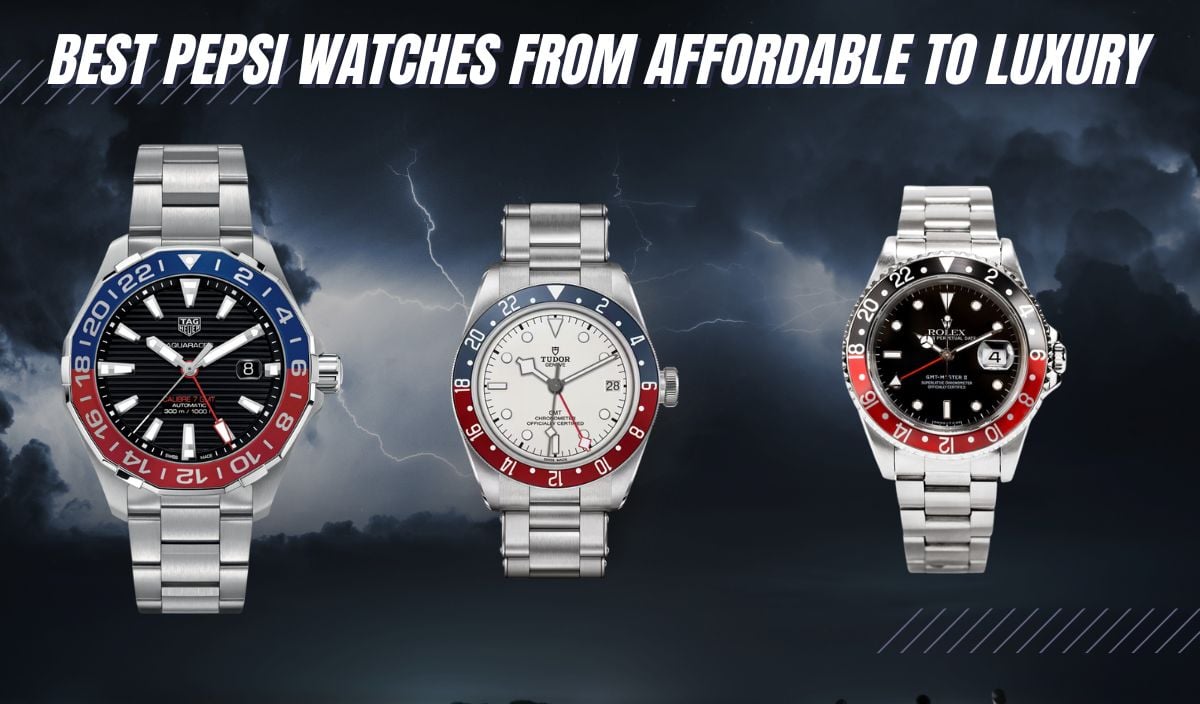
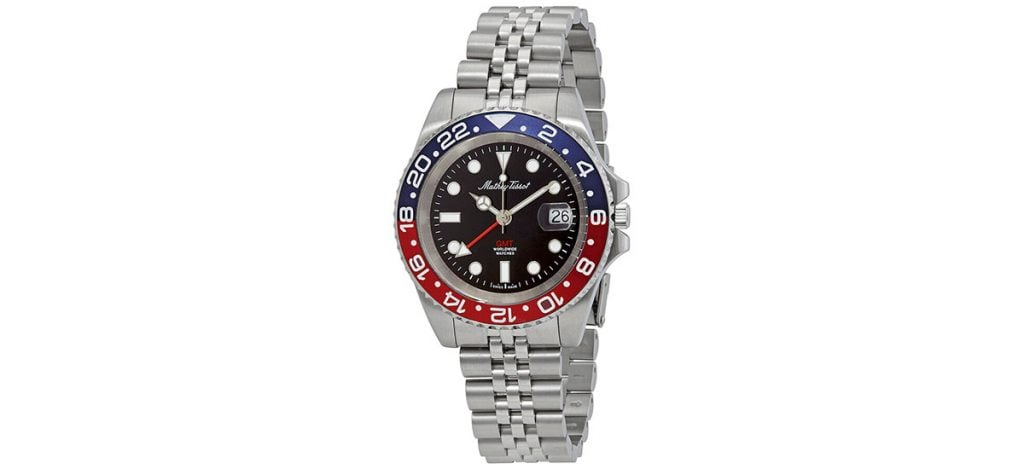
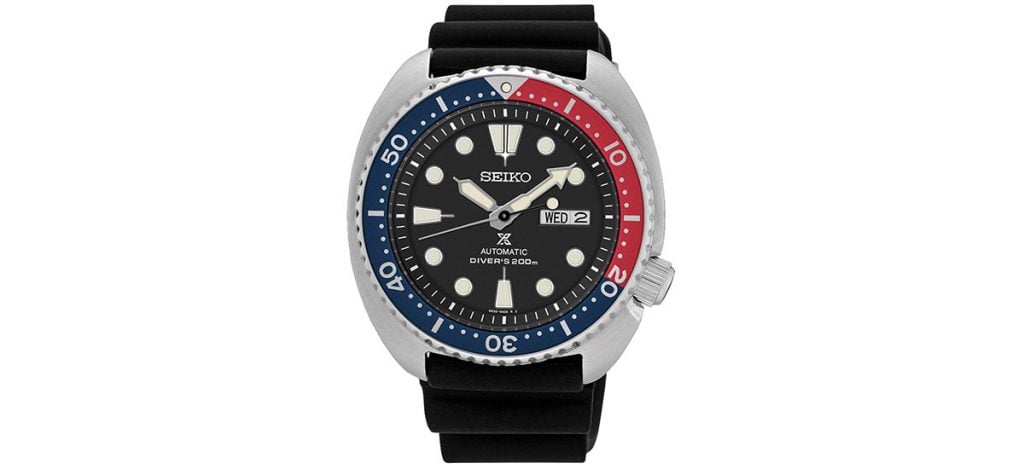
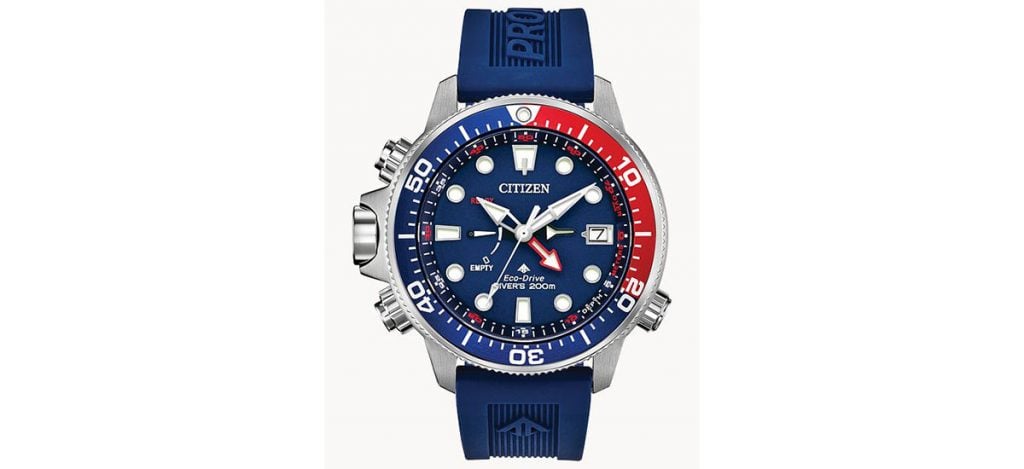
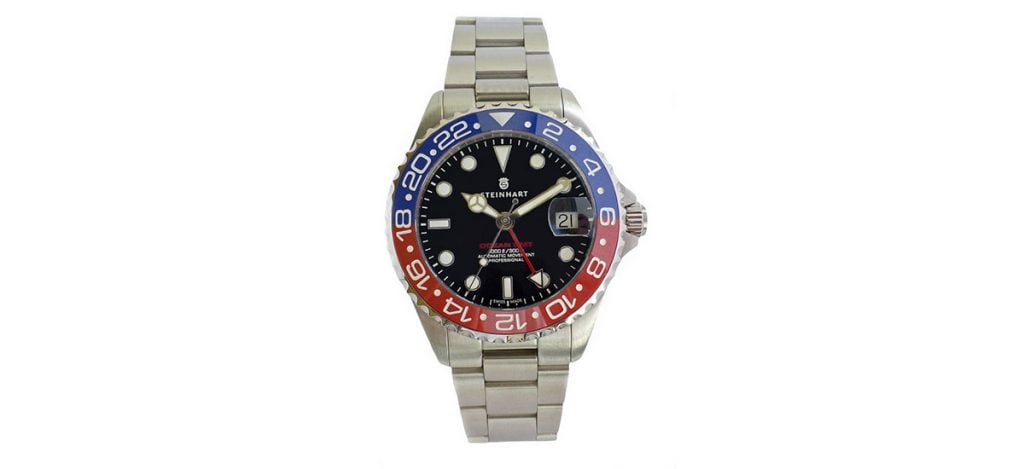
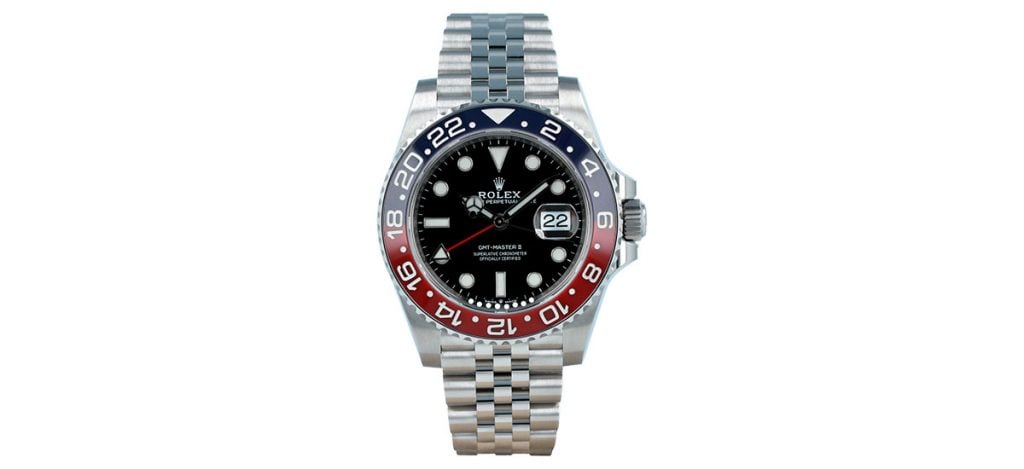
The unique appeal of Pepsi timepieces helps them stand out from the sea of other watches on the market. These watches have come to be associated with style, elegance, and a dash of vintage flare because of their recognizable red and blue bezels, modeled by the unique colors of the Pepsi-Cola logo.
But these timepieces are more complex than first appears. They have a fascinating past closely related to aviation and oceanic exploration. This article serves as a guide to the world of Pepsi watches.
Whether you’re looking to start your collection with something special, want a cool statement piece, or are trying to make a good investment, a Pepsi watch is the way to go. However, if you’re unsure if they are for you, you’re guaranteed to find out by the end of this article.
The history of Pepsi watches, which are distinguished by their recognizable red and blue bezels, dates back to the middle of the 20th century. “Pepsi” describes a color scheme resembling the iconic soft drink’s logo.
The Rolex GMT-Master, released in 1955 as a tool watch for pilots and foreign travelers, was the first timepiece to include a Pepsi bezel. Since then, the Pepsi bezel has come to be associated with all watches sporting a distinctive color scheme, making these timepieces one of the watch industry’s most well-liked fads.
Why Are They So Popular?
For a number of reasons, Pepsi watches are extremely well-liked among watch aficionados. The red and blue bezel design is aesthetic, arresting, and readily identifiable. It also makes a strong fashion statement when worn on the wrist. The color scheme embodies the spirit of travel and inspires a sense of exploration.
The Pepsi bezel has also evolved into a symbol of nostalgia and tradition. Watches with this recognizable bezel frequently have historical importance or ties to famous manufacturers like Rolex and Tudor. The rich history and tradition connected to these watches are what’s most appealing to enthusiasts.
Should You Buy a Pepsi Watch?
Pepsi watches are for unique people who are daring but not reckless. They are often diver’s watches and GMTs, perfect for travelers, athletes, and hobby divers. You might think they are exclusively for collectors, but that couldn’t be further from the truth.
Nowadays, Pepsi watches have become so popular that brands at every price point are participating in the trend. Ultimately, if you seek a statement timepiece, want a definite conversation starter, or want to make an investment, you are guaranteed to find a great match in the following list.
The Best Pepsi Watches
Orient Mako II Pepsi Bezel (ref. FAA02009D9)
The Mako II was originally introduced as an upgrade to the popular Mako line with several notable improvements. The Orient Caliber F6922 grants reliable and accurate timekeeping, all for 40 hours straight. Its stainless steel case measures 41.5mm in diameter, making it just about suitable for smaller-sized wrists too.
The iconic bezel rotates in one direction only, although it takes more effort than an average diving watch bezel. Being a diver’s watch, the Mako II’s water resistance will keep up with your occasional underwater adventures. The Orient Mako II Pepsi Bezel is a great entry point to the world of Pepsi watches.
The vintage appeal doesn’t have to go without contemporary functionality. Timex, a renowned American watch brand with a rich history dating back to 1854, pays homage to vintage timepieces from the ’70s with the Q GMT’s retro-inspired design.
The watch has a 38mm polished and brushed stainless steel casing with the Pepsi bezel rotating in both directions. It’s a fully functional GMT, with the 4th hand being responsible for tracking a secondary timezone. The quartz movement isn’t a huge let-down considering the price point. This watch is really hard to hate for any true enthusiast. Its affordability and versatile design make it a popular choice overall.
Price: $229
Citizen Promaster (ref. NY0086-83L)
Designed for adventure seekers, the Citizen Promaster NY0086-83L is a tough and sporty Pepsi watch. This Promaster model draws inspiration from Citizen’s rich heritage in professional diving watches. It’s equipped with a water resistance of up to 200 meters (660 feet), leaving the door open for deeper-than-average aquatic adventures.
While you’re down in the deep, the unidirectional rotating bezel helps you not to overestimate your remaining oxygen supply. Using Citizen’s renowned Eco-Drive technology, the Promaster harnesses the energy of light to fuel its quartz movement. It’s an excellent choice for hobby divers looking to stay unique during their diving sessions.
Price: $250
Seiko SKX009
Radiating the love of enthusiasts, the Seiko SKX009 is an affordable favorite among Pepsi diver’s watches. Born from the rich heritage of Seiko, the SKX009 doesn’t fail the test of quality and reliability. The watch was originally introduced in the 1990s as part of Seiko’s popular Diver’s Watch series.
It’s now discontinued since 2019, and getting your hands on a used example holds a great challenge due to the increasing demand and limited supply. It features a rugged stainless steel case with a screw-down crown, and it’s powered by the trusty 7S26 automatic movement. It might just be me, but I haven’t seen anyone wearing it without a smile on their face… The Seiko SKX009 became an essential for lovers of Pepsi watches with its timeless style and great value.
Price: $495
Orient Solar Quartz Diver Watch
If you’re looking for something affordable that looks the complete opposite, I have to suggest the Solar Quartz Diver from Orient. Cheaper isn’t always a bad thing, and this watch is a good example of that from several angles. What reels me in is the solar-powered quartz chronograph. I’m always down for more eco-friendly solutions, and the design makes this watch an even easier choice.
The bezel has that classic Pepsi colorway, featuring a satisfying 120-click unidirectional functionality. It might be a standard, but it sounds like true quality with nothing gimmicky about it. I was honestly impressed with most of what I discovered about this watch. Tack on the fact that it’s rated for water resistance of 200 meters, and the blend of style and function is just the icing on the cake.
Price: $320
Mathey-Tissot GMT Pepsi Bezel
As you’re conquering the world, you need a reliable and classy wrist companion that lives up to the image of the person wearing it. That’s what the Mathey-Tissot GMT is about. Crafted with meticulous attention to detail, the 42mm stainless steel case and bracelet offer surprising durability with a small touch of sophistication.
The design is, of course, deeply rooted in the origins of all Pepsi watches; the Mathey-Tissot GMT borrows many elements of its charm from the Rolex GMT Master II. But I guess there aren’t many Swiss-made Pepsi bezel GMTs on the market for this price after all… The watch is an excellent choice for those who are looking for a reliable option for a fair price.
Price: $450
Seiko Prospex “Turtle” SRP779K1
A touch of retro charm. The SRP779K1 pays homage to the iconic Seiko 6309 from the 1970s. Its adventure-suited stainless steel case features a unique hefty design referred to as the “Turtle” with a diameter of 45mm.
The watch is powered by Seiko’s reliable 4R36 automatic movement, which keeps accurate time throughout your diving adventures. The SRP779K1 keeps you stylish and unique up to water depths of 200m. The watch merges the spirit of the original diver’s watch with modern technology, resulting in a refreshing touch to horological heritage.
A diving watch with a ton of features built for exploring the ocean below. The 46mm stainless steel case is attached to your wrist via a sturdy polyurethane strap. The watch features a depth sensor for accurate diving readings and great water resistance of 200 meters.
The watch is equipped with the Citizen Eco-Drive E168 movement, which uses the power of light to fuel itself. The Citizen Promaster Marine Aqualand is a fantastic option for serious divers looking to show off and impress sharks, octopi, and starfish.
A watch that blends elegance and toughness. Similarly to the Mathey-Tissot GMT, the Steinhart Ocean 39 GMT takes inspiration from the Rolex GMT-Master II. It’s powered by a Swiss-made automatic ETA movement in a 39mm stainless steel case.
The 300-meter water resistance coupled with the unidirectional rotating bezel suggests there is more to this watch than what meets the eye. It’s a great GMT that you can drag along to your aquatic adventures. Adventurous travelers might find this watch a perfect wrist companion for their journeys.
Price:$600
Lorier Hyperion Series II
A Pepsi watch with a modern twist that’s been largely influenced by historical designs. Lorier is famous for applying a modern touch to its vintage-inspired watches. Since entering the market in the Spring of 2018, Lorier has met critical acclaim in prestigious outlets for producing handsome, rugged, and affordable timepieces.
These watches are specifically designed to be versatile, romantic, and durable. The Hyperion Series II comes in a small case with a diameter of 39mm, has water resistance up to 200 meters, and it’s powered by the Swiss SW200-1 automatic movement. This watch might easily be an attractive option for watch enthusiasts because of its traditional design features and modern aesthetics.
Price: $800
Christopher Ward C65 Trident GMT “Pepsi”
Vintage-inspired again, but this time it’s a British-made GMT. The 41mm watch has a Swiss Made Sellita SW330-1 automatic movement and a water resistance of 150 meters. The iconic bezel is made out of aluminum this time, with bidirectional rotation.
The LumiNova Grade X1 GL C1 ensures visibility of the dial and the hands, even in low-light conditions. The watch has a very competitive price among mechanical GMTs, making it a great option for someone who’s looking for a travel companion with great craftsmanship.
Price: $1,100
Raymond Weil Tango 300 GMT (ref. 8280-ST3-20001)
A stylish and sporty GMT powered by a Swiss automatic movement. It all started in 1976, in the middle of a watch industry crisis, when Mr. Raymond Weil decided to found his own company. Mr. Weil’s creations were immediately praised by watch enthusiasts – amateurs and connoisseurs alike.
The Tango 300 GMT is a 42mm travelers timepiece with water resistance up to 300 meters. The ETA 2893-2 automatic movement inside is known for its reliability and accuracy. The asking price of the Pepsi model is a bit higher than the standard GMT, but the added style is worth the extra.
The Yema Superman 500 GMT Pepsi Bezel is a modern interpretation of Yema’s iconic Superman dive watch. It features a stainless steel case with a diameter of 39mm and a thickness of 13mm. The watch is powered by the Swiss Made Sellita SW330-1 automatic movement with a standard GMT function. It has a stunning water resistance of 500 meters.
The most unique part of this watch is Yema’s unique bezel-locking mechanism that adds security to the unidirectional rotating bezel. Although there are better value options at its price point, the Yema Superman 500 GMT offers fair value for the money, making it a viable option for frequent travelers.
Price: $1,500
Davosa Ternos Professional TT GMT Pepsi Bezel (ref. 161.571.06)
A Swiss-made watch developed for Aquaman. It has a blue dial, a rotating ceramic bezel, and a stainless steel case. It is perfectly suited for underwater activities, but professional diving is no problem either since it has an outstanding 500-meter water resistance.
It has a Swiss Made ETA 2893-2 automatic movement, and the Super-LumiNova BGW9 luminescent helps tell the time even in deep underwater conditions. Versatile functionality and a dash of elegance are combined in the Davosa Ternos Professional TT GMT.
Price: $1,600
Zodiac Sea Wolf GMT ‘Crystal’ Topper Edition (ref. ZO9408)
The Zodiac Sea Wolf GMT ‘Crystal’ Topper Edition is a limited-edition timepiece that pays homage to the iconic Sea Wolf model from the 1960s. It features a stainless steel case, a coveted ‘Crystal’ sunburst dial, and the iconic bi-color rotating bezel.
The watch has a truly unique design language, with the round dial being accentuated by the case shape. The Zodiac Sea Wolf GMT ‘Crystal’ Topper Edition captures the spirit of adventure and nostalgia, thus being a prized possession for watch collectors.
Price: $1,800
Monta Skyquest Black Gilt
This Swiss-made tool watch kills it with its unique design language. It has a stainless steel case, a ceramic bezel, and a black dial with gilt accents. There is a limited edition model with an opaline silver dial that looks like something from heaven… Its GMT feature makes the watch ideal for world conquerors, although the 150m water resistance won’t let you too far into the ocean. The watch is a great example of Swiss engineering and performance.
For professionals, the Ball Roadmaster Marine GMT is a reliable and high-functioning timepiece. When Standard Time was adopted in 1883, Webster Clay Ball was the first jeweler to use time signals, bringing accurate time to Cleveland. Today, BALL Watch is one of the most respected and established watch brands in the United States.
The Roadmaster Marine GMT is a 40mm travelers’ watch with many quirks and features. It has Ball’s ground-breaking Amortiser shock absorption mechanism for increased longevity, while its dial incorporates micro gas tubes for superior luminosity. The watch remains a favorite for its uniqueness, toughness, and style.
Price: $3,500
TAG Heuer Aquaracer GMT (ref. WAY201F.BA0927)
Look no further for a luxury sports watch designed for hobby swimmers and divers. This 43mm watch is powered by the outstandingly precise TAG Heuer Caliber 7 automatic movement and features a water resistance of 300 meters.
The Pepsi-colored GMT bezel on the Aquaracer rotates in one direction. As its name suggests, the watch is ideal for aquatic sports. Overall this GMT is a great choice for frequent travelers and athletes who want a touch of uniqueness.
This chic and functional Pepsi watch blends contemporary design with historical appeal. It draws inspiration from Tudor’s rich diving heritage. It comes in a 41mm case, is powered by Tudor’s in-house Caliber MT5652 automatic movement, and has a water resistance of up to 200 meters.
This watch offers so tremendous value compared to its price, and it’s widely respected among watch enthusiasts. The Tudor Black Bay GMT is an outstanding example of the brand’s history.
Price: $4,620
The Omega Seamaster Planet Ocean 600M “Pyeongchang 2018” (ref. 522.32.44.21.03.001)
This timepiece is a limited-edition watch created to commemorate the Pyeongchang 2018 Winter Olympic Games. It features a stainless steel case with a diameter of 43.5mm and a thickness of 16.04mm. With its outstanding water resistance of 600 meters, you can bring it to the Atlantic whale party and show it off.
The watch is powered by the Omega Co-Axial Caliber 8900 automatic movement, known for its precision and anti-magnetic properties. It’s a truly high-functioning watch for the price of one of the biggest brands in the history of watchmaking.
Price: $8,600
Rolex GMT-Master II Pepsi (ref. 126710BLRO)
The avalanche starter. The original Pepsi watch. This is an iconic and highly coveted watch from Rolex. Powered by the Rolex Caliber 3285 automatic movement, offering exceptional accuracy among mechanical GMTs.
Crafted from Rolex’s signature 904L stainless steel, the case of the GMT-Master II Pepsi measures 40mm in diameter. The watch features the iconic Rolex Oyster bracelet, known for its great comfort. The Rolex GMT-Master II Pepsi represents the pinnacle of luxury travel watches. Demand for this watch keeps rising, and getting your hands on one is becoming very difficult.
Price: $10,900
Conclusion
Pepsi watches had a great impact on the watch industry. True watch enthusiasts will always turn their heads when they see the distinctive colorway on someone’s wrist. A Pepsi on your wrist is guaranteed to start a conversation with anyone who has a trained eye for watches. And the best part is that they are available for every budget.
Whether you’re a businessman trying to keep track of multiple timezones or a hobby diver wanting to show unique style to all the fish around you, there is a Pepsi watch for you. But most importantly, if you have a burning desire to make a statement, these watches are geared to your personality.
Watch brands have been releasing smaller-sized wristwatches in the past several years, and I believe this trend is here to stay. The days of mammoth-sized watches from the 2000s are fading, and 34mm seems to be the neutral size for all wrists.
Although 34mm may sound small for a male wrist, during the 1960s and 1970s, wristwatches were typically 34-35mm in size, and that was accepted as a men’s size. Now let’s learn about a variety of watch case sizes and how 34mm can be the sweet spot.
Watch Sizes for Men
Men’s watches are typically sized 38mm and above, but this can vary depending on the type of watch. For instance, dress watches are usually smaller in size (ranging from 34mm to 38mm) as they are intended to be worn for formal events.
These watches are designed to fit discreetly under a dress shirt cuff, so they tend to have a slim profile. The purpose of a dress watch is to complement one’s outfit without drawing too much attention. Examples of such timepieces include the Cartier Tank, which features a simple white dial and two hands, meeting the criteria for an elegant dress watch.
Another example of men’s watches is tool watches, which are typically larger in size due to their specific functions. Two prominent types of tool watches are dive watches and pilot watches.
Dive watches are traditionally larger because they serve a practical purpose. While modern divers rely on dive computers, divers used dive watches like the Rolex Submariner in the past. These watches feature luminescent markers on the dials and rotating bezels, allowing divers to measure their underwater activities’ duration. The larger size of dive watches was functional, as it facilitated easy readability and operation in underwater conditions.
Similarly, pilot watches are also known for their larger dimensions. Originally designed for aviators, pilot watches emphasized legibility and functionality. The larger size allowed pilots to quickly and easily read the time, even under challenging circumstances. Additionally, pilot watches often incorporated features like large crowns to assist pilots’ ability to wind the watch while wearing gloves.
Which Watch Size is the Right Size for You?
Watches come in a wide variety of shapes and sizes. However, when determining the ideal size of a watch, the case size alone is not the sole factor to consider. The lug-to-lug measurement plays a crucial role in how well a timepiece wears on the wrist.
This measurement provides an accurate reflection of how the watch will fit and if there will be any overhang. Even if a watch appears wide, as long as it does not extend beyond the wrist, it can still be considered wearable.
For instance, the Panerai Radiomir is large at 45mm in case size, yet it wears compactly without any overhang on my wrist size of 6 inches. By taking into account both the case size and the lug-to-lug measurement, one can ensure a comfortable and well-fitting watch on their wrist.
Considering these factors when choosing a watch is important to ensure optimal wearability and a satisfying overall experience. In my opinion, 38-40mm tends to be the ideal size for wristwatches, and it strikes as a well-balanced size.
Should You Purchase a 34mm Watch?
This question is indeed personal and subjective. If you have wrists that are 16cm or smaller, then a 34mm size can be a suitable choice. However, it’s important to note that 34mm may not be suitable for everyone, especially if you have larger wrists, as it could appear disproportionately small and even comical.
Ultimately, the decision to purchase and wear a 34mm watch is a personal one. It’s important to consider your individual style preferences, wrist size, and how the timepiece looks and feels on your wrist. While getting different perspectives can be helpful, ultimately, you should choose a watch size that you feel comfortable and confident wearing.
Remember that watch sizes are based on personal taste. It’s always a good idea to try on different watch sizes and styles to determine what works best for you. Now let’s delve into the list of 34mm watches and look at them in further detail below.
The Best 34mm Watches for Men
1. Casio World Time (ref. A500WGA-9)
Casio is renowned as the king of affordable watches, offering timepieces as low as under $20 with models like the F91W. Casio produces excellent starter watches as well as durable “beater” watches like the G-Shock series. Now, let’s review the Casio World Time timepiece, which features a 34mm case size.
The Casio World Time watch exudes a retro charm with its gold plating that harkens back to the 1980s. It is the only watch on this list incorporating a digital display, adding to its unique appeal.
With a 34mm wide case, 38mm lug-to-lug measurement, and 9.6mm thickness, the watch offers a compact and sleek design. Weighing only 50g, it provides a light and enjoyable wearing experience. The Casio World Time features a positive LCD display, ensuring excellent legibility.
The case includes two buttons on both sides for easy-function controls, and the clasp is equipped with a clip-on mechanism for convenient adjustability.Overall, the Casio World Time watch is a delightful timepiece with a distinct charm. With a retail price of $48, it remains affordable, making it an attractive option for those seeking both style and value.
2. Timex Marlin Hand-Wound 34mm (ref. TW2T18200)
Timex made a significant comeback with the release of the modern Marlin collection in 2017. This collection is a re-issue of the original Timex Marlin from the 1960s, marking Timex’s first mechanical watch release since 1982.
During the height of the Marlin hype in 2017, a friend of mine took advantage of the craze and purchased several Marlin timepieces, ultimately flipping them for a nice profit.
Now, let’s delve into the specifications of this Marlin re-issue. The case size is 34mm, with a thickness of 10mm. The Marlin offers various dial variations and colors, ranging from silver to black. The hour markers consist of Arabic numerals for even hours and stick markers for odd hours. With a water resistance of 30 meters, the Marlin is suitable for dress watch purposes.
The watch’s crystal is made of acrylic, which is relatively easy to buff out minor scratches. One drawback of the Marlin is its Chinese-made manual winding movement, manufactured by Seagull. Limited information is available about this movement.
Overall, the Marlin exudes an old-world charm. It is a simple yet exquisite dressy timepiece, available at an affordable price of $209. Additionally, Timex often provides discount codes, allowing customers to pay less.
Seiko offers exceptional value for money. One particular Seiko watch we will review is the Presage SRP841J1 from the Cocktail collection. This collection is known for its dressier timepieces. The SRP841J1 has a case size of 34mm and is marketed by Seiko as a ladies’ watch.
However, as we have learned, size is not limited to a specific gender, and this watch can be enjoyed by individuals of all genders. The watch’s dial is the standout feature, showcasing a silver color with beautiful blue hues. It features a unique design resembling a folding Chinese-style fan arranged in a circular pattern.
When light hits the dial, it creates a mesmerizing effect, adding to its visual appeal. The Hardlex domed shape of the crystal creates a visually pleasing effect, particularly when viewed from different angles. Additionally, the domed crystal can cause a slight distortion effect at the outer edges, adding further visual interest to the timepiece.
As a simple three-handed watch, the SRP841J1 includes a date indicator positioned at the 3 o’clock marker. The hour markers consist of applied indices, except for the 3 o’clock position. This watch serves as an excellent entry point into dressier timepieces.
Lastly, the SRP841J1 is attractively priced at $450, making it affordable for enthusiasts looking to own a Seiko timepiece from the Presage collection.
4. Marathon General Purpose Mechanical (ref. WW194003BK-0101)
I have yet to own a Marathon timepiece in my watch-collecting journey, but I am familiar with the brand’s reputation for producing high-quality watches for U.S. military personnel. The timepiece we will review is the General Purpose Mechanical (referred to as the GPM).
The GPM features a case made of High-Impact Composite Fibreshell, which ensures exceptional lightness and durability. With a case size of 34mm and a thickness of 11mm, it strikes a balanced profile. The watch is equipped with a sapphire crystal, known for its scratch-resistant properties.
The GPM houses the Seiko NH35A movement, ensuring reliable timekeeping. It has a water resistance rating of 3ATM, making it suitable for light water splashes. A standout feature of Marathon watches is the use of tritium tubes for low-light viewing.
These tubes contain fluorescent chemicals that automatically emit a glow in low-light environments. While your eyes may require a moment to adjust, once the tubes are fully activated, they emit a strong and colorful brightness.
The General Purpose Mechanical is a robust military field watch designed to withstand demanding conditions. It carries a price tag of $420, often discounted by Marathon, offering enthusiasts an opportunity to own a durable and reliable timepiece at a more affordable price.
Until recently, I was unaware that Hamilton offered a Khaki Field Watch in 34mm, which highlights the brand’s commitment to catering to a wide range of wrist sizes. The Khaki collection spans from 34mm to 44mm, demonstrating that Hamilton understands the importance of offering diverse sizes for their watch models.
The Khaki Field Officer Auto in 34mm features a case with a thickness of 10.4mm. The dial is black, and the hour markers consist of Arabic numerals, with larger numerals at the 6 and 12 o’clock positions. Positioned at the 3 o’clock marker, there is a date indicator integrated into the dial. This Khaki Auto watch includes three hands, with a red arrow adorning the tip of the second hand, adding a subtle touch of color.
With a water resistance rating of 100m, the Khaki Field Officer Auto is well-suited for various activities. It houses an ETA 2824 automatic movement, a reliable and widely recognized movement in the watch industry. This choice of movement is fitting for a military field watch, as it ensures dependable performance whenever you need it.
It’s worth noting that the Officer in this size has been discontinued. However, if you are interested in acquiring one, the secondary market may offer opportunities to find this timepiece. The Khaki Field Officer Auto carries a rich heritage and boasts an appealing design that captures the essence of a military field watch.
6. Victorinox Maverick Small Black 34 mm (ref. 241701)
Victorinox, renowned for being the original maker of Swiss Army Knives since 1884, has established a reputation for producing high-quality products. Their expertise in craftsmanship extends to their line of durable watches.
The watch under review is the Maverick Small Black, featuring a 34mm case diameter that sits thinly at 8mm. Inspired by dive watches, this Maverick model includes a unidirectional bezel. However, it’s important to note that despite its dive-inspired design, it offers a water resistance rating of 100m, which may limit its suitability for extensive diving activities.
The black dial of the watch is adorned with Arabic numerals at the 3 and 9 o’clock positions, contributing to its legibility. The presence of a date indicator at the 6 o’clock position ensures symmetrical aesthetics.
It’s worth mentioning that due to its 34mm case size and the inclusion of a diver’s bezel, the actual dial of the watch may appear relatively small when worn on the wrist. Therefore, trying on the watch before making a purchase is advisable to ensure the desired fit and appearance.
The Maverick Small is a straightforward, no-frills dive-style watch. With a retail price of $595, it is one of the more affordable options on this list.
7. Longines Conquest 34mm (ref. L3.377.4.58.6)
Longines, renowned for its heritage, quality, and brand recognition, holds a prominent position within the Swatch Group. Therefore, it comes as no surprise to find a Longines timepiece on this list, particularly in a 34mm size.
The Conquest 34mm, although marketed as a ladies’ watch, shares the same aesthetics as its larger counterparts in the 39mm, 41mm, and 43mm case versions. However, it’s important to note that the 34mm case version features a quartz movement instead of an automatic movement, resulting in a downgrade.
The Conquest 34mm serves as an excellent everyday timepiece, boasting a simple dial layout. The 6 o’clock and 12 o’clock positions are marked with numerals, while the remaining hour markers feature stick markers. Positioned at the 3 o’clock mark is a date indicator with a small cut-off marker, maintaining a balanced design.
A potential downside of this watch lies in the design and size of the crown and crown guards. The crown is too long, potentially causing discomfort on the wrist. Additionally, the sharp and edgy crown guards pose a similar issue.
Regrettably, the Conquest 34mm model has been discontinued, necessitating a search in the secondary market to buy it.
8. Junghans Max Bill 34mm Manual Wind (ref. 27/3701.02)
Junghans epitomizes the concept of “less is more,” and their Max Bill collection exemplifies this principle. With a range of automatic, manual winding, chronograph, solar, and quartz models, the collection offers various options. However, in this review, we will focus on the manual wind version.
The Max Bill Manual Wind in 34mm embraces simplicity with its clean and minimalist dial layout. Thin lines serve as hour and seconds markers, and some models feature small Arabic numerals and a small seconds sub-dial. The version under review features a symmetrical dial with small lume plots at the outer edge of the 3, 6, 9, and 12 o’clock positions.
A hint of lume is also present on the hour and minute hands, ensuring legibility in low-light conditions. Measuring a mere 9mm in thickness and equipped with a domed sapphire crystal, this Max Bill model exudes a vintage charm and provides a delightful wrist-wearing experience.
The design of the Max Bill in 34mm is clean and devoid of superfluous features, making it suitable for all genders. Its iconic design is highly regarded, and adding the Max Bill to one’s watch collection is highly recommended. The Max Bill Manual Wind is available for €975, which roughly translates to $1,050.
Mido, a brand within the Swatch Group, may not be as widely recognized in North America but enjoys popularity in Asia. Positioned in the mid-tier of the Swatch Group hierarchy, Mido falls below Longines but above Hamilton and Tissot in terms of quality and pricing.
This Mido Baroncelli Heritage is an interesting addition to this list as it is officially listed as a 33mm case diameter watch marketed towards women. However, due to its neutral colors and features, it can be easily worn by men with smaller wrists as well.
The dial of the Baroncelli Heritage is matte white with a wrinkled texture reminiscent of canvas material. The hour and minute hands feature a faceted design with alternating polish finishing, while the second hand adds a subtle touch of blue to the white dial. A date indicator is positioned at 3 o’clock, breaking up the dial that showcases painted hour and minute indices.
The Baroncelli Heritage comes with a 7-piece link bracelet, resembling the style of the Breitling Navitimer. Overall, this watch exudes a dressy aesthetic and is well-suited for formal evening wear. The retail price of the Baroncelli Heritage is $1,100.
10. Tudor Royal 34mm (ref. M28400-0006)
Tudor is a watch brand that holds a special place in my heart, having owned the Tudor Prince Date 74000 and currently owning the Black Bay Harrods Edition. The Tudor Prince, like the Rolex Oyster Perpetual Date, is 34mm in case diameter and features a slim case profile.
However, the Prince collection has been discontinued, and recent variations were only available in Asia by Tudor. In 2020, Tudor introduced the new Tudor Royal collection, initially targeting the Asian market but now available worldwide. The Royal collection has various case sizes, including the 34mm version we are reviewing here.
The Tudor Royal features an engine-turned-bezel reminiscent of vintage Rolex Datejusts and a satin-like finish on the case. The dial is a sunburst blue with Roman numerals for hour markers and a date indicator at 3 o’clock. The watch incorporates an integrated bracelet design with five pieces in each link. The Tudor Royal draws inspiration from the Rolex Oysterquartz with its case shape and integrated design but with a modern interpretation.
Furthermore, Tudor now offers a five-year warranty on their watches, ensuring the trust and reliability of the brand. With a retail price of $2,350, the Tudor Royal presents an attractive proposition compared to its Rolex counterparts, providing a great value proposition for watch enthusiasts.
11. Cartier Tank Must Large (ref. WSTA0041)
The Tank watch by Cartier holds historical significance as it was introduced in 1918 and was one of the first wristwatches created. This timepiece marked a significant milestone in horology. Since then, Cartier has established itself as a renowned jeweler and watchmaker in the industry, with the focus here being on the Tank Must Large.
The Tank Must Large embodies the essence of a classic dress watch, featuring dimensions of 34mm in length and 25.5mm in width. The dial boasts a silvery white color adorned with black Roman numerals, exuding timeless elegance. The Tank’s hands are iconic blue sword-shaped hands, adding a touch of sophistication.
With a leather strap and Cartier’s distinctive deployant clasp, which allows the excess strap to fold inward, the Tank Must Large offers both comfort and style. One of the signature features of this Tank is the beaded crown with a blue cabochon, which is a hallmark of Cartier’s design and adds visual delight.
The Tank is unquestionably a stunning timepiece that serves as a perfect complement to any evening attire. Its design is equally captivating on both male and female wrists, making it a versatile watch.
Considering the brand’s heritage and the historical significance of the Tank, this Tank is reasonably priced at $3,100 for a luxury watch of this caliber.
Omega has a rich history and a strong reputation for quality timepieces. For me, it also reminds me of my grandfather, making it my favorite watch brand.
The Aqua Terra 34mm retains the signature elegance of the Aqua Terra collection while offering a slightly more feminine design than its larger 38mm counterpart. With its 34mm case size and 11.9mm thickness, it is well-suited for those with smaller wrists. The lug width of 16mm and lug-to-lug length of 40.5mm further contribute to its comfortable fit.
This particular version of the Aqua Terra features a captivating “Lagoon Green” dial, which adds a unique and refreshing touch. The date indicator is positioned at 6 o’clock, ensuring a balanced and symmetrical design. The rounded hour markers distinguish it from the 38mm version, giving it its own distinct character.
Inside, the watch houses the Co-Axial Master Chronometer Calibre 8800, a precise and reliable movement that is METAS-certified, guaranteeing exceptional accuracy within a range of 0/+5 seconds per day.
With a water resistance rating of 150m, the Aqua Terra 34mm is a versatile timepiece that can handle more than just everyday splashes. Weighing in at 100g, it offers a comfortable and enjoyable wearing experience throughout the day.
Priced at $6300, the Aqua Terra 34mm represents a significant price. However, given its versatility, it could potentially serve as a one-watch collection.
13. Rolex Oyster Perpetual 34 (ref. 124200)
Rolex, known for its prestigious reputation and iconic designs, certainly holds its crown in the Swiss luxury watch industry. The Oyster Perpetual line, particularly in its 34mm size, offers a more understated and subtle option within Rolex’s catalog.
Although the 34mm case size may initially sound small, the Oyster Perpetual’s design is deceptive in terms of how it wears on the wrist. The protruding case back and thicker lugs give it a larger presence. Additionally, the Oyster Perpetual offers a wide range of dial color variants, ensuring you’ll find one that suits your style.
With a water resistance rating of 100m, the Oyster Perpetual allows you to confidently engage in activities such as swimming without worrying about water damage. The watch’s clasp features Rolex’s Easylink system, allowing for a small extension of the bracelet if your wrist swells up on a warm day.
This practical feature, appreciated by many, has set a standard other brands have followed. Among all the watches listed here, the Oyster Perpetual is my favorite, and it’s easy to understand why. Its simplicity and timeless design make a strong statement on the wrist. Priced at $5,800, the Oyster Perpetual represents a significant investment and long waitlist at authorized dealers.
14. Patek Philippe Calatrava 3919J
The Patek Philippe Calatrava is indeed regarded as the epitome of a dress watch, exuding sophistication with its 34mm case size, hobnail-textured bezel, and leather strap. The Calatrava 3919J fits snugly on the wrist and easily slips under the cuff due to its slim profile, measuring only 7mm in thickness.
Patek Philippe utilizes 18K yellow gold for the case material, a hallmark of their exquisite craftsmanship. The white dial features black Roman numerals, complemented by a leaf-shaped hour and minute hands. The small seconds sub-dial is positioned above the 6 o’clock mark.
The hand-wound movement of the Calatrava 3919J contributes to its thinness, allowing for a sleek and refined appearance. Additionally, it offers a power reserve of up to 48 hours, ensuring sufficient wear between winding.
While the Calatrava 3919J may not be my ideal dress watch from Patek Philippe, its intricate details and meticulous craftsmanship are undeniable. This Calatrava would undoubtedly be a fitting companion for a black-tie event or any formal occasion.
As the Calatrava 3919J was discontinued in 2006, sourcing it from the secondary market is the most likely option for purchasing this timepiece.
Several years ago in New York City, I visited a watch store and noticed a vintage AP Royal Oak in the display case. It was 33-34mm in case size, and I asked to try it on. It was a great experience trying on the vintage Royal Oak, and especially in smaller case sizes, they offer a unique and charming appeal to watch enthusiasts.
Moving on to the modern Royal Oak in 34mm ref. 77350ST.OO.1261ST.01, it is indeed a versatile and unisex timepiece, despite the availability of larger case sizes within the AP catalog. The stainless steel case of the 34mm Royal Oak features a combination of polished and brushed finishes, showcasing the brand’s fine craftsmanship. The watch measures 8.8mm in thickness and offers a water resistance of 50m.
The silver-toned dial with the iconic “Grande Tapisserie” pattern, white gold applied hour-markers, and luminescent-coated Royal Oak hands contribute to the watch’s distinctive aesthetic. The bracelet is secured by a butterfly deployant clasp with dual buttons, ensuring a secure and comfortable fit.
A minor critique of this timepiece is the absence of a micro-adjustment feature on the bracelet, which may make achieving the perfect fit a bit more challenging.
Considering the prestigious Royal Oak lineage and “Holy Trinity” title associated with the brand, the 34mm Royal Oak commands a high retail price of $25,300. Additionally, it’s worth mentioning that demand for Royal Oak watches often exceeds supply, resulting in waitlists for interested buyers.
Conclusion
Overall, 34 mm-sized watches are gaining appreciation in the watch industry, particularly among individuals with smaller wrists. This trend is refreshing as watch brands recognize the need for smaller sizes. As someone who has owned a variety of 34mm watches, I regret selling the Tudor Prince Date too soon.
I wholeheartedly support more brands offering watch variants in smaller case sizes, as it allows individuals with smaller wrists to fully enjoy the hobby. In my opinion, 34mm is a classically styled case size that strikes a balance. It is small and lightweight enough to go unnoticed on the wrist when desired, yet it still exudes elegance.
The message I want to convey is that we should be open to wearing watches with smaller case sizes. Embracing smaller watches can enhance the overall wearing experience. So, don’t hesitate to explore the world of 34mm watches!






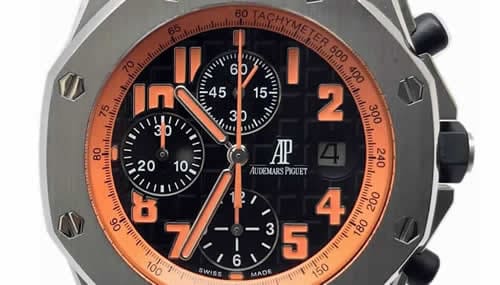
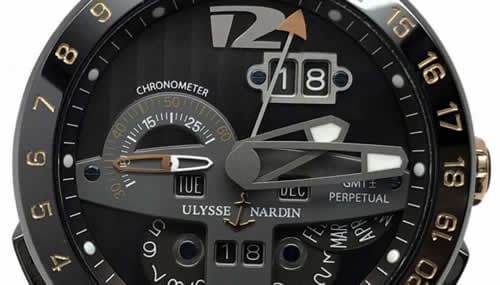
 Home
Home