


LIFT UP YOUR HEARTS
Czapek & Cie presents the Quai des Bergues “Sursum Corda,” the closing creation of the Maison’s 2025 anniversary quartet — marking 180 years since François Czapek founded his Geneva atelier in 1845, and ten years since the brand’s modern revival in 2015. With “Sursum Corda,” the Maison returns to the essence of the Quai des Bergues: an elegant balance of purity, restraint, and the enduring pursuit of Beauty. The piece stands as both a culmination of the anniversary year and a reaffirmation of Czapek’s creative identity, where historical inspiration and modern craftsmanship meet with clarity and purpose.
The Quai des Bergues collection — launched in 2015 — draws its name from François Czapek’s first Geneva atelier on the Quai des Bergues, a workshop that later led to boutiques in Paris and Warsaw. The founders of modern-day Czapek immersed themselves in 19th-century archives, studying pocket-watch references such as the 1850s model 3430, which inspired the line’s earliest wristwatches. The first production model, the Quai des Bergues N° 33, reinterpreted historic codes with elongated Roman numerals, a grand feu enamel dial and the signature twin de-centred subdials for small seconds and power reserve. Its proprietary calibre was developed with Chronode. Since its debut, the Quai des Bergues line has embodied Czapek’s philosophy of seeking Beauty through a dialogue between heritage, imperfection, and contemporary refinement.
A DIAL SHAPED BY RESILIENCE
The new “Sursum Corda” edition — crafted in 18K rose gold with a pristine white grand feu enamel dial — revives the original aesthetic codes of the Quai des Bergues: enamel, Roman numerals, and refined hands. Yet it adds a deeper symbolic layer. The Latin phrase “Sursum Corda” (“Lift up your hearts”) is subtly hidden beneath the enamel, visible only when light strikes at select angles. Often used by CEO Xavier de Roquemaurel in challenging moments, the phrase embodies resilience, optimism, and the will to persist. “It invites us to give our best even when hope seems lost — and yes, it carries a reference.” Interestingly, it was a Czapek team member, not Xavier, who suggested embedding this message within the anniversary dial, making it a shared symbol of the Maison’s collective spirit.
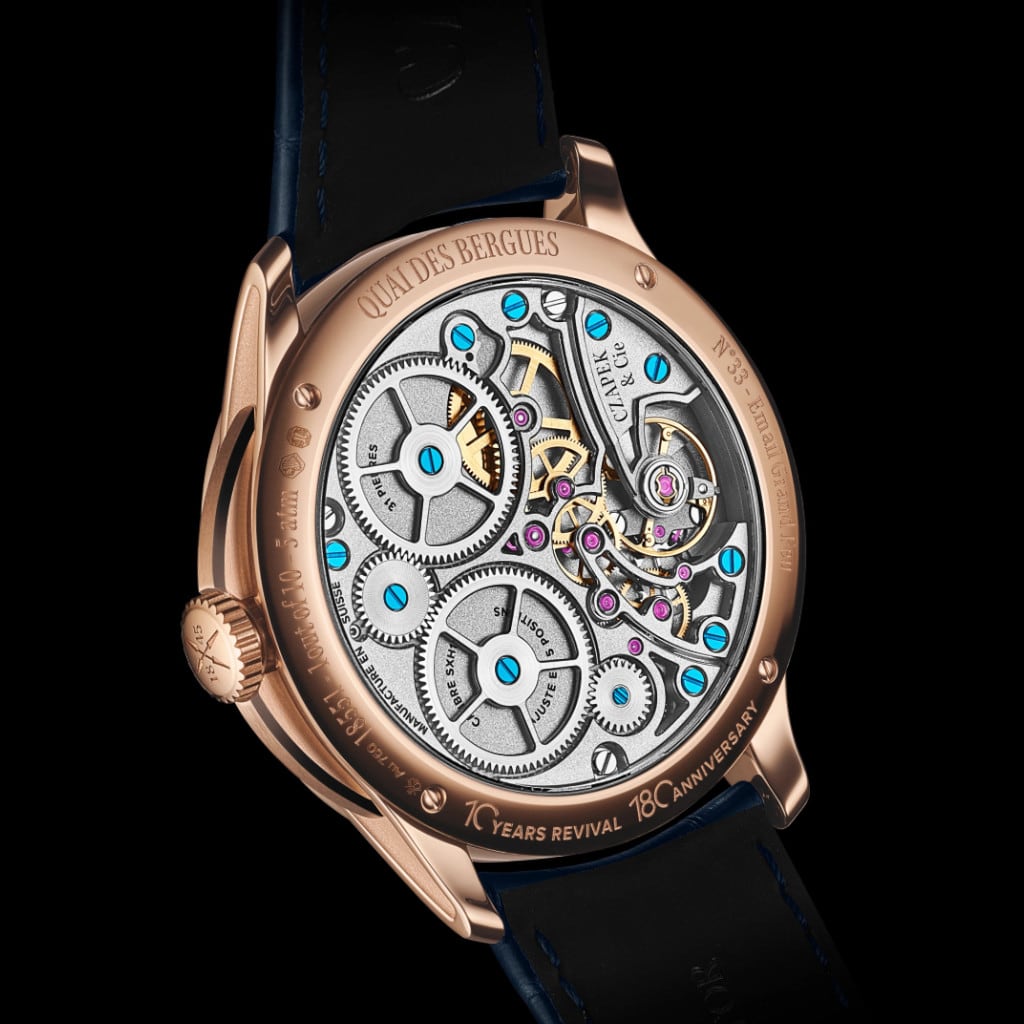
A laser-engraved “10 / 180” on the case marks both ten years since Czapek’s revival and 180 years since its founding. A discreet reproduction of François Czapek’s original signature sits within the small-seconds subdial, echoing the model’s theme of visible and hidden details. The piece is powered by Czapek’s manual-wound calibre, inheriting the lineage of the first Quai des Bergues wristwatches. Its twin-barrel structure provides a 7-day power reserve — practical for weekly winding and historically linked to 19th-century habits. Inspired by pocket-watch architecture, the movement features open ratchets, symmetry, and haute horlogerie finishes such as circular graining, sand-blasted surfaces, and hand-chamfered bridges. The new 40.5 mm case, positioned between earlier sizes, offers balanced proportions and clarity, becoming the sole size for future Quai des Bergues models and strengthening the collection’s identity.
THE MOVEMENT
The SXH1 caliber is a proprietary movement designed by Czapek. It is the first in a family of movements developed specifically for Czapek watches, according to the strictest rules of the watchmaking art. It was conceived in cooperation with Le Locle based company Chronode. This manually wound movement has two barrel springs, ensuring 7 days of power reserve and runs at a rate of 21,600 vibrations per hour, (3 Hertz). It features an annular balance wheel with weights for variable inertia and a Breguet terminal curve balance spring. The balance cock has been finely skeletonized and streamlined to give the whole balance greater transparency. It is finely decorated and remains aesthetically and functionally true to the 1850 original. The architecture remains symmetrical, and the sandblasted finish is a modern interpretation of the ‘satiné frost’ technique used in the 19th Century.