News Archives - Page 25 of 55 - Exquisite Timepieces
iconHome Blog / News / Page 25

Category: News

tudor pelagos review

Tudor Pelagos Review (READ Before Buying!)

Win Shearn Seah

April 5, 2025

“Tudor is just an affordable Rolex”. This term needs to be thrown into the bin and burned into ashes because this is so untrue. Yes, Tudor is Rolex’s sister brand. Yes, they were both founded by the same owner. But as of late, Tudor is building a name of its own without its big brother’s help. 

Tudor has been killing it as of late, releasing new models after new models, and it does not seem to be slowing down. Thanks to their release of the Tudor Burgundy Heritage Black Bay in 2012, Tudor has properly cemented a place in the Swiss luxury watch world. 

bot-only-imagebot-only-image

The models within the Tudor range that attract the most people are undoubtedly their Black Bay heritage models, and we all love them for different reasons. However, there is another great collection from Tudor that is arguably often unmentioned enough – that’s the Tudor Pelagos. 

History
Tudor Pelagos History

The Tudor Pelagos was first introduced in 2012 as Tudor wanted to prove to the world that they are one of the best brands for creating proper diver watches. 

During the same year of releasing the Black Bay model, which has a vintage-inspired diving watch design, the Pelagos is the opposite of that and has a modern design for people who go professional diving in the deep sea as just the name suggests (the Greek word for Pelagos is “deep sea”).

This release continues the legacy of Tudor since 1926, as Hans Wilsdorf always wanted to continue to strive making high quality watches that are built to withstand extreme conditions and pushing the limits. So much so that the marines even use the Pelagos for their important missions. 

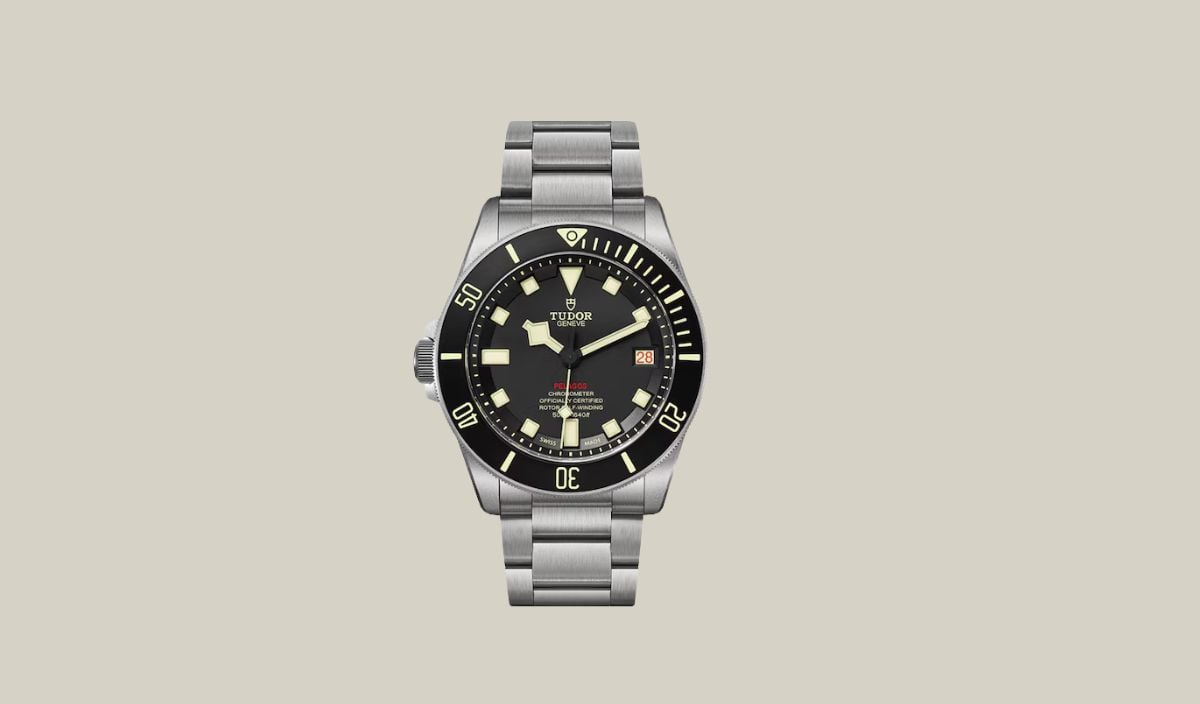
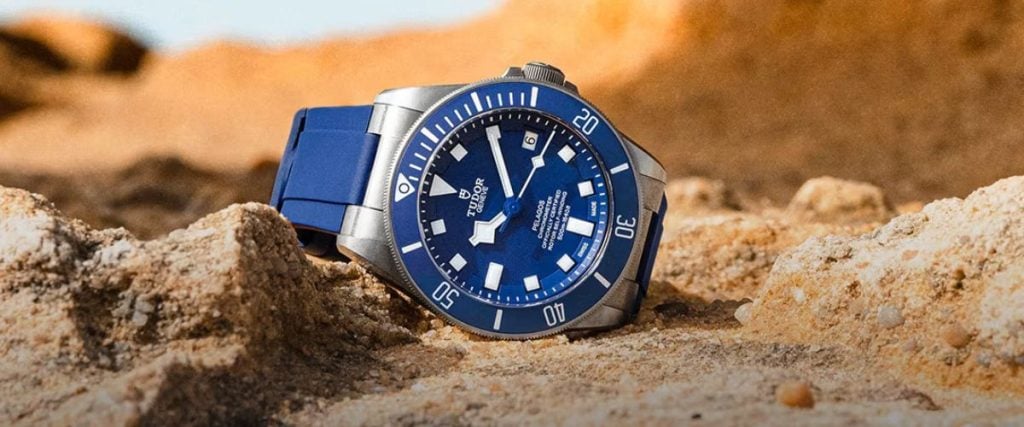
There are four versions of Pelagos (Pelagoses?) this current day: matte black with contrasting white (2012), a blue dial (2015), Left Hand Drive (2016), and a Pelagos 39mm (2022).

Case

The Pelagos features a 42mm and 14.3mm thick case (39mm and 11.8mm thick), and the design of it is very utilitarian and is built to fit on the wrist well with a slight curve on the lugs to ensure maximum comfort. 

What impresses me the most is the build quality and the material of the Pelagos. It has a titanium case, and it weighs like nothing. I have handled the watch many times, and every time I pick it up, it always surprises me how light it is compared to other stainless steel watches of this size. 

To complete the look of the titanium case, it features a fully brushed, satin finish that has zero light reflections, giving it an extra sporty and utilitarian look. With a water resistance of 500m (200m for the Pelagos 39), it also features a screw-down crown and a nicely engraved Tudor logo on it. 

Furthermore, it has a closed case back, as most dive watches will have, but for the LHD (Left Hand Drive) model, it has an engraved caseback showing a numbered serial, indicating how many LHDs were made by Tudor, which is a very cool touch. 

What I think is the coolest and most unique feature of the Pelagos is its helium escape valve. It is located on the left side of the case (right side of the case for the LHD) and writes “GAS ESCAPE VALVE”. The purpose of this is to allow helium to escape from the watch during deep-sea diving to prevent the watch from exploding due to high pressure.

The Pelagos also has a unidirectional and ultra-durable ceramic bezel, which is virtually scratch-resistant.The bezel has very satisfying action with 60 clicks with virtually no play in it, making it more useful and reliable when using it under water or timing events. What’s also very scratch-resistant is the flat sapphire crystal and that improves legibility under water. 

As you can tell from its features, you will understand why the navies went for the Pelagos for their choice of watch. 

Dial

The Pelagos has three different dials that it comes with (technically 4 but I will get into that later), matte black with contrasting white, matte black with an off white on the LHD and a blue dial. 

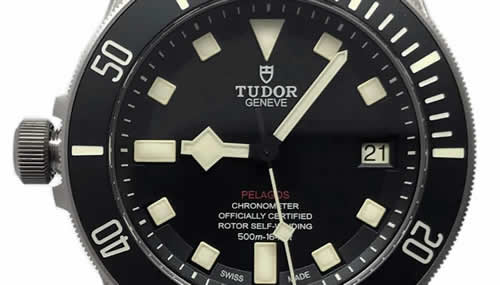
All 3 dials feature a brushed and an almost grainy surface finish on the dial, and again, improving legibility as there will be no reflection of light, making it more contrasting with its applied bright white indices. It also features the iconic Tudor snowflake hour hand, a sword-like minute hand and a smaller snowflake seconds hand.

The dial on the Pelagos 39 is slightly more unique. It has a sunburst black dial, offering a more alluring look and will look differently depending on lighting. This provides the watch an entirely new look, making it slightly more dressy than its brothers. 

It also features a date window at 3 with a white date disc and a black date font. What’s also on the dial is the five lines of text written at 6, showcasing the reliability and the waterproofness of the watch, albeit being a little cramped on the dial. 

On a side note, on the Pelagos 39, it does not feature a date window, giving the watch a more symmetrical dial and this appeals to more watch enthusiasts (mainly because you don’t need a date when you’re diving if you’re a purist). But also, it might not be as functional as the 42mm Pelagos without the date. 

The bezel also has contrasting white markers with a clearer and more precise minute track going from 0 to 15 to more accurately track your diving time between those minutes. 

For the LHD, the indices, markers and hands feature an off-white color, making it more vintage looking. Also, the word “Pelagos” on the dial is red in color and the date window in the roulette style, meaning the numbers alternate between black and red, which again, is a very cool touch.

The Pelagos 39 also features a red “Pelagos writing” and without the date window, it offers a cleaner and classic look and with just a pop of color to prevent the watch from looking too dull.

As a diving watch, the lume is excellent, featuring a blue colored lume on the hands, indices and the markers on the bezel. The lume lasts around 6-8 hours according to the wearers of this watch. No matter if you’re doing deep-sea diving, or just wanting to check the time on your watch during the night, the Pelagos got you covered. 

Movement

The Pelagos is powered by the very reliable in-house caliber MT5612. This automatic movement is 100% COSC certified to provide high performance robustness, reliability and also a precision of -4s to +6s a day. It also features a “weekend proof” power reserve of 70 hours, meaning the wearer can take off the watch on Friday and back to wearing it on Monday without worrying about it stopping. 

On a day to day basis, wearers have also claimed that the watch is actually more accurate than what it suggests, around +1 to +3 seconds a day, making it very accurate and also very reliable. 

In the Pelagos 39, it features an in-house caliber MT5400. It has all the great features and reliability of the MT5612, just without the date. Arguably, in the long run, the Pelagos 39 might be more reliable than the others due to it having one less component. One less component means one less part for it to potentially go wrong. 

Straps

The Pelagos has a full titanium bracelet, including the clasp as well, making the overall aesthetic much more utilitarian. The design of the bracelet features a three-link design that is very functional but also looks stylish. 

The bracelet also has a unique, patented auto-adjustable buckle. It is a spring mechanism that allows the bracelet to auto adjust during diving, depending on the depth of diving, the wrist might be compressed and thus, making the watch looser. 

This spring loaded adjustable buckle will adjust automatically on the spot to ensure the watch is always on the wrist of the diver. The same will happen as the diver returns to the wrist and pressure decreases, the buckle will return back to the original size. This auto-adjustable buckle is available in the Tudor Pelagos 42 only, where deep diving is prioritized. 

The Pelagos 39 is equipped with Tudor’s proprietary T-fit clasp that allows the wearers to adjust the strap on the fly without any hiccups.

It allows the wearer to make small and instant adjustments with a total adjustment window of 8 millimeters. This unique, patented clasp also has a 25 millimeter bracelet extension, which allows the wearers to be worn over a wetsuit. 

From experience, the T-fit clasp is one of the best in the business. Its ability to just adjust easily and smoothly, but at the same time does it very sturdily makes it one of the best that I’ve used among most watches, let alone watches in the same price bracket. 

But, there’s more. It even comes with a flexible and comfortable black rubber strap along with a titanium pin buckle that also has a Tudor logo engraved on it.

The rubber strap also features solid end links so there are no gaps between the rubber strap and the case. The attention to detail that Tudor has in this watch is amazing. 

This allows the watch to be truly an everyday watch. Want something more versatile to match with a shirt or perhaps suit? Go for the bracelet. Going to the beach or doing sports? Change it to the rubber strap.

However, I wish Tudor included a spring bar tool in the package so that the wearers can change the strap on their own. Instead, they have to bring it to the store to change it, which might be a hassle for some people. 

On-Wrist Experience
Tudor Pelagos On-wrist experience

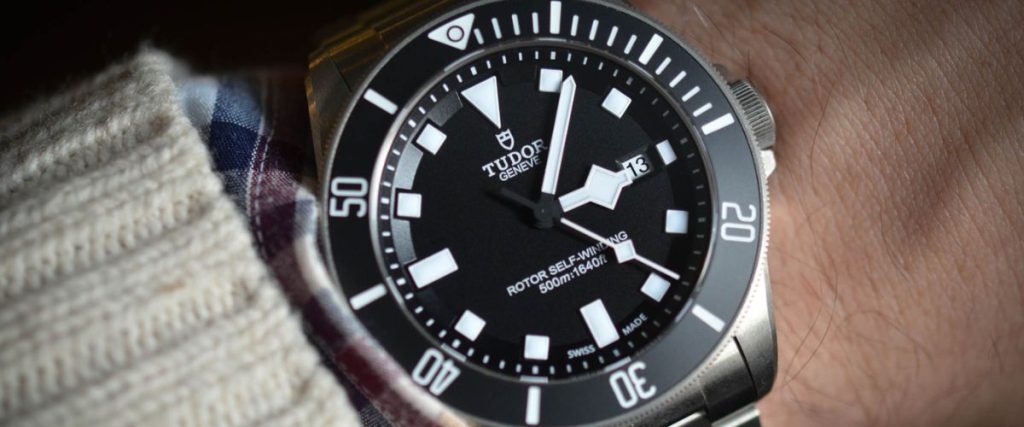
I have personally held this watch several times and have also compared this model to other watches as well. The Tudor Pelagos always surprises me in terms of how great it feels. It feels extremely light on the wrist and sometimes you forget that it’s on your wrist, but at the same time when you handle the watch, it feels extremely sturdy. 

The curved lugged on the case gives a great wearing experience as it sits well on your wrist. The 42mm will fit people with larger wrists and because of the weight, it actually feels that you’re wearing something smaller. 

Thus, I would say the Pelagos will fit a 7 inch wrist or above easily. So if you’ve got a smaller wrist, do not worry as it fits most wrists out there and besides, you can always go for a different Pelagos if it’s too small/big. 

Bezel action is great and wearers have stated that after long term use, there are still no scratches on the bezel and the “clicks” remain to be very tactile and satisfying after long term wear.

When I tried this watch on, I was wearing a suit, and to be honest, you could get away with it. Obviously it is not a dress watch by any means but I can see people wearing this on a slightly more formal wear with this watch, especially on the titanium bracelet.

The only slight issue with this watch is the thickness. With a thickness of 14.3mm, it does not hide under the cuff very easily, but other than that, if you’re not always wearing a suit (which is 80% of the people out there), this watch will wear great.

For me personally, I will pick the Pelagos 39mm as I believe it will fit most people’s wrist. Depending on where you are located, during the hotter days as your wrist expands or during colder days where your wrist contracts, the T-fit clasp is a dream to have, making it a comfortable fit all the time.

It is more wearable, thinner and at the same time, it still includes all the same specs, the 70 hour reserve, the accuracy, the finishing, and everything important is still there except the 500m water resistance. But let’s be real here, nobody is going more than 10 metres deep let alone 500m. 

Price & Availability

You can purchase the Tudor Pelagos at your local authorized Tudor retailer such as Exquisite Timepieces and you can get them online or in store.

The Pelagos 42 is priced at $5,200 whereas the Pelagos 39 is $4,875. It is usually available in stores and because of how great of a watch this is, I do not think the Tudor Pelagos is going to be gone any time soon.

You can also get them at preowned stores at potentially a lower price but please buy at your own risk and only buy from a reputable dealer. 

I personally think at this price point, I can safely say this is probably the best priced luxury watch out there. You get a reliable watch from a very reputable brand that offers 5 years international warranty, full titanium case and bracelet, solid wearability and an appealing design. Compared to many dive watches around the market at this price point, this Tudor Pelagos is hard to beat. 

Conclusion

I’ve admired Tudor for a very long time, making bold and daring watches but at the same time maintaining its identity as one of the best Swiss watch brands in a very competitive industry.

Doing things outside of the box may often backfire, especially in the very enthusiastic and scary watch world. But the release of the Pelagos is precisely why I think Tudor is making a brand for itself, and even succeeded at that. 

The Pelagos is incredibly well-made and for the money, it’s one of the best dive watches out there that you can find. For around $5000, it offers a sporty, durable, comfortable and most importantly, versatile wearing experience.

The inclusion of the rubber strap just makes it even better for money, and for the versatility to switch styles depending on your mood. It will suit most people out there and it ticks all the boxes for it being an excellent daily beater and even more uniquely, it’s made entirely from titanium. 

The Tudor Pelagos does not only suit people for day to day wear, and is even chosen by the marines, making it a watch that you have to try for yourself in store or perhaps even better, own one.
tag heuer connected review

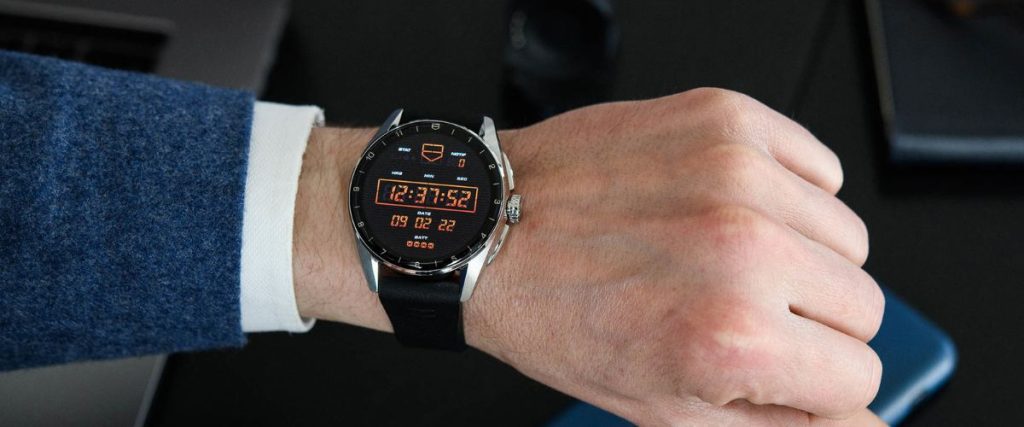
TAG Heuer Connected Review (READ Before Buying!)

Marcus Henry

April 4, 2025

Smartwatches are a pretty purpose-built genre. For the most part, they’re designed to exist unobtrusively on your wrist and are shaped entirely around their function. 

Popular companies such as Garmin and G-Shock love to use incredibly light materials, such as resin and titanium and are sure to advertise the utter weightlessness of their product.

bot-only-imagebot-only-image

But what if it didn’t have to be that way? What if you could find a smartwatch that didn’t hide its design but embraced it? A watch that wants to be seen and felt in its position on your wrist.

I know that was a bit of a theatrical intro, but the TAG Heuer Connected is really just that. It’s a smartwatch you’ll want to flash around a little. 

Not in a “look at me, I’m wearing a luxury smartwatch” kind of way (looking at you, Hublot Big Bang e Titanium Diamonds), but in a way that whispers, “this is a quality product that is built to last.”

If you’re still reading this, something about that speaks to you that’s worth investigating. So, let’s take a look at TAG Heuer’s Swiss smartwatches: the Connected E4 and the Golf Edition.

History

TAG Heuer Connected history

The TAG Heuer Connected collection turns one decade old this year. At its unveiling in 2015, then-CEO and industry legend Jean-Claude Biver proudly declared that the watch exemplified “Silicon Valley meets Switzerland,” and I think he was certainly right to do so. 

It was originally created through a partnership with Intel and Google since the watch is powered by Google’s Wear OS but features TAG Heuer’s iconic design. 

It was designed from the start to be a luxury Swiss smartwatch alternative, for those looking for just a little extra class on their wrist but with all the functionality of modern smartwatch tech.

The collection has evolved over the years—the current edition is the fourth, the E4—but the basic DNA remains the same. 

TAG Heuer didn’t want to create a distinctive smartwatch, but rather a smartwatch that looks in every way like a normal watch, with all the elegance that they know how to infuse in everything they make. 

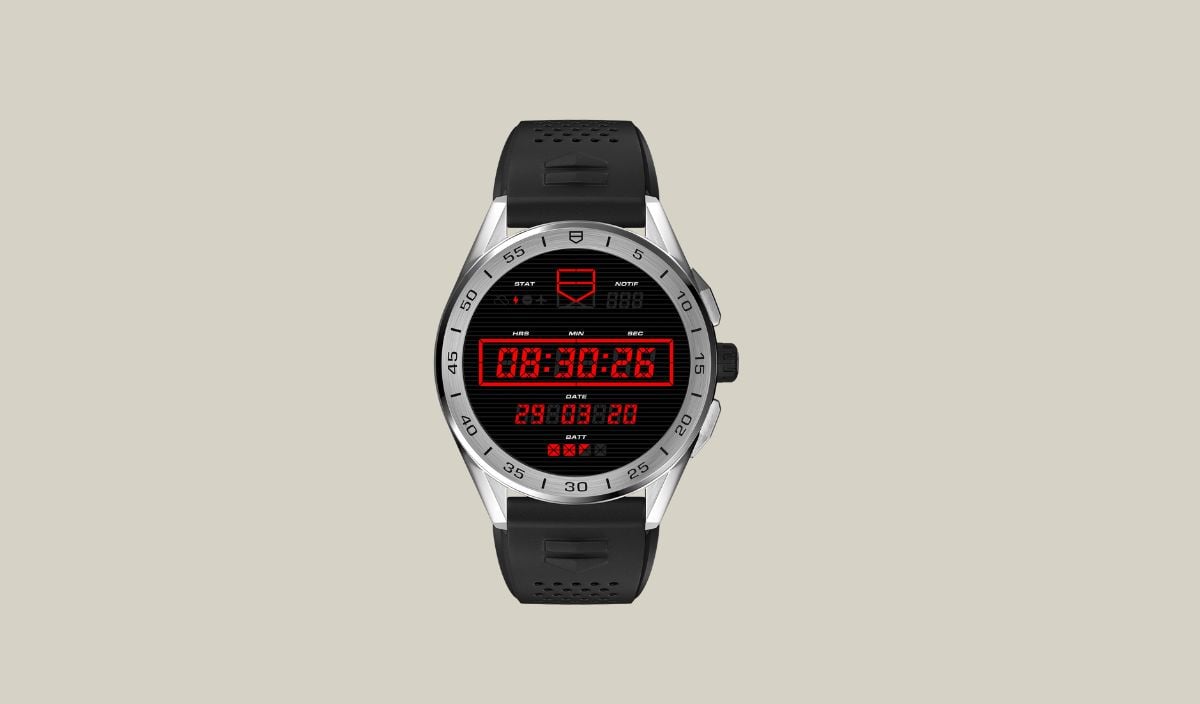
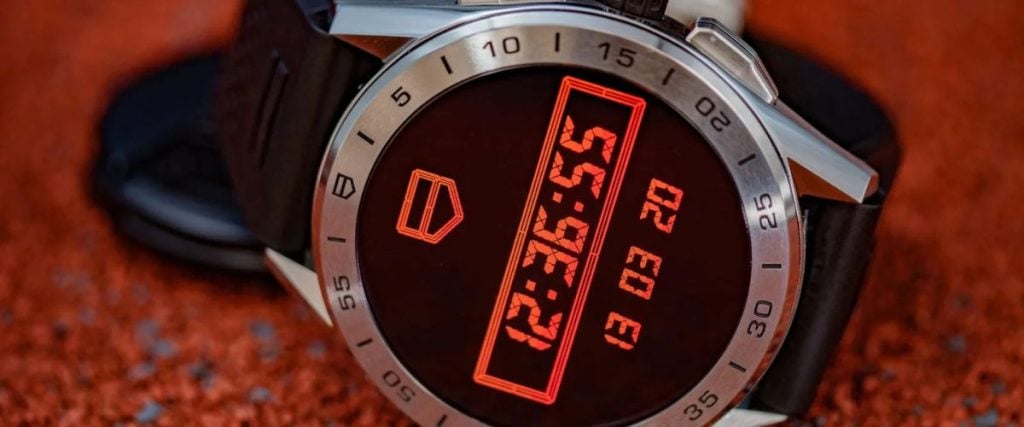
This is reflected in the case profile and the ceramic bezel, as well as the display, which throughout the collection’s history has been based on various watch faces offered by TAG Heuer.

Case

At first glance, anyone could be easily fooled into thinking the TAG Heuer Connected is really a mechanical TAG watch, and a large part of creating that elegant appearance is the case structure. 

TAG offers either a 42mm or a 45mm case with two pushers and a crown, much like you might see on a chronograph. Thankfully, TAG Heuer is careful to compensate for the large diameter by adding shorter lugs, making for an overall very wearable smartwatch.

The buttons and crown are specifically designed to be extremely ergonomic, comfortable and easy to use, and they sure look it. Personally, I’m a big fan of the tapered pushers, which have such a sleek shape and really accentuate the structure of the lugs. 

The crown is engraved with TAG Heuer’s logo and looks much like a standard watch crown, really helping to sell its watch identity.

In particular, the PVD ceramic bezel is an exceptional luxury touch that you’d be hard-pressed to find in nearly any other smartwatch on the market today. 

Not only that, but the sapphire crystal actually extends over this bezel, meaning that it won’t impede your usage of the touchscreen—so you get a touch of luxury shine without sacrificing the practical usage of the watch. With this case, TAG Heuer has really pushed the boundaries of what a smartwatch can be.

Display

If the case is the outfit your watch wears, and the movement is the beating heart, the display is the face, perhaps the most important element in creating an overall elegant presentation. TAG Heuer definitely put quite a good deal of attention into creating the different display options for their Connected E4, and all of the dial options are available directly from the company. 

While this means you don’t have the incredibly wide variety that you’d get with a Garmin, where people can design dials and sell them on the Garmin store, this also ensures that each dial will be high-quality and have razor-sharp clarity.

The dial options are simple but very clean. Most come directly from watches that TAG Heuer offers—even some that are directly inspired by their mechanical offerings, such as one face that features a virtual flying tourbillon (which may just be the single most ironic thing I’ve ever seen on a watch, but I digress). Another that replicates a mechanical skeleton dial.

The display itself is a touchscreen covered by a hard sapphire crystal, so you won’t acquire too many scratches on that lovely clear display. The screen is AMOLED, so it’s very bright when it’s active. 

The dial will go into an ambient mode when not directly in use, but the screen merely dims instead of going fully dark, so you don’t have to flick your wrist around and get the watch to turn on fully just to be able to see the time. 

To me, this is yet another proof of TAG Heuer’s intentionality in producing a smartwatch that works just like any other watch they make—easy to use and just as easy to tell the time as a mechanical timepiece.

Depending on which edition of the watch you spring for, you can also get different faces. The Golf Edition, for example, comes with 5 unique golf-inspired faces. 

In the past, TAG has also made Connected collaborations with Porsche and—believe it or not—Super Mario, so if you pick up an older one of these, you can even get custom dials featuring everyone’s favorite cartoon plumber. 

Oh, and there’s a current collaboration with the Oracle Red Bull Racing team with plenty of special dials inspired by the team’s colors. Outside of the special editions, however, you’ll be stuck with the much more restrained standard dial features.

Smartwatch Features and Battery Life

Let me preface this section with a brief disclaimer. You will probably be disappointed by the features the Connected E4 has to offer. I was, anyways. It’s not exactly a winning combo. In TAG’s defense, however—that’s not really the point. 

The watch is elegant, simple, and made to have a luxury feel and design. It’s not about cutting-edge technology. Would that have been nice to see here for a watch of this price? Absolutely. But at its essence, that’s not what it’s all about.

In any case, I’m not here to make an apology for the Connected E4, so it’s up to you whether the overall design and the features that are available are worth it for this watch. Let’s start off with the battery life, which is just one day (or two if you don’t use it late at night). It’s not exactly the 40-some days you can get on a Garmin with solar charging, but it’s also not built for the things the Garmin is, like adventuring off the grid. 

You’re wearing it around your home and around town, not to go explore uncharted waters. But a little bit longer would have been nice. Thankfully, the supplied charger is pretty cool, and I love the little TAG Heuer logo which lights up when it’s charging.

In terms of basic specs, the Connected E4 comes with a heart rate monitor, a GPS, and an accelerometer for swimming, running, and other activities. These all perform relatively well, with the possible exception of the heart rate monitor—I’ve heard a few complaints that it undercounts, which can also impact other calculations like your calories burned. These basic hardware features power each of the applications the watch has to offer.

If you’re a world-class athlete, you’d be much better off training with a Garmin or COROS than this TAG Heuer. TAG’s suite of wellness applications is relatively limited when compared to most others on the market. You do get real-time calories burned and energy management for races and other competitions, along with training sessions. 

In this latter category, you can actually follow programs made by top athletes (presumably TAG Heuer ambassadors), which is relatively compelling, and also follow along with a display of how to do specific exercises on the watch screen. It’s more of an everyday hitting-the-gym companion than an athletic trainer, to say the least.

Outside of the sports and fitness applications, you do get most of the other functions you’d expect from a modern smartwatch, like notifications, weather, calendar, and music syncing with your phone. The baseline is there, and it’s pretty strong, but it’s not exceptional cutting-edge tech.

Lastly, let’s touch on the golf-specific apps, which are, of course, exclusive to the Golf Edition of the Connected E4. These are actually pretty fantastic, and I was pleasantly surprised to see pretty much everything a golfer could ask for here. You’ve got automatic scoring for you and scorecard-keeping for everyone golfing with you. 

2D and 3D maps of 40,000 golf courses around the world, plus 3D mapping of all your shots over the map as you progress. Stats and feedback on how you did after your trip is over. Recommendations on which club to use for each shot. 

I’m not much of a golfer, but I really can’t think of much more you could ask for. If you’re looking for a golf companion, the TAG Heuer Connected really stands out from its competition.

Straps

There’s not too much to say about the different strap options here, as TAG Heuer has kept it pretty simple. Almost every option comes—if you don’t configure it—on a rubber strap, which is perfectly fine, honestly. Not much to comment on, but it gets the job done and is what 99% of people who are wearing a smartwatch will be looking for. 

Can you easily swap it out for leather if you so wish? Absolutely, TAG even gives you that option upfront when buying the watch, and you can just as well swap out for your own leather strap. But it’s a simple, workhorse option that comes right with the watch, and most people won’t have any need to swap anything out. 

If you spring for the Golf Edition, you’ll get a rubber strap with a little extra texture, inspired by golf balls in a way that’s not super obtrusive or gimmicky, but actually works pretty well.

That said… TAG Heuer does also offer the option to pair a steel bracelet with a steel case watch in either size. I can’t help but love it. It feels so ridiculous in so many ways. A luxury steel integrated bracelet on a smartwatch? Where do I sign up? It’s like Hublot putting their dress watches on a rubber strap. 

It just makes no sense, and yet it works perfectly for this watch. The bracelet itself is pretty darn good, too, with very little gap between links and mirrored central links contrasting with the brushed ends. Frankly, it has no right to look this good.

On-Wrist Experience

TAG Heuer Connected On-wrist experience

TAG Heuer manages to nearly perfectly accomplish what they set out to do: create a smartwatch that has an immaculate luxury look and feel. The watch is big, to be sure, and for those with smaller wrists, you’ll definitely want to go for the 42mm size. 

That said, TAG shortened the lugs a little to make for a watch that’s ever so slightly more wearable than how its measurement sounds. This means you get a larger display, which is perfect for its smartwatch nature, with extra wearability.

The look is definitely the biggest draw of the watch because most of the smartwatch features won’t cut it for a lot of people who are looking for a serious tool to wear. The heart rate monitor and pared-back fitness features are perfectly fine for a guy like me who just drops by the gym to stay relatively in shape and spends most of his time safely ensconced within civilization. 

For me, I really appreciate the luxury look and feel of the watch, and I don’t mind as much not having the latest tech and tactical features. It’s a watch I feel comfortable wearing with most outfits and even taking out to more formal events. That’s really the draw of the watch for almost anyone, I’m sure.

A last thing I want to touch on in terms of the watch’s everyday wearability is the way it integrates with your phone. It doesn’t have any sort of built-in cellular, so everything comes directly from Bluetooth with your phone. Since it runs on Google’s Wear OS, this can cause some problems for some (but not all) iPhone users. 

I’ve heard a few reports that the watch often struggles to pair with their phone. To really get it to work well with your iPhone, you end up needing to download the Google Wear OS app, as well as the TAG Heuer Connected app, which can be problematic for both your storage and the space on your home screen. 

You also can’t directly reply to notifications on the watch with an iPhone. It just integrates a lot better with Androids as a consequence of its Google-powered innards and can be a little frustrating at times to use with an iPhone. 

If you’re an Android user, this is all well and good and can be a little extra advantage with having the watch. If you’re an Apple fan, be sure to save a little screen and storage space for the apps you’ll need.

Price & Availability

The TAG Heuer Connected E4 currently goes for around $1,450, or $1,950 for the Golf Edition. This is sort of an average value, since there are different prices for the normal one depending on case material and how you choose to configure it, but it hovers around there.

Interestingly, the retail price of the watch has been steadily going down over time, which I actually really appreciate. TAG Heuer has shown an awareness of the market, and of how competitive their product is with other smartwatches that are available right now, and since the technology of the E4 has been outstripped in several ways recently, the price has gone down accordingly. It’s still not cheap, but it’s significantly lower than it was before (well over $2,000!), and I appreciate the intentionality from TAG here.

It’s certainly an expensive smartwatch option, but it’s also a luxury item that comes with the TAG Heuer brand name and is built to last. Yes, it costs more upfront, but it can also last you longer even while others are upgrading to the latest iterations of whatever smartwatch they’re into and end up spending more money.

Note as well that TAG also offers a trade-in program, where you can sell your E4 to get some money back towards a newer edition of the watch. If they release a new collection in the future, you won’t have to worry about missing out just because you got an older version of the watch.

You can find the TAG Heuer Connected E4 for sale on the company’s website at around $1,450.

Conclusion

It’s not a watch that’s going to stun your friends with its crazy features and long battery life, but it sure is beautiful. And in the end, that’s what TAG wanted. Whether you like it as it is or not, TAG Heuer hit their goal dead-on with this one, and I think there’s something to be respected in that. 

A luxury Swiss watchmaking house stuck to its guns and made something following its own ideals, its own design, and its own character, and this is the product. Love it or hate it, it’s a pretty darn good watch that deserves a round of applause.

rolex explorer review

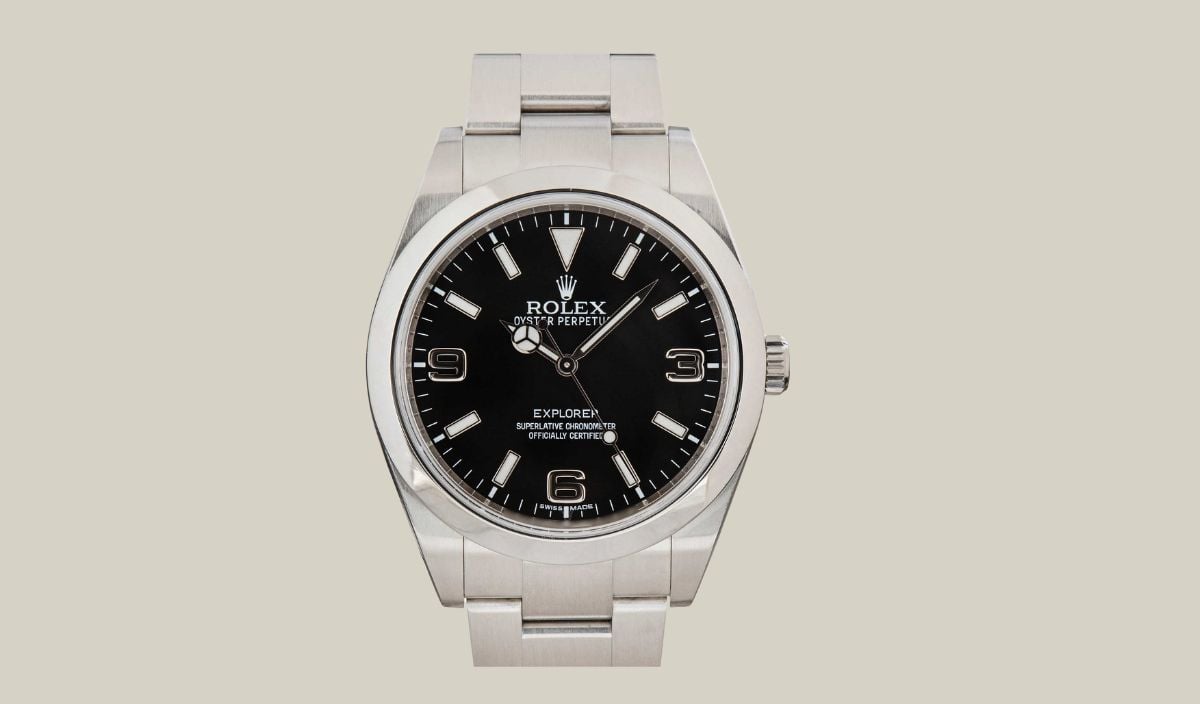
Rolex Explorer Review (Read BEFORE You Buy!)

Marcus Henry

April 3, 2025

Scrolling through the list of collections on Rolex’s website reveals just one icon after another. Datejust. Submariner. GMT-Master II.

The list reads more like a hall of fame for watches than a company website. You have to scroll past most of these other legends to reach the Explorer collection towards the end, almost as if Rolex is keeping this one hidden away for those with a little extra intentionality.

bot-only-imagebot-only-image

That extra searching will meet with a full reward, I assure you, for the Explorer collection is one of Rolex’s very finest. It couples Rolex’s traditional heritage with the tool watch style that they do best. 

It’s simple and understated, which is central to Rolex’s historical identity. It is Rolex distilled to a single drop. No flash. No flair. Just a nearly perfect tool watch that works. And keeps on working.

Whether you’re scaling the highest mountains or clocking a 9 to 5, the Rolex Explorer captures the spirit of adventure in every moment. It can weather any storm, from a blizzard on Mount Everest to a rapidly approaching deadline. If you’re looking for a go-anywhere, do-anything watch by the watchmaking brand, look no further.

History

Rolex Explorer History

The Oyster Perpetual Explorer was first introduced by Rolex to commemorate the first-ever summit of Everest in 1953 by Sir Edmund Hillary. Contrary to popular belief, Hillary himself was wearing a Smiths watch, but his team was wearing Oyster Perpetuals. 

As such, the Explorer itself wasn’t on the first summit of Everest, but mountaineering is in its DNA. From the inside out, it was designed to provide extreme precision even in extreme conditions.

The Explorer was one of Rolex’s first Professional watches. It’s far from the elegant flair of a Cartier Tank—essentially, it is for professionals, those pushing the limits of what is possible.

In the most extreme conditions, you don’t want a cheap battery-powered watch on your wrist that’s barely waterproof and could die at any moment.

Or at least, so the pros say. I wouldn’t know myself. The current editions of the Explorer were relatively recently updated, with the current 36mm size introduced in 2021 and the 40mm in 2023. 

Thankfully for those of us who have a deep appreciation for vintage watches and heritage releases, not much has changed from the original edition of the Explorer—which actually first came out at the same 36mm size. 

In all, it’s a watch that has remained faithful to its past. No need for vintage reissues here: the Explorer is the real deal and looks pretty much exactly how the original 1953 Explorer would look if it was introduced today.

Case

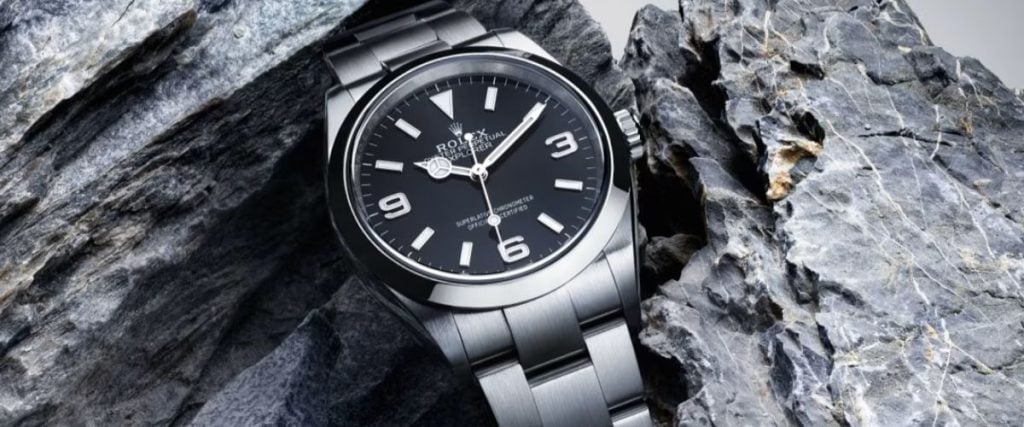
The Explorer case gets the job done, and it does it in probably the most understated possible way. It’s very simply brushed, creating a utilitarian tool-watch appearance uninterrupted by any polished bevels or flash. 

This case can get beat up by pretty much anything anywhere and, thanks to the brushing, scratches, and divots, won’t be that visible or eye-catching. With brushed satin finishing, I often find that beat-up watches are able to wear their scars as a badge of honor in a way that highly polished watch cases really can’t, as any slight mark on their surface will interrupt their smooth shine.

The case is what Rolex calls their proprietary Oyster case. Originally introduced all the way back in 1926, it enabled Rolex to create the first-ever waterproof wristwatch.

At its core, it involves screwing the bezel and the caseback into place, using the tight seal created by the threads and by rubber gaskets to add water resistance. Today, the Explorer has 100m of water resistance thanks to this, which is more than enough to take it swimming, if not a little diving, without any worries.

As a watch nerd, I love the effect created by contrasting areas of polish on a case or bracelet. I’m a big sucker for that sort of visual contrast, and thankfully, the Explorer provides just that with its mirror-polished bezel atop the brushed case.

It’s a little extra flash and shine that pairs so well with the glossy black dial (more on that later) and really turns this watch into something that you can dress up when you want to.

That spectacular Oyster case construction that I touched on earlier is crafted entirely out of Rolex’s proprietary Oystersteel, a special type of steel in the 904L family.

According to Rolex (personally, I’ve never put one of their watches through its paces, but maybe one day), it’s significantly more corrosion-resistant and has a unique radiance when compared to standard stainless steel

Again, Rolex is all about quality and simplicity. Corrosion resistance and a shinier, more precious-metal-like appearance? I’ll take both, please. The case is simple and fantastic. It gets the job done and protects the watch in a powerful and elegant way.

Dial

With the recent editions of the Explorer, Rolex has slightly altered the dial, with the primary changes being repositioning some text and switching the color from a matte black to a glossy black. 

I’m a huge fan of this change—the text is now in the same configuration as the original Explorer, and the glossy black dial is just so much deeper and more elegant than a matte black could be. It’s the elegant shine of a black silk bow tie—simple and timeless.

Overall, the dial is designed to be as legible as possible. It features numerals at 3, 6, and 9, which are even larger than those in the last edition of the Explorer, as well as square lume plots at the others and a triangle at 12:00.

This layout is so iconic and so legible that it’s been copied on hundreds of watches throughout history. I think I’ll let that speak for itself.

Both the applied indices and the hands are filled with Rolex’s special Chromalight lume, which is a bright white during the day and, when charged by UV light, emits an intensely blue glow at night. 

It’s a relatively recent development, from 2008, and it was updated in 2021 to make it an even more intense and longer-lasting shine.

Essentially, it’s a really high-quality lume that is definitely one of the key factors that will set the Explorer apart from similar but less expensive tool watches which will have vastly inferior lume.

The hands are quintessential Rolex, with the “mercedes” hour hand and simple pointed minute hand. I actually am quite fond of the seconds hand, with its round lume plot and round counterweight.

It’s just so visually and physically balanced and, to me, conveys a lovely sense of precision which is, of course, backed up by the powerful Rolex movement beating away inside.

Along the rehaut, you’ll find the iconic “ROLEX-ROLEX-ROLEX” repeated text engraved into the metal. A bit of a history lesson: all the way back in the 18th century, perhaps starting with Abraham-Louis Breguet, watchmakers were making fine and precision engravings in order to distinguish the quality of their work from that of counterfeiters. 

It’s a lovely way to both add that hefty Rolex branding and, by adding such a delicate and difficult-to-reach engraving, provide a way to authenticate the watch at a glance.

Finally, the printed text is very evenly spaced and balanced, with clean kerning (the space between letters) that shows a lovely attention to detail characteristic of Rolex quality. 

Every element of the whole dial shows a profound perfectionism, which is exactly what you pay for when you buy a Rolex or any other quality luxury watch. It’s legible and sporty but elegant, simple and restrained but refined. I really just can’t find any fault with it.

Movement

For a watch like the Explorer, you desperately need a movement that can take a few knocks in intense environments and keep right on ticking. Rolex has placed their in-house caliber 3230 in this role, which was developed in 2020. 

It’s an automatic movement with a whopping 70-hour power reserve, so if you wear this watch every two days, it’ll always be wound. It’s COSC-certified as a chronometer, and to this, Rolex has added their own certification process, earning it the title of “Superlative Chronometer”, which means it keeps time to within +/- 2 seconds per day.

So how does it stand up to life’s adventures, wherever they may be? The cal. 3230 features all three of Rolex’s recent watchmaking developments: the blued Parachrom hairspring, the Rolex Chronergy escapement, and Paraflex shock absorbers. 

Without getting too into the technical details of each of these, each one definitely brings some major benefits to the power and durability of this watch. The Parachrom hairspring increases the watch’s resistance to magnetic fields and also keeps great time even over a long span of time without regulation. 

It’s also more resistant to breaking than standard hairsprings and silicon hairsprings, which have become the standard for the rest of the industry. The Chronergy escapement is what gives the cal. 3230 such a long power reserve, thanks to a significant increase in efficiency for the movement.

In all, it’s a movement designed to resist whatever life throws at you, especially since it’s safely ensconced within its strong Oyster case. There’s not much else I can say about it—it’s a workhorse time-only beater that will power you through all of life’s explorations.

Straps

The Explorer comes normally on a classic Rolex Oyster bracelet, as if the heritage inspiration couldn’t get any better. Once again, there’s not too much to say here and certainly nothing to nitpick at. The bracelet was first developed in the 1930s, so its design actually precedes the Explorer collection, interestingly enough. 

Rolex has equipped this bracelet with both an Oysterlock folding clasp, which snaps over the buckle to hold it tightly shut and prevent it from coming open, and an Easylink rapid extension system, which can quickly add an extra 5mm to its length via a folding link. 

This latter tool is much more useful than you’d think—your wrist actually fluctuates a little in size throughout the day depending on your level of physical activity and other factors, so the option to quickly pop 5mm onto the length can be actually super convenient.

I would strongly recommend keeping your Explorer permanently on its bracelet. The 36mm version has a 19mm lug width, which is quite difficult to find a good strap for—although the 40mm version is at 20mm, which is much easier. 

That said, both of them are made with slots in the case wall between the lugs to better integrate the end link and make it look like it flows right into the case. This means that without the bracelet, you have those slots revealed, which can be a pretty ugly look from some angles. 

Thankfully, the Oyster bracelet is great, and it’s really not too much of a loss. You can try to put a strap on it if you really want, but like I said, keeping it on the bracelet is probably the best option.

On-Wrist Experience

Rolex Explorer On-Wrist Experience

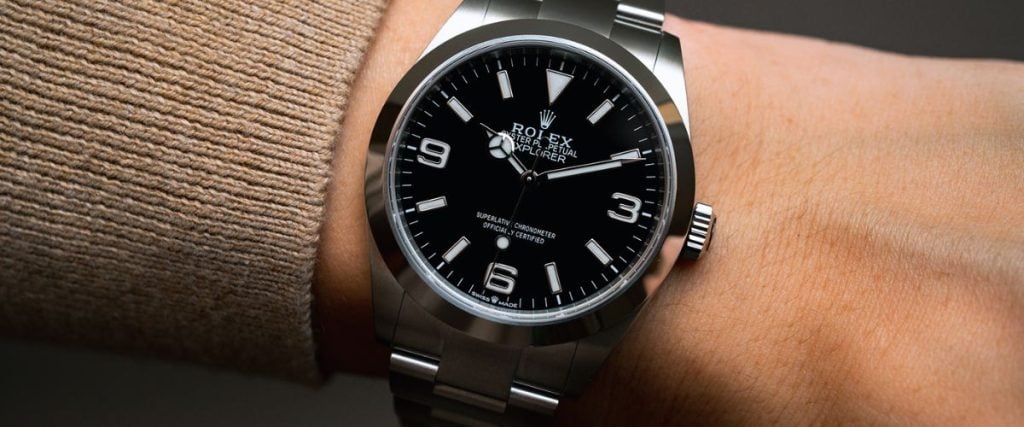
The Rolex Explorer wears amazingly and has a super unobtrusive presence on the wrist—just like you would expect, considering all the rest of the under-the-radar details we’ve discussed so far.

The 36mm version, in particular, is quite small by modern standards, and its 19mm lug width keeps its wrist presence rigidly restrained. It can definitely take some getting used to its small size, so you might need to give it a little more wrist time to adjust to it. 

Once you do, however, I’ve found that it becomes natural and easy to wear, especially for those of us with smaller wrists. Honestly, 38mm is right around the sweet spot for me, so I don’t mind a 36mm version in the least, especially when it’s the vintage size.

The 40mm option is much larger and feels more modern in its sizing. It definitely doesn’t take over too much, but it’s enough to give it much more of a modern sports watch feel and look, sprawling over the wrist with its larger case size and lug width. 

I’m really fascinated by just how much of a difference the case size can make in the overall appearance of the watch. The 36mm is quiet, elegant, and simple, with a pronounced vintage feel. The 40mm is bold but not over-the-top, sporty, and fresh.

Both are great watches in their own right and completely identical on every other level. But the difference in size is definitely something important to consider when purchasing your Explorer.

It’s a watch that, as I’ve mentioned before, can take anything you throw at it. I’m not exactly the type of guy who wanders around climbing mountains, but you can really just feel a sense of bravery and confidence when you wear the watch. Maybe it’s the Rolex name, maybe it’s the solid build and structure of the case, but it just feels strong. 

In a way, it’s inspirational too. If I ever was going to climb a mountain, I’d wear an Explorer to do it. Maybe Rolex should test to see if some of the cal. 3230’s crazy high power reserve actually runs me, too, along with the hands when I’m wearing it…

Price & Availability

Currently, there are three different Explorer models available on Rolex’s website. There are two editions, all in Oystersteel, the 36mm and the 40mm versions. The 36mm goes for $7,350, and the 40mm is just slightly higher at $7,800. Finally, if you’re looking to really accentuate that elegant glossy black dial, you can spring for a two-tone yellow gold Rolesor model (only at 36mm) for $12,700.

I also want to touch quickly on the current market value of these watches since the gray market may be a better move if you don’t necessarily need it directly from Rolex, and they are, of course, expensive investments. 

The 36mm and the 40mm Oystersteel versions are currently reselling for around their market value, with the 36mm slightly lower and the 40mm slightly higher. The big difference is in the Rolesor model, which has a lower market price of around $9,169. 

Definitely not the watch to pick if you’re planning on reselling it, but that really shouldn’t matter. Pick the watch that you love, and that speaks to you!

Conclusion

Every time I take one of these deep dives into a Rolex collection, I walk away with a newfound appreciation for the simplicity and charm of Rolex’s work, and I hope I’ve conveyed that to you as well here. 

The Explorer marries simplicity, refined elegance, and utilitarian strength in a way that many others have striven to emulate since its inception in 1953. It is, in many ways and for many people, the tool watch. Will it be yours?

I’ve said it several times already, but if you were to ask me which luxury watch brand everyone should experience at least once, my answer would be Grand Seiko.

This Japanese watchmaker has no shortage of incredible designs, all completely hand-finished and equipped with in-house movements.

bot-only-imagebot-only-image

However, with so many Grand Seiko watches to choose from, it’s not always easy to recommend a single model, especially if you’re searching for that one holy grail Grand Seiko that pretty much does it all. 

Don’t get me wrong, there are many Grand Seiko watches that I consider to be grail-worthy, and I personally have a few on my own wish list.

But if there’s one model that stands out to me, and one that I know many in the watch-reviewing community have a real soft spot for, it’s the Grand Seiko Elegance Mechanical GMT SBGM221. 

As its name suggests, this watch is undeniably elegant, seamlessly transitioning between an everyday watch and a sophisticated companion for formal occasions.

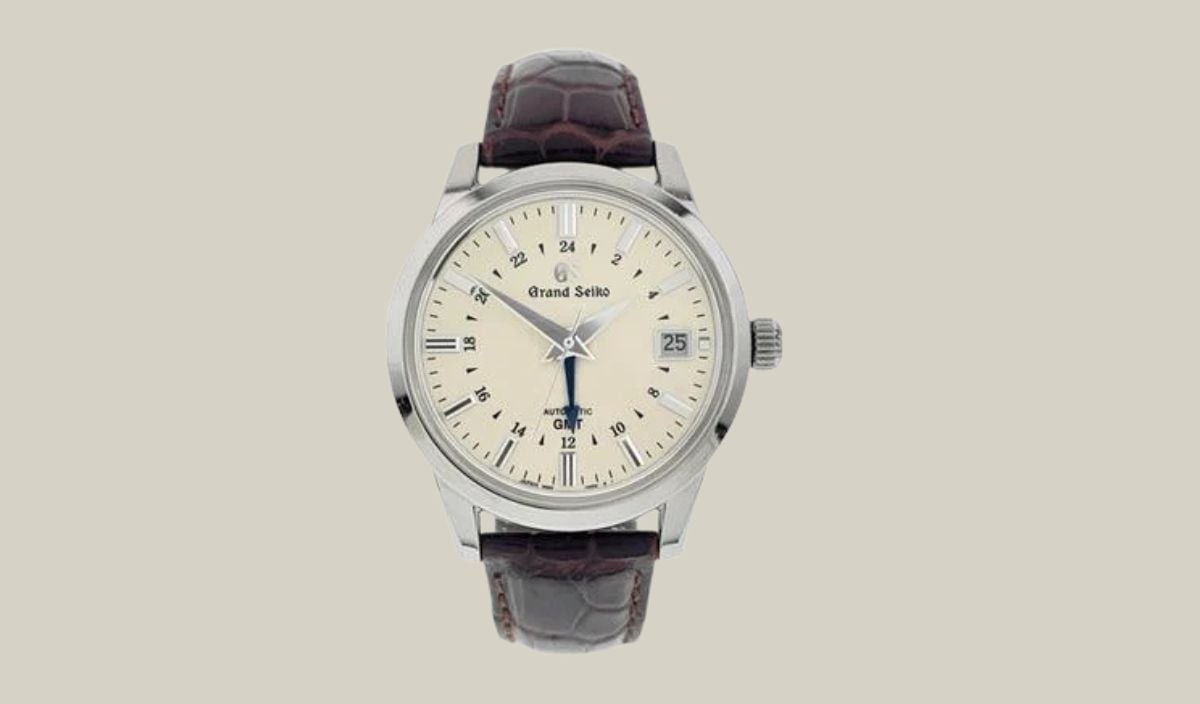
It features a beautifully warm cream-colored dial, well-proportioned case dimensions, and an automatic movement with a three day power reserve and a GMT complication. It’s a watch I’ve tried on multiple times, and each time, it impresses me just as much as the first. 

But today, I want to take a closer look at this particular model and explain why I believe it’s one of the best Grand Seiko watches currently available on the market.

A Little Background on the Grand Seiko Elegance Mechanical GMT SBGM221 

Grand Seiko Elegance Mechanical GMT SBGM221

The watch we’re looking at today, the Grand Seiko Elegance Mechanical GMT SBGM221, is one of the most refined and well-balanced pieces in Grand Seiko’s lineup.

Sitting within the Elegance collection, this model embodies everything that makes Grand Seiko special: meticulous craftsmanship, timeless design, and technical excellence. 

At $4,900, it’s positioned at the more accessible end of Grand Seiko’s mechanical watch range. But don’t let the price fool you because this is still very much a Grand Seiko through and through, offering incredible value for what you get. And I think that’s proven strongly by the fact that this is a Grand Seiko watch that’s remained a permanent fixture in the company’s line-up for close to a decade. 

Technically, the Grand Seiko SBGM221 is part of a lineage that traces back to 2011, when the SBGM021 was first introduced.

But in 2017, Grand Seiko refreshed the model, replacing the “Seiko” branding at the 12 o’clock position with the standalone Grand Seiko logo, shifting it from its original spot at 6 o’clock.

This update marked a significant moment for the brand, reinforcing its identity as an independent high-end watchmaker, distinct from the broader Seiko lineup. 

The Elegance collection, where the SBGM221 resides, is Grand Seiko’s home for dressier timepieces. These watches focus on refined aesthetics, traditional proportions, and classic finishing, making them perfect for both formal and everyday wear.

Unlike most GMT watches, which tend to lean toward a sportier or tool-watch design, the Elegance GMT SBGM221 is a rare example of a GMT complication housed in an elegant, vintage-inspired case. 

Grand Seiko’s history itself dates back to the late 1950s, when the company set out to challenge Swiss watchmaking by producing timepieces that met the highest standards of precision, durability, and craftsmanship.

The 1967 Grand Seiko 44GS helped establish the brand’s now-iconic design language, which included sharp case angles, highly polished surfaces, and incredible attention to detail, principles that continue to shape every Grand Seiko watch today, including the Elegance GMT SBGM221. 

While the Grand Seiko SBGM221 may not be a direct reissue of a vintage model, it carries forward the Japanese watchmaker’s legacy in a way that feels both timeless and modern.

With its blend of classic proportions, high-end finishing, and a sophisticated GMT complication, it’s easy to see why this watch has earned a cult following among collectors and enthusiasts alike.

A Soft Case of Stainless Steel

The case of the Grand Seiko SBGM221 is a perfect representation of the brand’s dedication to precision and craftsmanship. Inspired by the original 62GS case design, it carries a vintage charm but has been updated with modern proportions for better wearability.

At 39.5mm in diameter, 46.9mm lug-to-lug, and 13.7mm thick, the dimensions strike a beautiful balance between presence and elegance. 

While the thickness might seem substantial on paper, the way the case is designed ensures it never feels bulky.

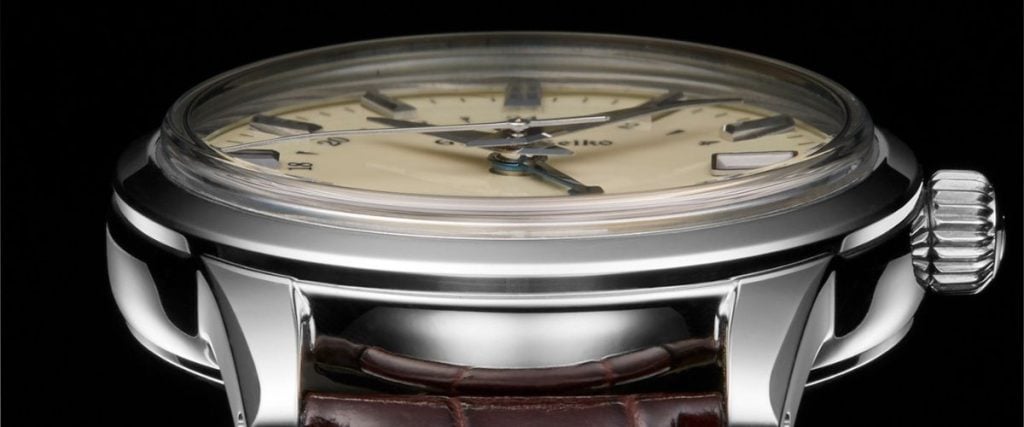
The distribution of height across the mid-case, exhibition caseback, and domed sapphire crystal makes the watch sit comfortably on the wrist. The curved lugs further enhance the fit, helping the watch hug the wrist rather than standing too tall. 

Grand Seiko’s finishing is among the best in the industry, and the SBGM221 showcases this expertise beautifully. The case is primarily polished using the Zaratsu technique, a traditional Japanese method that results in distortion-free mirror surfaces.

This level of finishing is rarely found even in watches at much higher price points and is a key reason why Grand Seiko watches have such a distinct, high-end look.  The Grand Seiko Elegance Mechanical GMT SBGM221 uses a mix of high-polish and brushed surfaces to create contrast and depth. 

As for the bezel, it’s Zaratsu polished and kept intentionally slim, allowing the dial to take centre stage. Sitting atop is a box-shaped sapphire crystal and to further improve visibility, Grand Seiko has applied an anti-reflective coating on the inner surface, reducing glare without compromising the crystal’s clarity.

Turning the watch over reveals another piece of sapphire crystal, one secured by six screws. This exhibition case back offers an unobstructed view of the Grand Seiko caliber 9S66 working inside. 

The crown, located at 3 o’clock, is practical and well-proportioned. It’s not a screw down crown, so keep that in mind, which means the Grand Seiko Elegance Mechanical GMT SBGM221 is only splash resistant.

But this is as expected, since this is a dress watch after all. It would have been nice for this to be upped to 50 metres for a little more protection, but it’s not a deal breaker. The crown features the Grand Seiko emblem, subtly engraved, and offers a smooth, satisfying action when winding or setting the time.

A Creamy, Understated Dial 

For me, it’s the dial of the Grand Seiko Elegance Mechanical GMT SBGM221 that really sets this watch apart. At first glance, it might seem simple; just a warm, creamy ivory backdrop. But spend a little time with it, and you’ll start noticing all the little things that make it special.

For starters, it has a glossy finish that catches the light beautifully, but not in an overpowering way. Instead, it gives off a soft, refined glow that complements the polished indices and hands. It’s the kind of dial that never gets boring because every shift in lighting reveals something new. 

One of the standout features is the applied hour markers. These aren’t just stamped and stuck onto the dial, they’re individually crafted, multi-faceted, and finished to perfection.

They appear simple but up close, you’ll notice the razor-sharp edges and how they catch the light. The markers at 12, 6, and 9 are doubled, giving a bit of extra prominence to those positions, while the rest maintain that signature Grand Seiko sharpness. The finishing on these markers is so precise that you won’t find a single flaw, no matter how closely you inspect them. 

The hands follow the same philosophy being diamond-cut and polished to an insane level of perfection. The hour and minute hands are broad and angular, tapering to fine points, and the second hand is a thin, elegant needle.

Then there’s the GMT hand, which is heat-blued by hand. This isn’t some chemically treated, factory-stamped blue hand, this is real, traditional craftsmanship. The deep blue contrasts beautifully against the creamy dial, adding a subtle pop of color without overwhelming the overall look. 

Speaking of contrasts, the text on the dial is printed in black, which keeps things crisp and easy to read. The 24-hour scale is placed toward the center of the dial, maintaining a balanced layout. At 3 o’clock, you’ve got the date window, framed in a polished metallic border.

Again, Grand Seiko didn’t just slap in a standard date disc either but one with a silver background decorated in a subtle circular texture that catches the light. It’s a small detail, but one that makes a big difference.

A Weekend-Proof Movement

Inside the Grand Seiko Elegance Mechanical GMT SBGM221 watch beats the 9S66 automatic GMT movement, and it’s got plenty to brag about. With a solid 72-hour power reserve so you can easily take it off on a Friday and throw it back on Monday morning knowing it’ll be still running perfectly.

It also offers a smooth 28,800 vph beat rate and 35 jewels. It’s regulated to six positions for accuracy and runs within an impressive +5 to -3 seconds per day. 

One of the best things about the 9S66 is that it’s a “true” GMT, meaning the local hour hand is independently adjustable. If you’re crossing time zones, all you have to do is jump the hour hand forward or backward without stopping the movement or messing with the minutes.

Even better, the date moves along with the hour hand when you pass midnight, keeping everything in sync. Sure, this means there’s no traditional quickset for the date, but the added convenience of a proper travel GMT setup more than makes up for it. 

And then there’s the finishing. Flip the watch over, and through the exhibition case back, you’re treated to a beautifully decorated movement, complete with the Grand Seiko lion emblem subtly visible on the crystal at a certain angle.

And of course, the movement itself isn’t just about looks. Grand Seiko incorporates cutting-edge tech here, like their MEMS (Micro-Electro-Mechanical Systems) manufacturing process, which allows them to produce ultra-precise, lightweight escape wheels and pallet forks.

They also use their proprietary Spron 610 alloy for the hairspring, making it highly resistant to magnetism, shocks, and temperature changes.

Straps

The Grand Seiko Elegance Mechanical GMT SBGM221 comes fitted with a beautifully crafted brown crocodile leather strap, and it’s as good as you’d expect from Grand Seiko. Right out of the box, it feels broken in, supple, comfortable, and ready to wear without that stiff “new leather” phase.

The deep brown shade pairs perfectly with the warm ivory dial, and the subtle red stitching adds just a touch of character without being over the top. 

The strap is secured with a high-quality three-fold deployant clasp, which not only looks great but also helps extend the life of the leather by reducing stress on the material compared to a traditional pin buckle. It’s a small detail, but one that makes a big difference over time. 

With 19mm lugs, strap options are a little more limited than the more common 20mm size, but the drilled lugs make swapping straps easy if you do want to experiment.

And this is definitely a watch that can handle different looks. If it was me, I’d throw it on a tan or honey brown leather strap for a more casual vibe, or even a deep navy to bring out the blue GMT hand. While the crocodile strap is a perfect match for the watch’s refined aesthetic, the Grand Seiko SBGM221 is versatile enough to dress up or down depending on what you pair it with. 

On-Wrist Experience 

On the wrist, the Grand Seiko Elegance Mechanical GMT SBGM221 is a dream to wear. At 39.5mm in diameter and 13.7mm thick, it’s a touch taller than you might expect, but Grand Seiko has worked some magic here with the curved lugs to ensure it sits comfortably and low, hugging the wrist rather than perching awkwardly. This means it works just as well on a smaller 6-inch wrist as it does on a 7.5-inch one. 

The case design is classic Grand Seiko, with those Zaratsu-polished surfaces catching the light beautifully. It definitely has presence, but it’s not an attention-seeker. It’s refined, elegant, and effortlessly stylish.

Thanks to the warm ivory dial and that pop of blue from the GMT hand, it’s a watch that can be dressed up or down with ease. It’s right at home in a formal setting, peeking out from under a blazer sleeve, but it doesn’t feel out of place with a more relaxed weekend outfit either. 

The crocodile leather strap adds to the comfort factor, feeling soft and broken in from the start. The deployant clasp is a nice touch, making it easy to put on while also preserving the life of the leather. If you want to switch things up, the neutral tones mean it pairs well with a variety of straps.

Price & Availability

The SBGM221 has been a staple of Grand Seiko’s Elegance collection since its release in 2017, and it’s showing no signs of going anywhere. In fact, I’d argue that the collection would feel incomplete without it.

It’s one of those models that has become synonymous with the brand being a perfect balance of classic design, impeccable finishing, and everyday versatility. If it ever does leave the lineup, I believe it would only be to make room for an improved version. 

Retailing brand new for $4,900, the Grand Seiko Elegance Mechanical GMT SBGM221 is easily one of the most affordable high-end GMTs on the market.

There aren’t many true fliers out there at this price point, especially not from a brand with Grand Seiko’s level of craftsmanship. Other options like the Longines Spirit Zulu Time or the Tudor Black Bay GMT exist, but both lean much more towards the sporty side, while the SBGM221 retains an effortless elegance that makes it unique. 

If buying new isn’t a priority, you can also find this model on the second-hand market for around $4,000, making it an even more tempting proposition. Whether brand new or pre-owned, just be sure to purchase from an authorized Grand Seiko retailer like Exquisite Timepieces.

Conclusion

All things considered, the Grand Seiko Elegance Mechanical GMT SBGM221 watch is anything but a compromise. It may sit at the more accessible end of Grand Seiko’s lineup, but every aspect of its design, finishing, and movement execution is undeniably top tier.

This is a watch that embodies everything Grand Seiko stands for, offering some of the best in terms of precision, craftsmanship, and elegance.

At $4,900, it’s a rare breed: a high-end, true GMT that delivers exceptional value without sacrificing an ounce of quality. Few watches in this price range come close to matching what the Grand Seiko SBGM221 offers, and the fact that it has remained a permanent fixture in the Elegance collection for years speaks volumes.

It’s refined but never flashy, timeless yet versatile, and packed with the kind of thoughtful details that make Grand Seiko so special.

If you’re after a luxury GMT that isn’t overly sporty to flashy but one that offers some serious watchmaking excellence in an elegant and dressy package, the Elegance GMT SBGM221 is undoubtedly one of the best options out there.

srp777 vs srpe93

Seiko SRP777 vs SRPE93: Which is the Superior Turtle?

Charlotte H

March 27, 2025

The Seiko Turtle is one of the most recognizable dive watches in the world. It has a storied history, a distinctive design, and a reputation for being both durable and reliable.

So no, the Seiko Turtle isn’t some rare breed of turtle—if that’s what you’re looking for, you might want to check out the National Geographic website instead.

bot-only-imagebot-only-image

No, this is the nickname given to one of Seiko’s most iconic dive watches, and it’s called the Turtle because of its distinct, cushion-shaped case that resembles a turtle’s shell. 

Seiko first introduced the Turtle back in the 1970s with the legendary 6306 and 6309 models, and since then, the watch has seen multiple reissues, each staying true to its roots while incorporating subtle but necessary modern improvements.

Today, the Seiko Turtle lineup includes a variety of models, all sporting the signature case shape, bold dials with plenty of lume, impressive water resistance, and reliable in-house automatic movements.

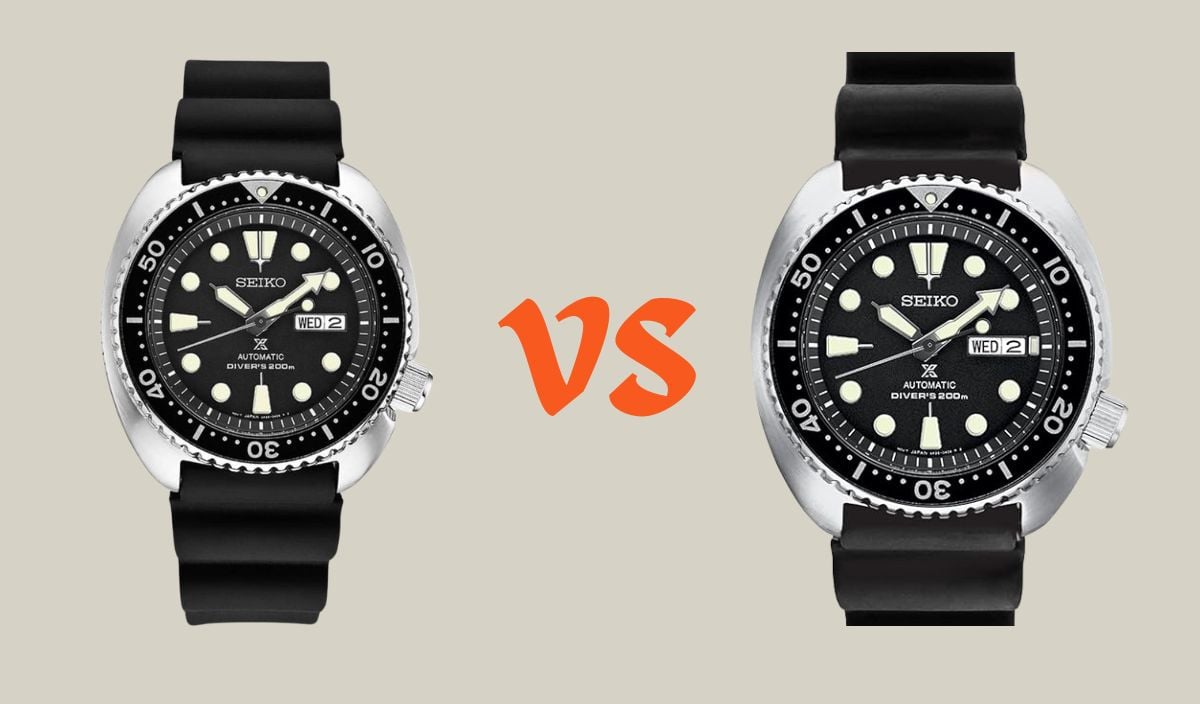
While most of these variations have obvious differences, whether it’s case size, dial colors, bezel inserts, or added complications, there are two models that look almost identical: the Seiko Turtle SRP777 and the Seiko Turtle SRPE93. 

If you’re not super familiar with these two watches, you’d be forgiven for struggling to spot any differences between them at all.

Seriously, if you can pick them apart in just a few seconds, you deserve some serious brownie points. But yes, there are subtle differences, and as any watch collector will tell you, even the smallest differences in a watch can have a big impact, whether it’s on how a watch wears, how it looks, or just how it feels on the wrist. 

So today, we’re putting the Seiko Turtle SRP777 and SRPE93 head-to-head, breaking down every little detail, so you’ll know exactly which one is the better choice for you.

The Seiko Turtle SRP777

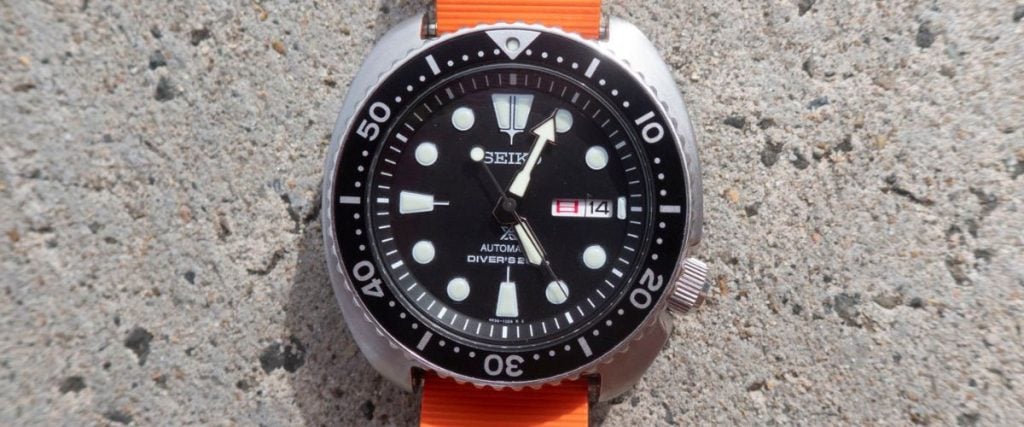
Seiko Turtle SRP777

Starting with the older of the two, the Seiko Prospex Turtle SRP777 is a modern reissue of the legendary Seiko 6309, a famous dive watch that the Japanese watchmaker first launched during the late 1970s.

This modern-day SRP777 reference however arrived in early 2016 but still retained many of the signature Turtle features including the cushion-shaped case, bold dial design, and robust diving capabilities that made its predecessor such a hit. 

At first glance, the SRP777 appears nearly identical to its vintage inspiration, measuring to 44.3mm in diameter with a lug-to-lug of 47.25mm. The stainless steel case features a brushed finish on the top and polished sides, maintaining the classic Seiko diver aesthetic.

Again, it’s the unusual shape of the case that gives the Turtle its nickname with a rounded, ergonomic, and undeniably comfortable profile. Despite its large dimensions, the watch wears smaller than expected due to its short lugs, making it surprisingly wearable on a variety of wrist sizes. 

One of the standout features of the SRP777 is its day-date window. Unlike more modern Seiko divers like the SRPE93, the SRP777 retains a beveled day-date window as a direct homage to the original 6309.

This small yet significant detail enhances the vintage appeal of the watch and is one of the main components that sets it apart from its younger sibling. For collectors and enthusiasts who appreciate the little nuances that make a watch special, this beveling adds a layer of depth and nostalgia. 

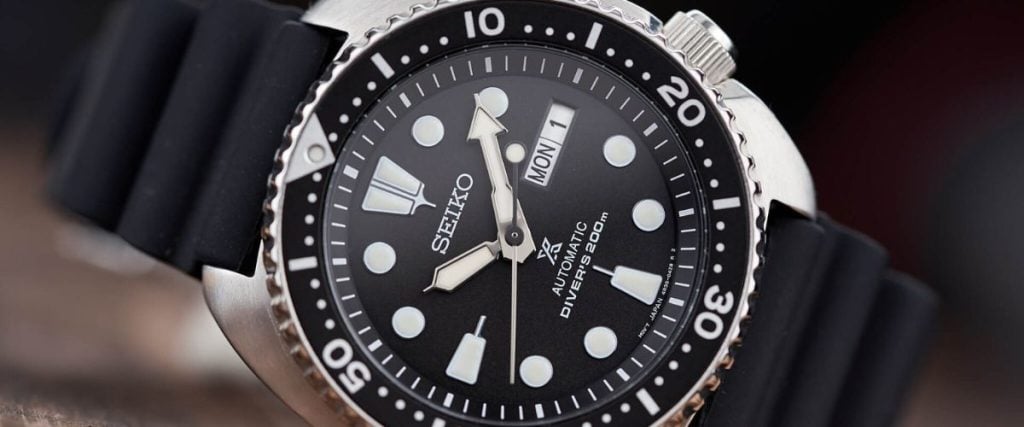
The dial is a rich matte black, offering excellent legibility in various lighting conditions. Large, well-defined hour markers are generously coated with Seiko’s proprietary LumiBrite, ensuring that the watch remains highly readable even in low-light environments.

The hands follow a classic Seiko diver design, with a broad arrow-style minute hand and a sword-shaped hour hand, making it easy to distinguish the time at a glance. The seconds hand features a lumed lollipop tip, another nod to traditional Seiko diver aesthetics. 

The bezel is a unidirectional 120-click mechanism with a fully indexed aluminum insert. The action is smooth with firm, precise clicks, making it a joy to operate. Seiko’s bezels are known for their reliability, and the Seiko Turtle SRP777 is no exception, providing an essential tool for divers to monitor elapsed dive times. 

The case back of the SRP777 is another area where Seiko has paid tribute to its past and offers another slight deviation from the SRPE93. The SRP777 features the iconic tsunami wave motif, deeply engraved and prominently displayed, alongside lettering that reads “Air Diver’s 200m”. 

Inside the watch beats Seiko’s in-house 4R36 automatic movement, a workhorse caliber that offers hacking and hand-winding. It also operates at 21,600 vibrations per hour and provides a respectable 41-hour power reserve.

It’s a reliable and robust movement, designed for longevity and ease of maintenance. It’s so reliable that Seiko still uses it in many of the dive watches today. Completing this model is a 22mm black silicone strap that is soft, flexible, and comfortable straight out of the box.

The Seiko Turtle SRPE93

Seiko Turtle SRPE93

Arriving a little later in 2021, and a watch still in production now, the Seiko Prospex SRPE93, is unsurprisingly another modern take on the Seiko Turtle design.

Much like its predecessors, this model stays true to the core identity of the Seiko Turtle, offering a cushion-shaped case, robust dive watch capabilities, and a timeless aesthetic. 

At 45mm in diameter with a thickness of 13.42mm, the Turtle SRPE93 is slightly larger than the SRP777 but still retains an ergonomic and well-balanced profile on the wrist.

Thanks to its rounded case and relatively short lug-to-lug length, the watch again wears smaller than its dimensions might suggest, making it comfortable for a wide range of wrist sizes. The case is engineered from classic stainless steel and features a brushed finish on the top with polished sides. 

The dial of the Seiko Prospex Turtle SRPE93 is also deep matte black, ensuring excellent contrast and legibility. At the centre are the same large and highly visible hour markers coated with Seiko’s LumiBrite. But peeking out just to the right of the dial is one of the subtle but notable differences between this model and the Turtle SRP777. 

Here you can see the addition of a lume block at the 3 o’clock marker. This lume pip was added to retain the ISO certification, as it is part of the new requirement.

In addition, to accommodate this change, the Seiko Turtle SRPE93 does not have the beveling on the day/date window that was present on the SRP777.

Another update lies in the case back. While it still features the iconic tsunami wave motif, the text has been updated to again reflect the new ISO diving specifications. Instead of the previous “Air Diver’s 200m” marking found on the SRP777, the case back of the Turtle SRPE93 now reads “Diver’s Watch 200m.”

This subtle change may go unnoticed by casual observers, but for Seiko enthusiasts, it represents an important update that aligns with modern dive watch standards. 

Other than that, the SRPE93 retains all the same spec as its older sibling. It has the same unidirectional rotating black aluminium bezel, Seiko’s reliable in-house 4R36 automatic movement with a 41-hour power reserve and a comfortable black silicone strap, secured with a pin buckle.

Seiko SRP777 vs SRPE93 – How to Choose 

The Case Size 

While both watches share the signature Seiko Turtle design, the SRPE93 comes in slightly larger at 45mm compared to the SRP777’s 44.3mm diameter.

The difference might seem minimal on paper, but on the wrist, even a fraction of a millimeter can impact the overall feel. The SRP777’s more compact dimensions make it a great option for those who prefer a slightly more manageable fit without sacrificing the iconic cushion-shaped case.

On the other hand, if you like the presence of a slightly larger case, the SRPE93 will give you that extra bit of wrist real estate while maintaining excellent wearability thanks to the short lug-to-lug distance. 

The 3 o’clock Lume 

One of the most notable updates in the Seiko Prospex Turtle SRPE93 is the addition of a lume pip at the 3 o’clock marker. This was introduced to meet the latest ISO dive watch standards to ensure enhanced visibility in low-light conditions.

However, this adjustment led to the removal of the beveling around the day/date window, which remains intact on the SRP777. If you appreciate the vintage-inspired detail and added depth that the beveling provides, the SRP777 might be the more appealing option.

However, if you prioritize lume and low light legibility, then the SRPE93’s additional Lumibrite pip will no doubt serve you better. 

The Case Back Decoration 

Both watches feature the classic Seiko tsunami wave motif on the case back, a signature design element in the Prospex series. However, the text has been updated in the SRPE93 to reflect modern ISO certification requirements. The SRP777’s case back reads “Air Diver’s 200m,” while the SRPE93 now simply states “Diver’s Watch 200m.”

While this change does not impact performance, some collectors might prefer the original wording as a nod to Seiko’s long-standing dive watch heritage. 

Which One Is Right for You? 

Choosing between the Seiko Prospex Turtle SRP777 and SRPE93 ultimately depends on what you prioritize in a dive watch.

If you appreciate subtle vintage aesthetics and small nostalgic details like the beveled day/date window and original case back text, and prefer a slightly more compact fit, the SRP777 is a fantastic choice.

However, if you’re looking for a more modernized version with updated ISO compliance, superior lume at the 3 o’clock position, and don’t mind the lack of beveling, then the SRPE93 is the way to go.

Conclusion

At the end of the day, choosing between the Seiko Prospex Turtle SRP777 and the SRPE93 comes down to personal preference. If I had to pick, I’d go for the Seiko SRPE93 simply because I believe you can never have too much lume on a dive watch.

The additional lume at the 3 o’clock marker ensures even better visibility in low-light conditions which is a key factor for me. 

That said, I completely understand why many collectors are drawn to the Turtle SRP777. It carries a piece of Seiko’s history with its vintage-inspired design elements, including the beveled day-date window, which adds a nostalgic charm. For those who appreciate subtle nods to classic models, the SRP777 is an appealing option. 

Practicality is another consideration. The SRPE93 is still in production and can be ordered easily, typically retailing for around $495. It offers a lot of watch for an affordable price, making it a solid choice for those who want a brand-new, readily available timepiece.

On the other hand, the SRP777 has been discontinued, meaning you’ll need to explore the second-hand market for this one. While pre-owned models are generally more affordable, averaging around $400, they may be harder to find in good condition. 

Ultimately, these two watches are incredibly similar in both aesthetics and specifications. To the untrained eye, it would take a keen collector to spot the differences when one is on your wrist.

But in the end, what matters most is what you value in a watch, whether it’s modern practicality or vintage charm. No matter which you choose, both are excellent examples of Seiko’s dive watch prowess, proving that the Turtle remains a true icon in the world of horology.

To Top