Charlotte H, Author at Exquisite Timepieces - Page 5 of 18

Author: Charlotte H

tissot prx review

If there’s one watch I’ve worn and written about more than any other, it’s the Tissot PRX. And that’s no coincidence. It’s easily one of my favorite releases of the past few years. It helps that I have a soft spot for integrated sports watches, but even before the PRX, there weren’t many great options in my category in my price range.

Don’t get me wrong, I’d love to own an Audemars Piguet Royal Oak or a Patek Philippe Nautilus. But with several extra zeros on the price tag, they’re a dream for future me, not something I can pick up today.

bot-only-imagebot-only-image

So when Tissot arrived with the PRX, it felt like an early Christmas present. It arrived with the same beautifully fluid, integrated architecture, a stunning array of textured dials, and depending on the model, a Swiss-made mechanical movement with a power reserve that lasts well beyond the weekend.

As you can probably tell from the title, I’m a huge fan of this watch. But more importantly, I think the Tissot PRX is one of the best entry-level timepieces for any collector.

Today, I’ll be going through the different models in the collection, breaking down their features and helping you figure out which PRX might be the right fit for you. Or, if you’re still on the fence, whether it’s a watch you should even consider in the first place.

A Quick History of the Tissot PRX
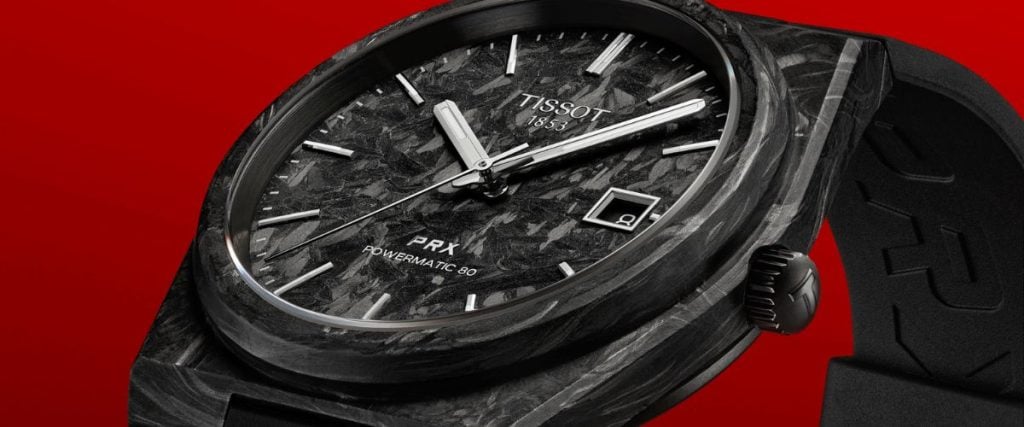
Tissot PRX collection

If you’re into watches, you know that the integrated sports watch craze didn’t start yesterday. It dates back to the 1970s, when legends like the Audemars Piguet Royal Oak and the Patek Philippe Nautilus set a new standard for sporty elegance. The problem though is that they were, and still are, priced well beyond the reach of most collectors.

Tissot also introduced the PRX in the 1970’s, right in the middle of this integrated design revolution. It had all the right ingredients including a sleek barrel-shaped case, a seamlessly integrated bracelet, and a quartz movement that made it precise, low-maintenance, and affordable.

The name “PRX” itself stood for Precision, Robustness, and 10-bar water resistance (with the “X” representing the Roman numeral for 10). Despite its looks and accessible pricing though, the PRX wasn’t all that successful and was discontinued after just a few years.

But then fast forward to 2021, and Tissot brought the PRX back to life. And unlike before, it’s had a whole lot more success. They didn’t just reissue it but they modernized it with upgraded movements and better materials all while staying true to its retro roots.

The tonneau-shaped case, the slim integrated bracelet, and the polished bezel are all back, but with upgraded finishing, sapphire crystal, and a mix of quartz and automatic movements.

The Powermatic 80 version, with its 80-hour power reserve and anti-magnetic Nivachron balance spring, was a particularly exciting addition for mechanical watch lovers.

Since its revival, the PRX collection has expanded rapidly. It now includes 35mm and 40mm options, a variety of dial colors, two-tone and gold PVD finishes, and even a chronograph model.

What started as a tribute to a nearly forgotten watch has become one of Tissot’s biggest success stories and in my opinion, one of the best value-for-money integrated sports watches you can buy today.

Breaking Down the Tissot PRX Collection
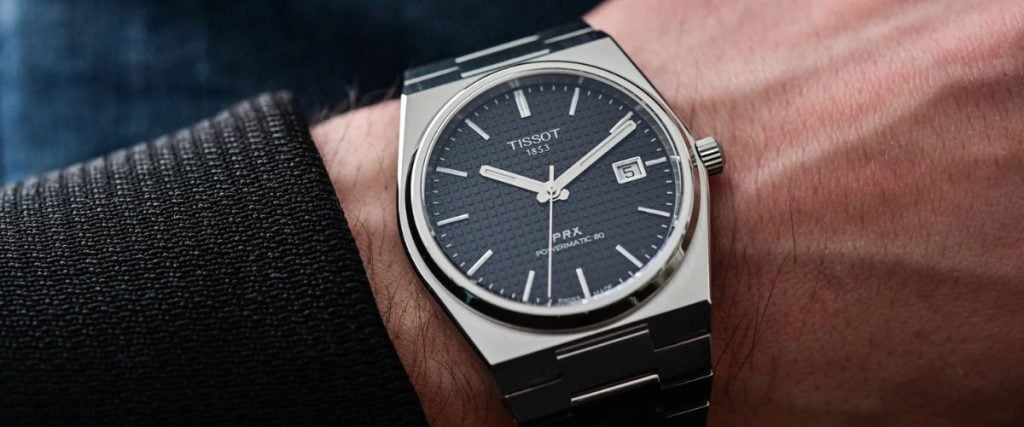
Tissot PRX 40

With the PRX lineup growing rapidly, there’s now a model for just about everyone. Here’s a quick rundown of the different versions and what sets them apart.

Tissot PRX 40mm Quartz – One of the most affordable entries into the PRX world, this model sticks closely to the original 1978 design with a slim 40mm case, integrated bracelet, and a sunray-brushed dial. It’s a great everyday watch with hassle-free quartz accuracy.

Tissot PRX 40mm Powermatic 80 – A step up in both mechanics and finishing, this version swaps the quartz movement for Tissot’s impressive Powermatic 80 automatic caliber, offering an 80-hour power reserve. It also gets a more intricate textured dial. A few standout variants even feature a knurled 18k rose gold bezel, not my personal favorite, but it adds a fun, luxurious twist.

Tissot PRX 35mm Quartz – A smaller, more unisex-friendly option with the same sunray-brushed dial and quartz movement as its 40mm sibling. Perfect for those who prefer a more compact fit.

Tissot PRX 35mm Powermatic 80 – The automatic version of the 35mm PRX, bringing the same textured dial and mechanical movement as the 40mm Powermatic 80, but in a more wearable size.

Tissot PRX 25mm – A recent addition, this ultra-compact PRX brings the integrated sports watch aesthetic to an even smaller, more jewelry-like size with a quartz movement.

Tissot PRX Chronograph – The most complicated PRX, featuring three subdials for small seconds, a 12-hour counter, and a 30-minute counter, plus a central chronograph hand. Flat pushers on the side of the case add to its sporty, retro appeal.

The Case

Most people are drawn to the Tissot PRX because of its case. The Swiss watchmaker has absolutely nailed the sleek, integrated design that makes this watch so special.

The barrel-shaped profile is wonderfully sleek and comes with vertically brushed finishing to give it a refined yet sporty look. This is contrasted by a highly polished bezel, which catches the light beautifully.

Most models in the Tissot PRX collection stick to a stainless steel construction, but there are a few standout versions utilising 18k rose gold bezels, and even a full black carbon case for those wanting something more unique.

The Tissot PRX 40mm models (both quartz and Powermatic 80) measure, unsurprisingly, 40mm across. The quartz version comes in at a thickness of 10.4mm thickness, while the automatic Powermatic 80 versions are slightly thicker at 10.9mm to accommodate the mechanical movement. The difference is minimal on the wrist, but if you prefer ultra-thin watches, it’s worth noting.

The 35mm PRX models are scaled-down versions of their larger counterparts, perfect for those who prefer a more compact fit.

The quartz model measures 9.6mm thick, while the Powermatic 80 version comes in at 10.93mm, making it slightly taller but still very sleek. There’s also the 25mm PRX, the most recent addition to the collection, which is just 9.5mm thick.

Then we have the Tissot PRX Chronograph which is a different beast entirely. Due to its more complex movement, it measures 42mm in width and 14.54mm thick, making it the chunkiest PRX by far. It’s still wearable thanks to the integrated design, but it definitely has more wrist presence compared to the standard models.

Since the Tissot PRX is a sports watch after all, it comes with a 100 meters of water resistance and scratch-resistant sapphire crystal.

On automatic models, the caseback is transparent, giving you a view of the Powermatic 80 movement and its wave-decorated rotor. As you’d expect, those with quartz movements have a basic closed exterior.

The Dial

Depending on the model you choose, the dial options for the Tissot PRX vary. Typically, you’ll get to choose from  either a smooth sunray-brushed dial on the quartz version or a textured tapisserie-style dial on the Powermatic 80 models.

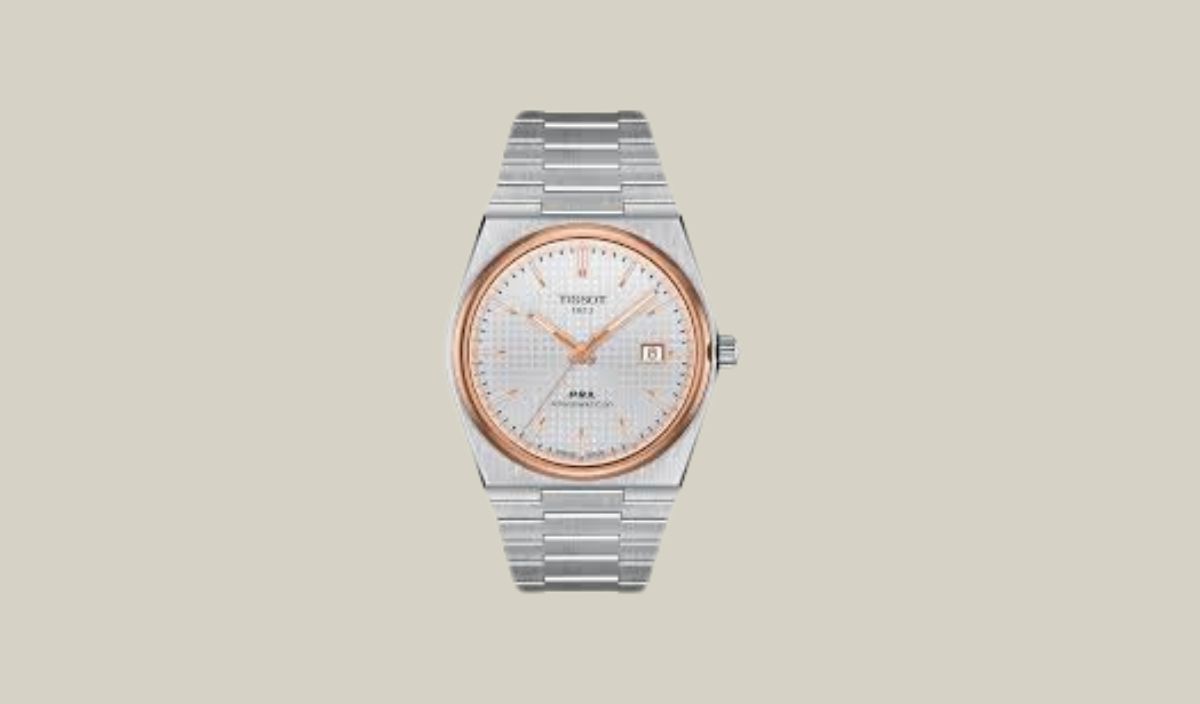
I particularly love the Tissot PRX Powermatic 80 models with their gorgeous waffle-textured tapisserie dial, a feature that instantly brings to mind the Audemars Piguet Royal Oak.

This texture enhances the way light plays across the surface, giving the dial more depth and making the colors appear even richer. Some of the standout shades in this range include deep navy blue, crisp white, emerald green, black, and bright mint green.

In contrast, the quartz-powered PRX models feature a more understated sunray-brushed dial, which gives off a soft, radiant sheen. These versions come in silver, black, navy blue, pastel light blue, and green, as well as some bolder choices like mint green, hot pink, gold, and white mother-of-pearl.

Some of these colors, especially the mother-of-pearl and bright pink, are exclusive to the 35mm quartz lineup, making them particularly special if you’re after something a little different.

Tissot has also released a few gradient dials, which shift in color depending on the angle of light, adding even more variety to the PRX collection. These dial colors are exclusive to specific sizes and movement types, so it’s worth checking availability if you have a particular shade in mind.

Despite all these variations, every Tissot PRX dial maintains a clean and elegant design, with slim baton-style hands, faceted indexes, and a neatly positioned date window at 3 o’clock. There’s even a touch of lume on the hands, giving just enough nighttime readability without disrupting the sleek aesthetic.

The Movement

As we’ve touched on already, the Tissot PRX collection comes with two movement options: quartz and automatic. Both have their merits, depending on what you’re looking for in a watch.

The quartz models are powered by a Swiss-made battery-operated movement, offering exceptional accuracy with minimal maintenance.

As with all quartz watches, you’ll need to change the battery every few years, but other than that, it’s a simple, no-fuss choice and ideal if you want a stylish timepiece without worrying about winding or power reserves. The Tissot PRX Quartz watches are also slightly thinner which will be a bonus for those wanting the most compact size.

On the other hand, the Tissot PRX Powermatic 80 models step things up with an automatic movement, giving the watch a mechanical soul.

The Powermatic 80 calibre has become one of Tissot’s most celebrated movements, primarily because of its weekend-proof 80-hour power reserve. That means you could take the watch off on a Friday evening and it would still be running on Monday morning, something that’s rare in this price range.

This movement beats at 21,600 vibrations per hour (3Hz) and features 23 jewels, hacking seconds, and an anti-magnetic Nivachron balance hairspring, which helps protect it from everyday magnetic fields like those from smartphones or laptops.

The Straps

One of the defining features of the Tissot PRX collection is its integrated bracelet, which plays a huge role in the watch’s overall aesthetic.

The vast majority of PRX models come fitted with a stainless steel bracelet, and in some rare cases, 18ct gold, both featuring flat, vertically brushed links that enhance the sleek, seamless look. The polished bevels add just the right amount of contrast, catching the light beautifully as the bracelet curves around the wrist.

For me, the bracelet is a huge part of what makes the PRX so special. It feels solid, well-constructed, and comfortable, tapering elegantly as it reaches the clasp.

I can’t imagine ever wanting to swap it out for something else, and let’s be honest, due to its integrated nature, finding alternative straps isn’t as easy as with a standard lug-based watch.

That being said, it’s not impossible, and Tissot does make things a little easier by equipping the PRX with a quick-release mechanism, allowing for effortless strap changes without the need for tools.

If you’re looking for something sportier, some PRX models are available with textured rubber straps, a great option if you want to take advantage of the watch’s 100-metre water resistance. These rubber straps have a slightly raised, grid-like texture that complements the sporty design of the case.

On-Wrist Experience

One of the biggest strengths of the Tissot PRX collection is just how effortlessly it wears on the wrist. Thanks to its slim profile, integrated bracelet, and flowing case architecture, the PRX feels incredibly comfortable and hugs to the wrist without ever feeling bulky or obtrusive.

The smooth taper of the bracelet ensures that it sits flush against the skin, making it one of those watches I’ve often forgotten I’m wearing.

Of course, wrist size plays a role in which Tissot PRX model will be the best fit. The 40mm PRX is going to be the most versatile, ideal for medium to larger wrists around 6 to 7 inches in size.

For those with smaller wrists or just a love of more compact cases, the 35mm PRX is a fantastic alternative. This is the model that suits my frame best and I have 5.5 inch wrists.

Even smaller still, the 25mm PRX is the most recent addition and caters to those who prefer a more delicate or traditionally feminine size. I’m yet to try this model on for size, but I have no doubt it’ll suit my 5.5inch wrist and anything smaller effortlessly.

Finally, there’s the 42mm PRX Chronograph which is the thickest and boldest of the bunch. While it’s noticeably chunkier due to the added chronograph complications, it still wears well thanks to the integrated bracelet design but will likely best suit those with 6.5 inch wrists and bigger.

Price & Availability

If you’re considering adding a Tissot PRX to your collection, the good news is that availability isn’t an issue.  As for price, that varies depending on size, movement, and materials.

At the most affordable end of the spectrum, the quartz-powered PRX 25mm starts at $315, making it a great entry point into the collection. The 35mm and 40mm quartz versions follow closely behind at $395, offering the same sleek aesthetic in a larger package.

For those who prefer an automatic movement, the Powermatic 80-powered PRX starts at $695. With its weekend-proof 80-hour power reserve and refined finishing, it delivers exceptional value at this price. The top-tier 18ct gold models push the price up to $1,995. Finally, the PRX Chronograph, packed with additional complications, sits just below this at $1,895.

Conclusion

As someone who owns multiple Tissot PRX watches in various sizes and movements, I can honestly say I love them all equally.

The finishing on these watches, especially considering their price point, is absolutely spectacular. They look and feel like timepieces much more expensive than they actually are, and I always look forward to wearing them.

The Tissot PRX collection truly offers something for everyone, whether you’re after a sleek quartz model or a more intricate Powermatic 80 automatic. With so many variations in size, dial color, and materials, I guarantee there’s a perfect fit for your style, wrist, and budget.

As the title of this article suggests, the Tissot PRX is a personal favorite of mine, and if you’re even remotely tempted to take the plunge, I can wholeheartedly recommend it. I promise you won’t be disappointed.
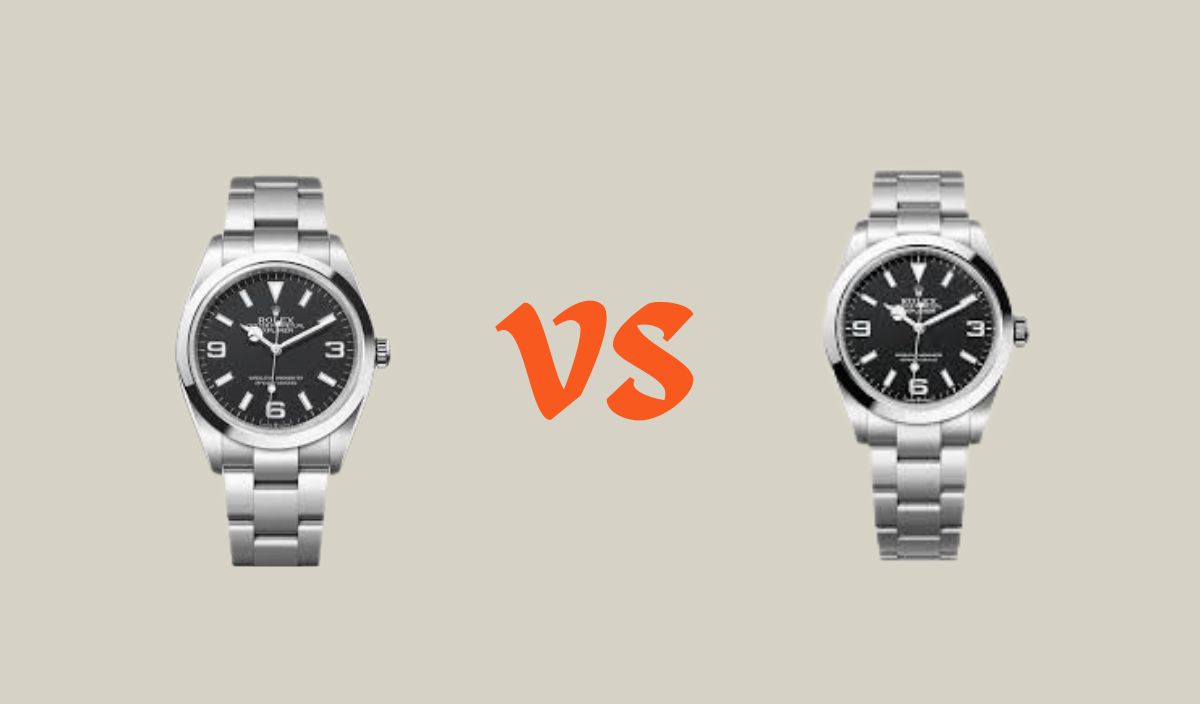
rolex explorer 36 vs 40

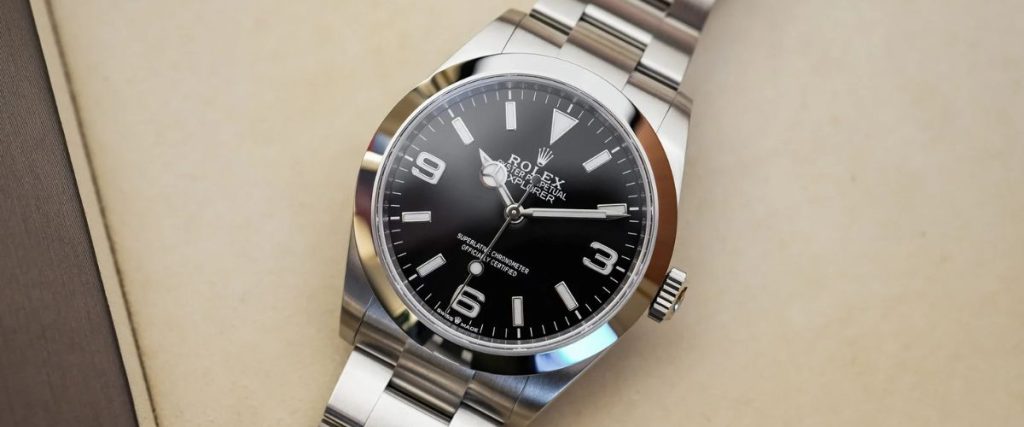
The Rolex Explorer is one of those rare timepieces that manages to blend history, adventure, and sheer practicality into a single, understated package. Born in the 1950s and famously tied to the golden age of mountaineering, it’s become a staple of Rolex’s lineup for good reason.

The Explorer isn’t oversized like some of its sporty siblings or overly dressy that it feels too flashy, and that’s precisely its charm. It’s a go-anywhere, do-anything watch that feels just as at home scaling peaks as it does slipping under a shirt cuff at a dinner party. 

bot-only-imagebot-only-image

For decades, the Explorer has epitomized the idea of a “tool watch”, something built to be functional first, stylish second. And while the design has remained remarkably consistent over the years, Rolex has introduced subtle changes that make choosing the right model surprisingly tricky.

Case in point: the Explorer 36 and Explorer 40. On the surface, they might seem nearly identical, but the differences are there, and they matter, whether it’s about fit, proportions, or the case materials on offer.

A Bit of Background on the Rolex Explorer

The Rolex Explorer has one of the coolest origin stories in the world of watches. Back in 1953, Rolex supplied their Oyster Perpetual watches to the British Mount Everest Expedition, led by John Hunt.

And these weren’t just marketing props. Rolex genuinely wanted to see how their watches held up in extreme conditions. So, on May 29, 1953, Edmund Hillary and Tenzing Norgay made history by reaching the summit, and with them, the Rolex Explorer became part of the story. 

By the end of the year, Rolex introduced the Explorer as a tribute to that achievement. It wasn’t flashy or ornamental but built to be practical, robust, and readable.

The watch was designed to handle just about anything, with a waterproof Oyster case, a self-winding movement, and a simple yet effective black dial with luminous markers. It was a watch, not for showing off, but for getting the job done, whether that job was conquering Everest or navigating general everyday adventures. 

Over the years, the Explorer has remained consistent, which is part of its appeal. It’s always been made with stainless steel, always featured that iconic 3-6-9 dial, and has always been focused on function over form.

References like the 1016, which had a three-decade run starting in the late ‘50s, became benchmarks for what a tool watch should be: tough, reliable, and timeless. 

The Explorer has evolved gradually. You got sapphire crystal with the ref. 14270 in the ‘80s, a move to modern movements with the ref. 114270 in the early 2000s, and then, in 2010, the size jumped to 39mm with the ref. 214270.

That last change was divisive at first as some felt the proportions were off, especially with the short hands on the earlier versions. Rolex fixed it in 2016 with longer hands and better lume, but the jump to a larger case showed how even the Explorer couldn’t escape the industry’s trend toward bigger watches.

And of course, that was made even more clear with the launch of the Rolex Explorer 40 in 2023, which inevitably replaced the slightly smaller 39mm reference. 

What’s amazing about the Explorer is how it’s managed to stay relevant for so long without losing its essence.

Rolex doesn’t mess around with this watch; it’s not like the Submariner or GMT-Master, which come in a dozen variations. The Explorer is straightforward and singular, and that’s what makes it so compelling. It’s a watch that doesn’t need hundreds of variations to stand out; it’s brilliant as is. 

But that said, although the Rolex Explorer collection is limited in its options, there are still options. Two are the Explorer 36 and the Explorer 40. These two references have a lot in common, but they also offer subtle yet significant differences in size, proportions, and case materials. Choosing between them might seem straightforward, but the details are what make all the difference.

The Rolex Explorer 36

Rolex Explorer 36

The Rolex Explorer 36 has a kind of quiet confidence about it. At 36mm, it’s not trying to be big or bold—it just knows what it is. And that’s part of what makes it so special.

This is the size that Rolex had in mind when the Explorer first launched back in 1953, celebrating the legendary Everest ascent by Hillary and Norgay. It’s not oversized, not undersized, just right for what the Explorer was designed to be: a reliable, legible tool watch for adventures.

When Rolex reintroduced the 36mm Explorer in 2021 with the ref. 124270, it felt like coming home. After years of experimenting with larger case sizes, they went back to the dimensions that made the Explorer an icon in the first place.

They also packed the model with some new technology too. The Caliber 3230 remains one of Rolex’s newer in-house movements, offering a 70-hour power reserve, enhanced accuracy, and magnetic resistance.

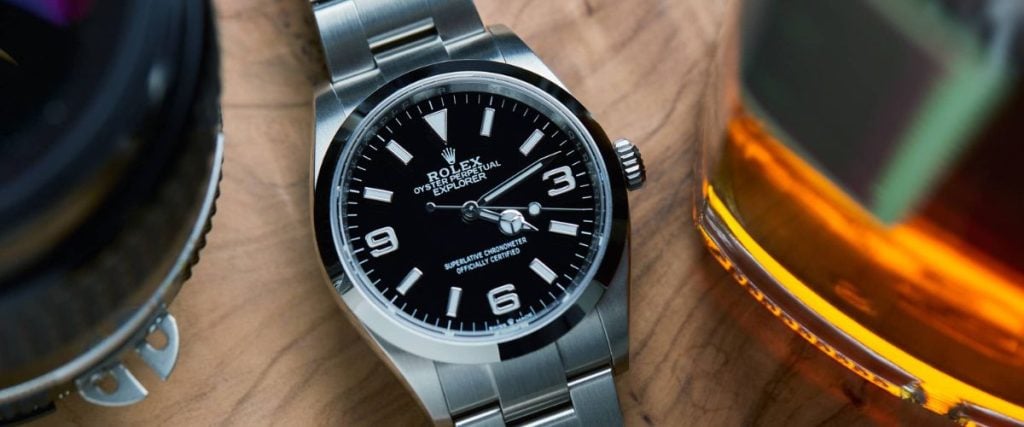
The 36mm model is exactly what you’d expect from an Explorer. It’s clean and purposeful and comes with a black lacquered dial, luminous hands, and those unmistakable 3, 6, and 9 numerals. The lume is Rolex’s proprietary Chromalight, which glows blue in the dark and stays visible for hours.

One of the most standout differences of the Explorer 36 compared to the Explorer 40 is reference 124273 which delivers the tool watch with a two-toned construction.

It pairs the steel case with a Rolesor gold bezel, winding crown and centre bracelet links. It adds a little bit of something different to the Explorer collection, still delivering a rugged tool watch but one with a more luxurious and elegant finish.

The Rolex Explorer 40

Rolex Explorer 40 History

The Rolex Explorer 40 is basically the bigger sibling of the Explorer 36. We’ve already discussed the Explorer 36 above so truthfully, you already know most of what the 40 has to offer because, aside from its size, it’s almost identical.

Let’s start with what’s the same, which is, honestly, just about everything. Like the 36, the Explorer 40 has a durable Oystersteel case made from a solid block of corrosion-resistant steel, designed to take whatever life throws at it.

It’s waterproof to 100 meters thanks to the screw-down case back and the Twinlock crown, and its sapphire crystal keeps the black lacquered dial perfectly protected.

That dial also has the same clean, purposeful design as the 36 with those iconic 3, 6, and 9 numerals, the inverted triangle at 12 o’clock, and baton-style hour markers, all coated in Rolex’s Chromalight lume for excellent readability in the dark.

Inside, it’s powered by the same movement, the Caliber 3230, which has become a Rolex staple. It’s a workhorse of an automatic movement, featuring the brand’s patented Chronergy escapement for efficiency, a Parachrom hairspring for magnetic resistance, and a 70-hour power reserve.

You’re getting the same precision and reliability you’d expect from a Rolex, tested to a rate of +2to -2 seconds per day which is well beyond the usual chronometer standards.

But here’s where the Explorer 40 takes its own path: the size. At 40mm wide and 11.6mm tall, it’s noticeably larger than the 36mm Explorer. And while the thickness is nearly identical—just 0.1mm taller—the extra width makes a real difference on the wrist. It has more presence, feeling a bit bolder without losing the Explorer’s signature understatement. If you’ve got a larger wrist or just prefer something with a bit more heft, the Explorer 40 will probably feel more balanced for you.

One other key difference is that unlike the Explorer 36, which is also available in a two-tone Rolesor gold and steel version, the Explorer 40 sticks exclusively to stainless steel, or at least for now. That simplicity keeps it in line with the Explorer’s rugged, no-frills heritage, though it might leave some wishing for more options.

Rolex Explorer 36 vs 40 – How to Choose

When it comes to choosing between the Rolex Explorer 36 and the Explorer 40, the key differences boil down to size and metal options. The two watches are nearly identical in design and features, so the choice really depends on how you want the watch to wear and what kind of vibe you’re going for.

The Size

The Explorer 36, as the name suggests, measures 36mm across, while the Explorer 40 bumps that up to 40mm. The difference might not sound massive on paper, but it’s very noticeable on the wrist. The 36mm size is the classic Explorer size, matching the proportions of the original 1953 model that accompanied mountaineers to the summit of Everest.

It has that vintage-inspired feel and is compact enough to work for a wide range of wrist sizes. In fact, it’s one of those rare Rolex watches that easily suits both men and women.

The Explorer 40, on the other hand, is a bit more of a modern take on the tool watch with its larger size. It measures to 40mm wide and 11.6mm thick so it has a much bigger presence and will better suit larger wrists.

If you’ve got a bigger frame or simply prefer watches that feel more substantial, the 40mm will likely feel better balanced. But if your wrist is on the smaller side, the 40 might come across as oversized and thus feel a little less versatile.

The Metal Options

As for design options, the Rolex Explorer collection is, and probably always will be, a little restrictive. It’s part of the collection’s charm. But for those that want at least a little bit of choice, the Rolex Explorer 36 is available in two versions: classic stainless steel (what Rolex calls Oystersteel) or a two-tone mix of steel and yellow gold (which Rolex refers to as “Rolesor”).

That Rolesor version adds an 18k yellow gold bezel, crown, and centre bracelet links, giving the Explorer a dressier, more luxurious feel. The Explorer 40, however, is currently only offered in stainless steel. That keeps it in line with the Explorer’s rugged, tool-watch roots and gives it a cleaner, sportier look.

Which Rolex Explorer Is Right For You?

If you’re leaning toward the Rolex Explorer 36, you’re probably someone who values tradition and versatility. Its smaller size and two-tone Rolesor option make it a great pick for those who want something that can easily transition from casual to dressy, and it’s a natural fit for smaller or average-sized wrists.

Plus, that 36mm size works equally well for both men and women, making it one of Rolex’s best unisex options.

The Explorer 40, on the other hand, is for those who like their watches a little bigger and bolder. It’s a sportier choice that’s perfect for larger wrists or for anyone who wants a watch that feels a bit more modern. Without the gold accents, it leans more utilitarian, making it ideal for someone who’s after the pure Explorer DNA without any frills.

Conclusion

At the end of the day, choosing between the Rolex Explorer 36 and Explorer 40 is less about one being better than the other and more about finding the one that feels right for you.

Both watches deliver the same legendary craftsmanship, robust Oystersteel construction, and timeless Explorer design. They’re even powered by the same reliable Caliber 3230 movement and offer that clean, versatile aesthetic that’s been a hallmark of the Explorer since its debut in 1953.

The decision really comes down to size and style. If you want a watch that feels more traditional, with compact proportions that work equally well on smaller wrists or for those looking for a subtle, dressier option, the 36mm model is hard to beat.

If, on the other hand, you prefer something with a bit more wrist presence, a modern edge, and a sportier vibe, the Explorer 40 offers all of that without compromising the Explorer’s original stainless steel heritage.

Ultimately, whichever model you choose, you’re getting a watch that’s brilliantly engineered for the everyday. It’s built to withstand a lifetime of adventures, whether that’s scaling mountains or navigating the everyday. You really can’t go wrong.

rolex submariner review

Few watches have achieved the status of the Rolex Submariner. If you think of a dive watch, this is the one that pops into your head. It’s the blueprint countless other brands have followed, and even today, many consider it the gold standard of the category.

Its design is instantly recognizable, its reputation is nearly untouchable, and thanks to a little help from James Bond, it has a pop culture presence that most watches can only dream of.

bot-only-imagebot-only-image

But the Rolex Submariner is not a cheap watch, nor is it easy to get hold of – at least, brand new. Yet, despite that, it remains one of the most talked-about dive watches ever. I’d say it’s the one watch I get asked about more than any other.

The questions are usually something like: “What’s the best affordable alternative to the Rolex Submariner?” or “Is the Rolex Submariner actually worth it?”

If you’re on a tight budget, the Rolex Submariner probably isn’t for you. But if you’ve got some cash to spare and you’re after a durable, stylish, and premium dive watch, then you’re probably wondering if the Rolex Submariner is your best option.

If so, you’ve come to the right place because in this article, I’ll be reviewing the entire Rolex Submariner collection to find out if this is still the dive watch to beat.

A Quick History of the Rolex Submariner

Rolex Submariner History

Rolex was already making waves in water-resistant watches long before the Submariner was born. Back in 1926, Rolex introduced the Oyster case, a design still used today, which is an innovative, hermetically sealed case design that keeps water out from the components working hard inside. 

To prove its effectiveness, Rolex strapped an Oyster watch onto the wrist of British swimmer Mercedes Gleitze during her attempt to swim the English Channel.

The watch survived the icy waters and emerged unscathed, giving Rolex an incredible marketing story that set the foundation for its reputation for durability and water resistance.

Over the next few decades, Rolex continued pushing the limits of waterproof technology, even attaching prototype watches to deep-sea submersibles to test their endurance at extreme depths. This obsession with performance eventually led to the creation of one of the most important dive watches of all time.

By the early 1950s, recreational diving was growing in popularity, thanks to innovations like Jacques Cousteau’s Aqua-Lung. Divers needed a reliable way to track their time underwater, and Rolex saw an opportunity. In 1953, they released the first-ever Rolex Submariner, reference 6204, boasting an unheard-of 100-meter water resistance.

This watch set the template for everything we associate with dive watches today. It came with a rotating bezel adorned with a 60-minute scale, high-contrast luminous markers, and a robust stainless steel case.

Not long after, Rolex upped the ante and improved the Submariner’s water resistance to 200 meters and introduced the now-iconic “Mercedes” hands for better legibility. The Submariner was quickly proving itself as the ultimate tool watch for divers.

Then, in 1962, something happened that would catapult the Rolex Submariner into mainstream culture: it landed on the wrist of none other than James Bond.

Sean Connery famously wore a Submariner 6538 in Dr. No, and just like that, the Submariner wasn’t just a tool for divers anymore but a symbol of adventure, sophistication, and style. 

While Rolex kept refining the Submariner with technological upgrades like a stronger case and better lume, its newfound Hollywood status meant it was now appealing to a much broader audience. The Rolex Sub became no longer just about function but a statement piece, a watch associated with success and prestige.

By the 1970s, Rolex had introduced a version of the Submariner with a date function and a “Cyclops” magnifier over the date window, a feature that remains divisive among purists to this day.

Water resistance was improved to 300 meters in the late ‘80s, and by the 2000s, Rolex was incorporating high-tech materials like ceramic bezels and Parachrom hairsprings for even greater durability and precision.

Despite all these advancements, one thing has remained constant, and that’s that the Submariner has never strayed far from its original design. That’s part of its magic.

A modern Submariner still looks unmistakably like the watch that debuted in the ‘50s, and to me, that’s a simple testament to how perfect the original formula was.

With nearly 70 years of history behind it, the Rolex Submariner remains one of the most desirable watches in the world. But with so many alternatives available today, including ones that are just a fraction of the price, is it still the best dive watch you can buy?

The Case

The Rolex Submariner’s case is one of the most meticulously engineered components of this legendary dive watch. As its history attests, it’s been designed to withstand the demands of deep-sea exploration and yet still maintain the elegance and refinement expected of a Rolex (and James Bond).

As of March 2025, the Submariner collection consists of eight core models, all featuring a 41mm case size and available in a selection of materials, including Oystersteel, Rolesor (a combination of steel and gold), and solid 18ct yellow gold. 

Each model is paired with either a black, blue, or green Cerachrom bezel, offering a variety of aesthetic choices while maintaining the fundamental essence of the Submariner’s DNA.

The most notable point of interest is Rolex’s Oyster case design, which has been at the forefront of waterproof watch technology since 1926. In the Submariner, this has been pushed to a water resistance of up to 300 meters or 1,000 feet, something that is cleverly achieved through an expertly crafted monobloc middle case, formed from a solid piece of Oystersteel. 

This material alone deserves an entire blog, but in short, it’s an advanced alloy that belongs to the 904L steel family. It boasts exceptional corrosion resistance and a wonderful polished appearance even under the harshest conditions.

In addition to the steel models, the Rolex Submariner is also available in luxurious solid 18ct yellow gold, 18ct white gold, and Rolesor, which harmoniously blends the robustness of steel with the luster of gold. The gold used in these models is produced entirely in Rolex’s own foundry to ensure high levels of quality and a distinctive, rich radiance.

Another key feature of the Rolex Submariner’s design is its Triplock winding crown, which plays a crucial role in ensuring the watch’s water resistance. Introduced in 1970, this system incorporates three separate waterproof zones that protect the movement from moisture and external elements. 

The crown screws down securely against the case, forming an impenetrable seal that can withstand the pressures of deep-sea diving.

Additionally, the Submariner’s case features crown guards that are integrated into the middle case to protect the winding crown from impact. This design not only enhances durability but also contributes to the watch’s distinctive profile.

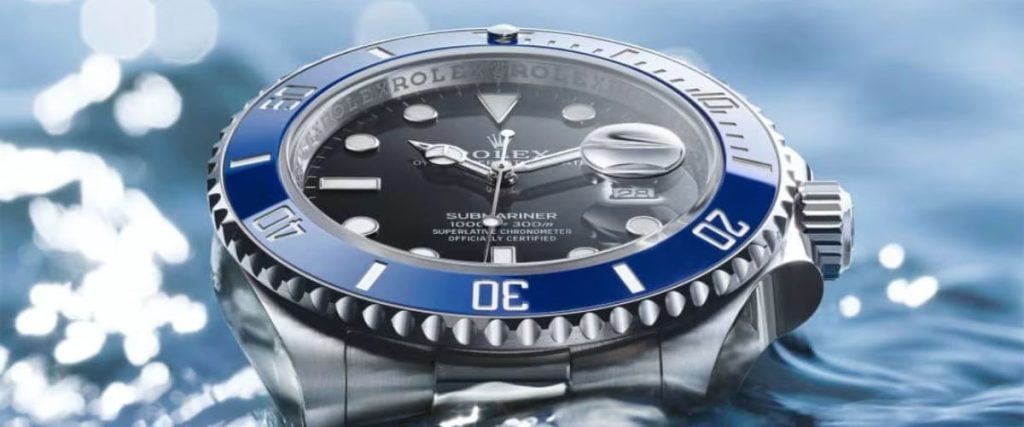
The unidirectional rotatable bezel is another hallmark, providing divers with an essential tool for tracking immersion time. Each one is crafted from Rolex’s proprietary Cerachrom, a high-tech ceramic material that ensures the bezel insert is virtually scratchproof and impervious to fading from UV exposure. 

The engraved 60-minute graduations are coated with platinum or gold via Physical Vapour Deposition (PVD) to ensure visibility and longevity, and the bezel’s notched edge allows for an easy grip.

Within the current collection, each of the eight Rolex Submariner models offers a slightly different take on the iconic design.

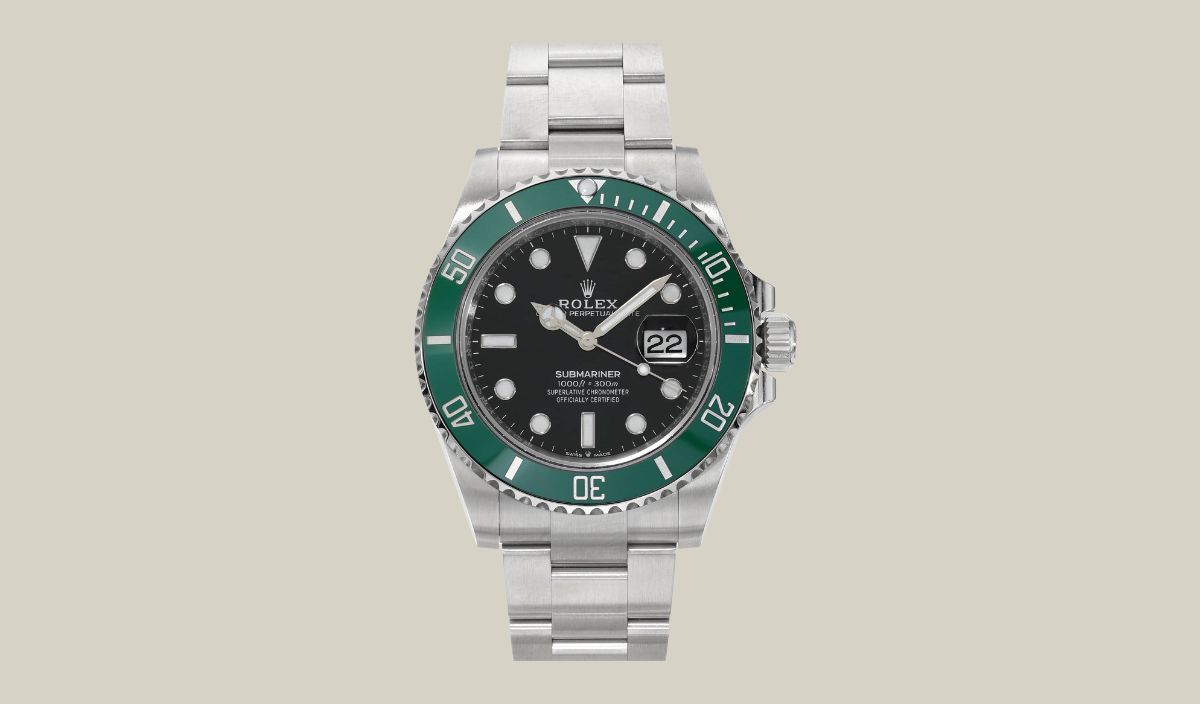
The all-steel Submariner models include the reference 124060, a classic no-date variant with a black dial and black bezel, as well as the 126610LN, which features a date function while maintaining the same colour scheme. 

The reference 126610LV brings a bold twist, pairing a black dial with a vibrant green bezel, which is a nod to the “Kermit” Submariner of the past.

For those seeking a combination of steel and gold, the Rolesor models are an elegant alternative. The reference 126613LB presents a striking blue dial with a matching blue bezel, while the 126613LN opts for a more traditional black-on-black aesthetic accented by 18ct yellow gold.

In the solid gold category, the Submariner is available in 18ct yellow gold with two variations: the reference 126618LB, which features a rich blue dial and bezel, and the 126618LN, which offers a sleek black dial and bezel combination.

Finally, for those who prefer the exclusivity of white gold, the reference 126619LB pairs a black dial with a contrasting blue bezel.

The Dial

The Rolex Submariner dial is all about function. Everything on it serves a purpose, and that purpose is predominantly readability, whether you’re deep underwater or just glancing at your wrist in everyday life. It’s simple, straightforward, and very Rolex.

A big part of what makes it so easy to read is the Chromalight display. Rolex’s proprietary luminescent material glows an intense blue in the dark, giving divers a clear view of the time no matter the lighting conditions. In daylight, it’s a bright white that stands out crisply against the dial.

Applied to the hands, hour markers, and the little triangle at the zero position on the bezel, Chromalight ensures everything you need to see is visible at a glance.

Speaking of hour markers, they follow the same design Rolex has used on its dive watches for decades. Again, they are simple, formed in geometric shapes of circles, rectangles, and a triangle at 12 o’clock. The reason for this is to make reading the time quick and intuitive.

The markers are all outlined in white gold to prevent tarnishing and to help keep the watch looking sharp for years.

Then there are the Mercedes hands, which is another signature Rolex detail. The hour hand has a distinctive circular section near its tip, which does look a bit like the Mercedes-Benz logo, though that’s probably just a coincidence.

More importantly, it provides plenty of space for lume, making it easy to differentiate from the long, sword-like minute hand. The seconds hand also has its own luminous dot.

Rolex switched to glossy dials in the mid-1980s, and that’s what you’ll find on all current Submariner models.

The deep black or rich blue finish gives the dial a luxurious, almost liquid-like appearance, adding a bit of refinement to what is, at its core, a serious tool watch. It also contrasts nicely with the white text and markers, ensuring the dial remains highly legible.

Finally, one other small but interesting distinction in the lineup is the presence (or absence) of a date function. Most modern Submariners come with a date window at 3 o’clock, complete with the signature Cyclops magnifying lens. 

But if you want the cleanest, most traditional look, there is a single reference 124060 with no date or magnifying glass. It’s the purist’s choice, and it sticks closely to the original Submariner formula from the 1950s.

The Movement

Inside the Rolex Submariner ticks the in-house Caliber 3235. It’s an automatic winding movement that essentially matches the design DNA of the case and dial: it can handle demanding conditions.

One of its most notable features is the Chronergy escapement. Rolex reworked this critical component to be 15% more efficient back in 2015, thanks to thinner pallet stones and a double escape wheel with specially cut teeth. 

Made from nickel-phosphorus, it’s also highly resistant to magnetic fields, which is increasingly important in a world filled with electronic devices that can interfere with mechanical movements.

Another key feature is the power reserve. By using a nice long mainspring housed in a barrel with thinner walls, Rolex has equipped the Submariner with a power reserve of 70 hours. That means you can take the watch off for an entire weekend and come back to it on Monday without needing to reset the time. 

The movement also features Rolex’s Paraflex shock absorbers for improved durability, along with a blue Parachrom hairspring, which is both highly resistant to shocks and unaffected by temperature changes.

Finally, we can’t forget the accuracy. Like so many of Rolex’s watches, the Submariner is a Superlative Chronometer. This means it meets Rolex’s stringent precision standards, which go beyond the official COSC certification (which is already impressive enough).

COSC allows for a deviation of -4/+6 seconds per day, while Rolex tightens this to an impressive -2 to +2 seconds per day after casing.

The Strap

The Submariner wouldn’t be the same without its robust and functional Oyster bracelet. It’s a design that has been a Rolex staple for more than seven decades, evolving over the years while always maintaining its signature three-piece link structure. 

Originally inspired by the Bonklip-style bracelets of the 1930s and 1940s, Rolex officially patented the Oyster bracelet in 1947, and it has been a defining feature of the brand’s sports watches ever since.

Today’s Submariner bracelet is refined and durable, featuring solid links that give it a reassuring weight and feel on the wrist. But function is just as important as form.

Rolex equips the Submariner’s bracelet with an Oysterlock clasp to prevent accidental opening, ensuring that the watch stays securely fastened no matter the situation you’re in.

There’s also the Glidelock extension system, which is a clever innovation that allows for micro-adjustments in 2mm increments, up to 20mm in total.

No tools are needed, so it’s incredibly useful for those that find themselves needing to make adjustments on the go, whether it’s to expand it when you get hot or placing it over a wetsuit.

On-Wrist Experience

Rolex Submariner On-wrist experience

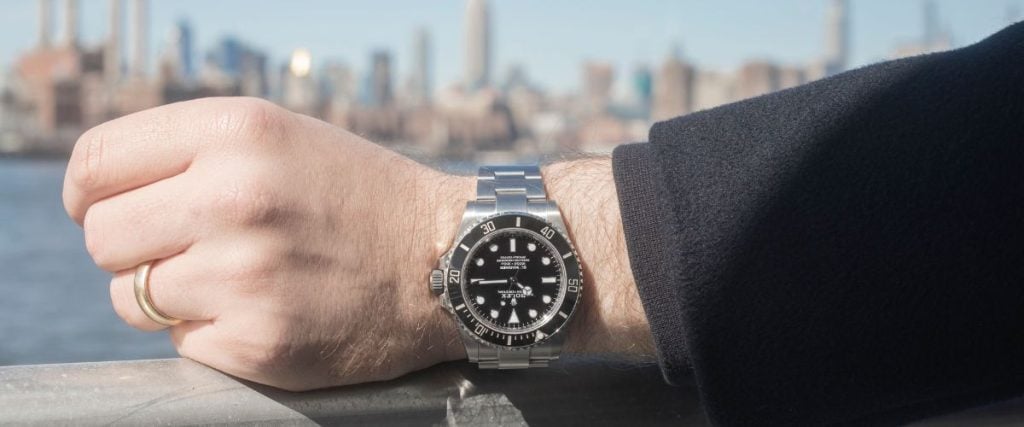
On the wrist, the Rolex Submariner strikes an impressive balance between presence and comfort. With a 41mm case diameter and a thickness of 12.5mm, it has enough heft to feel substantial but isn’t overbearing in any way. 

In Oystersteel, Rolesor, or solid 18k gold, the watch carries a reassuring weight, and it’s a nice reminder that this is a serious tool watch that will live up to its durable reputation.

I have no doubt some will find it heavier than other luxury watches, but that’s part of its appeal. It feels strong and solid, which is what you want in a watch like this.

Despite its robustness, the Submariner is still incredibly comfortable. The way the case curves down and the smooth transition to the Oyster bracelet means it sits well on a variety of wrist sizes, typically best suited for those with wrists around 6.5 inches and up.

Price & Availability

So, how much does the Rolex Submariner cost? As of March 2025, the diver’s model starts at $9,200 for the no-date version (Ref. 12406), and from there, prices rise as you add the date complication and precious metals.

The Submariner Date in Oystersteel costs $10,250, while two-tone Rolesor models push the price higher. If you’re after a full 18k gold version, be prepared to spend well over $40,000.

Availability, however, is another story. Like most Rolex models, the Submariner is notoriously difficult to buy new. Waiting lists at authorized dealers are long, with some people waiting for years just to get the call. Because of this, many are understandably turning to the pre-owned market.

Pre-owned prices tend to sit between $12,000 and $15,000, depending on condition, age, and model. That’s more than retail, but it’s the reality of buying Rolex in today’s market. 

The Submariner is one of those rare watches that not only holds its value but often appreciates over time. If you’re not set on buying brand new, it’s worth checking out reputable pre-owned specialists like Exquisite Timepieces to explore your options.

Conclusion

If you were going to ask me, then yes, I do think the Rolex Submariner is still the one dive watch to beat. Sure, there are plenty of fantastic alternatives out there, some cheaper, some easier to buy, but none quite have the same set of specs, heritage, and legacy as the Submariner.

After all these years, the Submariner still feels worth it. It’s a watch you’ll never regret owning, one that collectors keep coming back to, and one that will still look just as good decades from now. Is it the only dive watch that matters? Of course not. But is it one of the best? Yeah, I’d say so.

rolex explorer 2 review

Is the Rolex Explorer 2 Worth the Hype?

Charlotte H

April 29, 2025

The Rolex Explorer 2 is one of those watches that has a cult following, and for good reason. It’s rugged and instantly recognisable, carrying that unmistakable Rolex DNA.

It was originally designed in 1971 for spelunkers (that’s just a fancy word for cave explorers), with the intention of helping adventurers distinguish between day and night in total darkness. But let’s be real, most people you’ve spotted wearing it have never once set foot in a deep underground cave.

bot-only-imagebot-only-image

That’s because over the years, the Rolex Explorer II has evolved from a niche tool watch into something much bigger. With its bold 24-hour bezel, independent GMT hand, and no-nonsense steel construction, it’s now a go-to choice for travelers, collectors, and basically anyone who just appreciates a cool, solid timepiece.

But after all these years, is the Rolex Explorer 2 still worth the hype? Is it well and truly a watch deserving of adventuring or is it just another luxury sports watch riding on its own legend?

A Quick History of the Rolex Explorer

Rolex Explorer 2 History

The Rolex Explorer is one of the brand’s most understated models in my opinion. It’s not quite as well known as the Rolex Submariner with its rotating diver’s bezel or the  chronograph-equipped Daytona. It’s also not quite as timeless as the Rolex Day-Date.

That’s because it’s built for one thing: adventure. But while it may be one of Rolex’s simplest designs, it carries a history that’s anything but ordinary.

The Rolex Explorer was officially introduced in 1953, the same year Sir Edmund Hillary and Tenzing Norgay became the first climbers to reach the summit of Mount Everest. Rolex had already been testing its watches in extreme conditions, including on previous Everest expeditions, and the Explorer was born from those experiences.

Built for durability, legibility, and reliability, it featured a clean black dial, high-contrast numerals at 3, 6, and 9, and a robust steel case designed to handle whatever the elements threw at it.

Over the years, the Rolex Explorer became the ultimate “go anywhere, do anything” watch. It was simple, reliable, and versatile enough to be worn from the mountains to the boardroom.

The reference 1016, produced from 1960 to 1989, remains one of the most beloved Explorers of all time, known for its timeless design and impressive longevity.

Even as Rolex introduced new variations, including a brief move to a 39mm case in 2010, the Explorer has largely stuck to its roots, staying true to its original purpose as a rugged, no-frills tool watch.

Then, in 1971, Rolex expanded the Explorer lineup with a brand-new model suitably named the Explorer 2. While it shared the same spirit as the original, it was designed for a different kind of adventurer, spelunkers, or cave explorers, who needed a way to distinguish between day and night in total darkness.

The Rolex Explorer II featured a fixed 24-hour bezel and an extra orange-tipped hour hand, originally functioning as an AM/PM indicator. Over time, it evolved to include independent GMT functionality, making it a popular choice for travelers as well.

Today, the Rolex Explorer and Rolex Explorer 2 continue to be staples in the brand’s lineup. They’re not as flashy as a Day-Date or as hyped as a Submariner, but that’s exactly what makes them special.

Built for adventure yet understated enough for everyday wear, they appeal to those who appreciate rugged functionality without the need for excess attention. Now without further ado, let’s get up close and personal with the Rolex Explorer II and see if it truly lives up to its status…

The Case

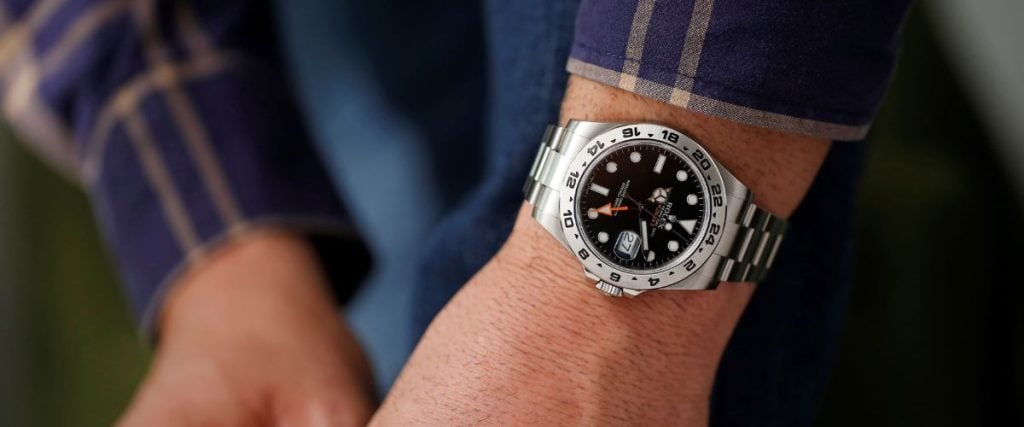
One of the defining features of the Rolex Explorer II is its robust and no-nonsense case. At 42mm in diameter, it’s on the larger side for a Rolex sports model, but that added wrist presence makes sense given the watch’s tool-watch DNA. It’s built to be legible, durable, and ready for adventure, whether you’re actually exploring caves or just navigating your daily routine.

Crafted from Rolex’s proprietary Oystersteel (a 904L stainless steel alloy), the case is highly corrosion-resistant and maintains its polished sheen even under harsh conditions.

Rolex originally introduced 904L steel in the 1980s, borrowing the material from aerospace and chemical industries where extreme durability is a necessity. In real-world use, that means the Explorer II can handle almost anything, whether it’s saltwater, sweat, or the occasional scrape without losing its luster.

The case follows Rolex’s classic Oyster architecture, which means a monobloc middle case, a screw-down case back, and a screw-down Twinlock crown to ensure a water resistance rating of 100 meters.

That may not be as deep as a Submariner, but for a watch designed primarily for land-based adventure, it’s more than enough. The Twinlock system provides a secure seal against moisture and dust, and unlike the chunkier Triplock crown on the Submariner and GMT-Master II, the Rolex Explorer II’s crown is slightly smaller and more integrated into the case design. The crown guards also follow Rolex’s recent design tweaks, appearing more angled and streamlined compared to previous versions.

Then there’s the bezel which is arguably one of the most recognizable features of the Rolex Explorer 2. Unlike the ceramic bezels found on many modern Rolex sports models, the Explorer II sticks with its traditional brushed stainless steel bezel, engraved with a black-filled 24-hour scale.

Some collectors speculated that Rolex might introduce a ceramic version with some of their newest references, but in keeping with tradition, they wisely stuck to the brushed steel.

On the wrist, the case has a commanding yet balanced feel. The mostly brushed finish gives it a utilitarian appearance, but the polished sides of the case add just the right amount of refinement.

Rolex also adjusted the proportions slightly in recent years by widening the bracelet and slimming the inner edges of the lugs. While these tweaks are subtle, they help improve the overall balance and wearability of the watch, making it feel more proportionate despite its 42mm size.

Topping it all off is a sapphire crystal with Rolex’s signature Cyclops lens over the date. While Rolex historically avoided heavy anti-reflective coatings, recent models feature improved inner-surface coatings to reduce glare and improve legibility.

Combined with the bright, high-contrast dial and large markers, the Rolex Explorer II remains one of the most readable Rolex watches in any lighting condition.

The Dial

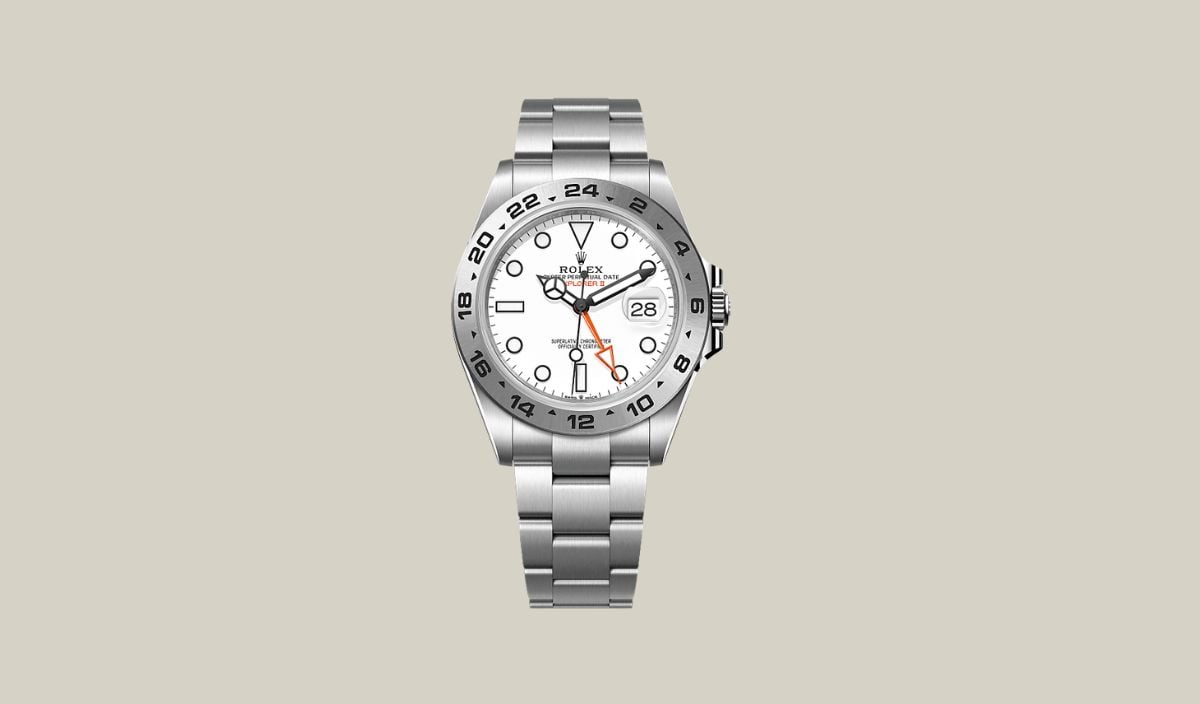
Speaking of legibility, the dial of the Rolex Explorer 2 is designed with absolute clarity in mind. Whether you opt for the classic black display or the striking white “Polar” dial, readability is exceptional as you’d expect.

Each dial comes with bold geometric hour markers which include a mix of triangles, circles, and rectangles so legibility is instant. The high-contrast design of the Polar dial is particularly impressive with the stark white background offset by deep matte black markers and hands, a combination rarely seen in Rolex’s lineup.

The black dial version, by contrast, uses polished white gold markers and hands filled with Rolex’s proprietary Chromalight luminescent material, giving it a more traditional but equally effective look.

Another defining feature of the Rolex Explorer 2 is its bold orange GMT hand, a nod to the original 1971 reference 1655. Unlike the modern GMT-Master II, which features a rotating bezel for tracking a second time zone, the Explorer II uses a fixed, 24-hour-engraved steel bezel.

This means the GMT hand is primarily intended as an AM/PM indicator for those operating in environments where day and night distinctions are blurred. That being said, the GMT hand can still be used to track a second time zone, making the Explorer 2 an equally functional travel companion.

Of course, no Rolex sports model would be complete without the brand’s signature Cyclops lens over the date window at 3 o’clock. The magnification makes the date easier to read, once again adding to the dial’s reputation for legibility.

Finally, the dial is completed by some simple lettering for the EXPLORER II logo at 12 o’clock, printed in orange to match the GMT hand, and markings for the Superlative Chronometer certified movement at 6 o’clock.

The Movement

The Rolex Explorer II runs on the caliber 3285, the same movement found in the GMT-Master II. If that sounds like Rolex cutting corners, it’s not. The 3285 is a thoroughly modern movement built to handle both everyday wear and the kind of punishment you’d expect from a watch

designed for explorers. It’s chronometer-certified, accurate to within +2/-2 seconds per day, and packs a 70-hour power reserve which is more than enough to keep ticking through a weekend off the wrist.

Where the Explorer 2 diverges from the GMT-Master II is in how it uses its 24-hour hand. Since the bezel is fixed, this isn’t a watch designed to juggle three time zones at once. Instead, it stays true to its roots by helping the wearer distinguish day from night in environments where the sun isn’t a reliable indicator.

The independently adjustable local hour hand still makes it a useful travel companion, but it’s clear that Rolex intends this watch for those who need a rugged, no-nonsense tool rather than a jet-setter’s accessory.

Functionally, it’s as practical as it gets. The hacking seconds function allows for precise time setting, and the quick-set local hour hand makes adjusting for time zones a breeze.

The date mechanism, which as mentioned is viewed through the Cyclops lens, jumps instantly at midnight, rather than creeping forward. These are small details, but ones that Rolex gets right.

The Strap

The strap for the Rolex Explorer 2 is exactly what you’d expect. It’s a solid three-row link 904L stainless steel Oyster bracelet that is durable, comfortable, and secure.

It comes with a handsome brushed finish that matches the rugged, tool-watch aesthetic of the case. There’s no polished center link here either, just a utilitarian design that feels every bit as refined as it does functional.

The bracelet is secured with Rolex’s Oysterlock folding safety clasp, designed to prevent accidental opening. It’s a small but critical feature, especially for those who intend to put the watch through its paces in unpredictable conditions.

And because comfort is just as important as security, Rolex has included the Easylink extension system, allowing for a quick 5mm adjustment without the need for tools.

The integration between case and bracelet is seamless, with solid end links that flow perfectly into the lugs. Rolex has never been one to cut corners when it comes to their bracelets, and it shows here; the brushed surfaces are crisp, the taper of the bracelet feels just right, and the overall balance on the wrist is impeccable.

And while the Oyster bracelet is undoubtedly the perfect match for the Explorer 2, Rolex has given you options. With a 21mm lug width, you could swap in a rubber or leather strap if you really wanted to, but honestly, it’s hard to imagine anything looking better than the bracelet it comes with.

On-Wrist Experience

The Rolex Explorer 2 has never been a delicate watch and the models in the current collection carry that tradition forward. At 42mm in diameter and 12.5mm thick, it has a definite presence on the wrist. It’s substantial enough to feel like a proper tool watch, but not so bulky that it

becomes cumbersome. It won’t disappear under a fitted shirt cuff, but it’s still comfortable enough for all-day wear.

Thanks to the updated case proportions and subtly refined bracelet that came with the 2021 Explorer II, the watch feels well-balanced, with the weight evenly distributed across the wrist.

The fully brushed Oyster bracelet keeps things secure without sacrificing comfort, and the Easylink extension ensures a perfect fit no matter the situation.

If you have a wrist in the 6.5 to 7.5 inch range, the 42mm case will wear well, sitting broad but not overwhelming. On smaller wrists, it will lean further into its tool-watch identity, offering that decisive, adventure-ready aesthetic with an oversized look, but one that looks purposeful.  

Price & Availability

The Rolex Explorer 2 holds a prominent position in the luxury watch market and that’s mirrored in its pricing and availability. As of March 2025, the retail price for a new Explorer II stands at around $9,750. However, due to high demand and limited availability, getting one isn’t easy.

There are a lot of long waiting lists with authorised retailers, and any retailer online suggesting they have them in stock probably deserves a second look.

Because of their current allusivity, Rolex Explorer 2 watches have increased prices on the pre-owned market. Of course, prices vary depending on the condition, age and provenance, but from looking, most models are selling for around $10,000 to $12,800.

If you are going to purchase pre-owned, just be sure you’re choosing a reputable retailer like Exquisite Timepieces. We ensure all of our pre-owned Rolex watches are genuine and we’ll ensure your model comes with the box, papers and official warranty.

Conclusion

If you were to ask me, then yes, the Rolex Explorer 2 more than lives up to its reputation. Sure, it’s a luxury sports watch but it’s equally a rugged, adventure-ready timepiece with real functionality and a history to back it up. It’s clearly built to withstand the elements but also maintains Rolex’s classic design language and drive for precision.

And while it might not be as popular as the Submariner or Daytona, it’s still a staple for those who appreciate durability, reliability, and understated style.

It’s mainly a watch for people who need more than just aesthetics. Travelers will benefit from the independent GMT function, collectors will appreciate its heritage, and those who prefer a no-nonsense tool watch will find it a perfect fit.

With its 42mm case and well-balanced proportions, it offers wrist presence without unnecessary bulk, making it suitable for both rugged environments and daily wear.

Availability can be a challenge, but let’s be honest, that just adds to the Explorer 2’s appeal. Demand often exceeds supply, so that keeps both retail and pre-owned prices strong so if you’re looking at a Rolex as an investment, it might be a smart choice.

All in all, the Rolex Explorer 2 is a watch that delivers where it matters. It’s tough enough to handle real-world adventures, refined enough for everyday wear, and built with the level of craftsmanship that has made Rolex a household name.

cartier tank must small vs large

Cartier Tank Must Showdown: Small vs. Large

Charlotte H

April 28, 2025

Size matters, especially when you’re strapping on a watch as legendary as the Cartier Tank Must. And let’s be real, choosing between the Small and Large isn’t exactly easy.

On one hand, you want your watch to make an impression, so it fares to go big, right? But then you remember this is a dress watch, so the size should feel effortless, and comfortable, sitting just right without dominating your frame.

bot-only-imagebot-only-image

As someone who obsesses over watch sizes, and as a person with a relatively small wrist but a love for larger watches, I know how important it is to find the right balance. Too big, and it overwhelms your wrist but too small, and it might not give you the presence you want.

The Cartier Tank Must is all about proportions, elegance, and wearability, so choosing between the Small and Large comes down to more than just aesthetics. It’s about how it feels, how it fits, and how it complements your style. In this guide, I’ll break it all down to help you find your perfect match.

A Quick History of the Cartier Tank Must

Cartier Tank Must History

The Cartier Tank is one of the most iconic watches of all time, a design that has barely changed since its creation in 1917. Inspired by the silhouette of military tanks viewed from above, its clean lines and rectangular shape broke away from the round pocket watches of the era. The Tank was revolutionary, not just in design but also in its philosophy.

It was a watch for everyone, worn by style icons, Hollywood stars, and royalty alike. Over the decades, Cartier introduced multiple variations, but in the 1970s, a new era of the Tank was born with the Must de Cartier, otherwise known as the Tank Must.

The 1970s were a turning point for the watch industry. With the rise of quartz movements, traditional mechanical watches were facing an identity crisis.

Cartier, known for its ultra-luxurious timepieces, saw an opportunity to create something more accessible while maintaining the brand’s signature elegance. Enter the Must de Cartier collection in 1977. Unlike its solid gold predecessors, the Tank Must featured gold-plated cases and quartz movements, making it a more affordable luxury.

Minimalist yet striking, the Cartier Tank Must was a departure from the ornate detailing of other Cartier timepieces. Many of the models had no numerals and indices, just a sleek dial and the classic sword-shaped hands.

The crown, still adorned with a blue cabochon, added a touch of unexpected flair. This balance of simplicity and boldness made the Tank Must an instant hit. It was a watch that felt luxurious but wasn’t out of reach which is a rare feat in high-end watchmaking.

Fast forward to 2021 and Cartier revived the Tank Must bringing back its signature minimalist aesthetic. The colorful lacquered dials returned as did many of the no-numeral dials. To this day, the collection stays true to the original Must ethos, remaining elegant, unisex, and effortlessly wearable.

The Cartier Tank Must Small

The Cartier Tank Must actually comes in three sizes: Small, Large, and Extra Large. The Extra Large is the only model equipped with an automatic movement, so today, we’re focusing on the two quartz-powered sizes, the Small and Large models, to help you decide which one suits you best.

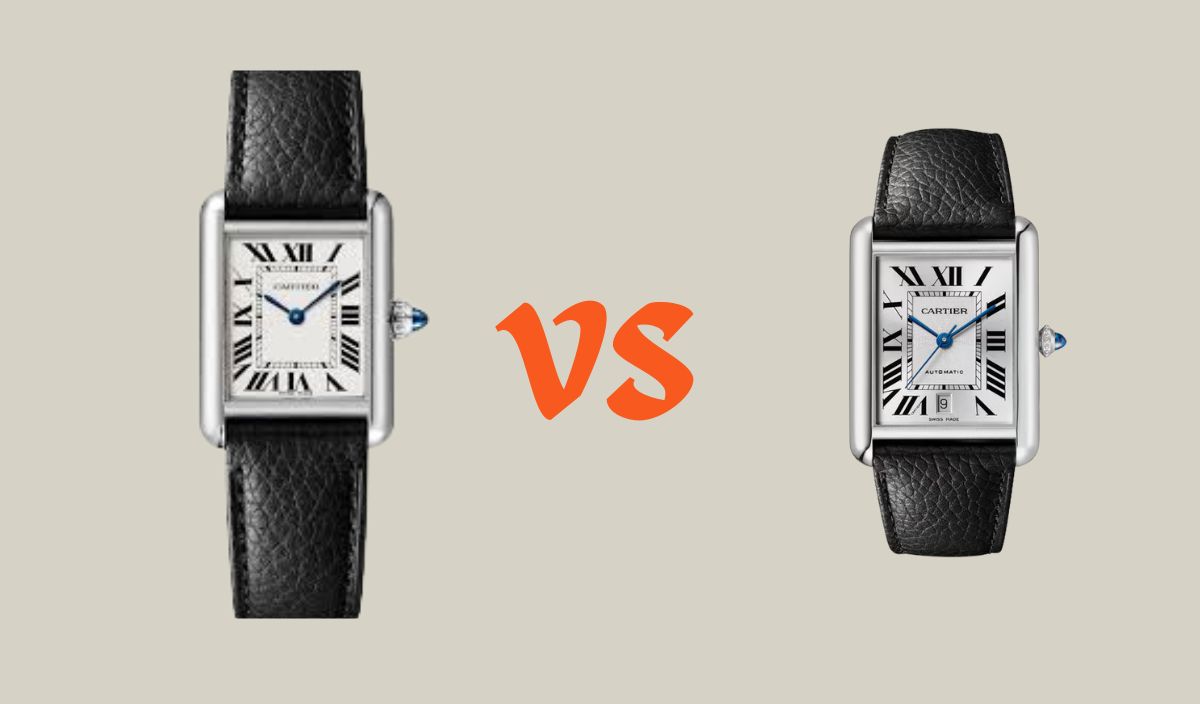
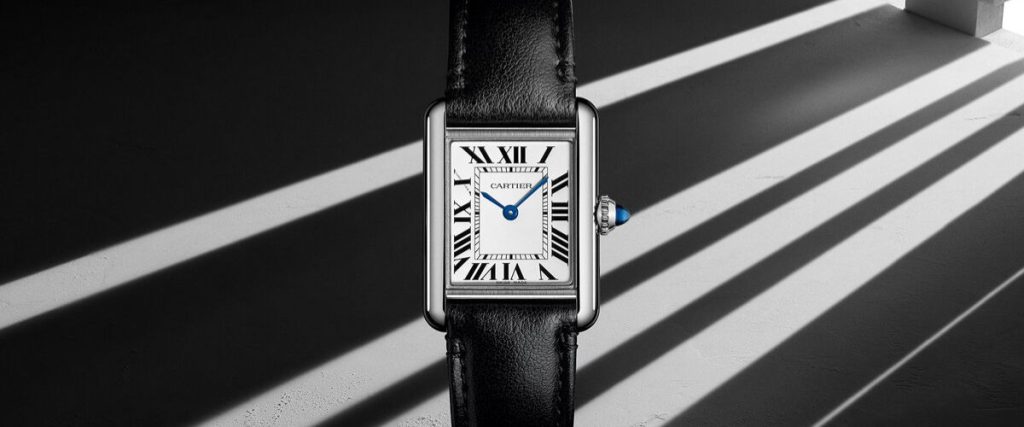
The Cartier Tank Must Small measures 29.5mm by 22mm with a slim height of 6.6mm, making it the most compact and refined of the lineup.

Each model maintains the Tank’s signature aesthetic with its slim, polished rectangular case topped with sapphire crystal glass. And of course, they all feature the brand’s hallmark blue spinel cabochon set into the crown.

As of writing this article, the modern Tank Must Small offers four different variations, all sharing the same crisp white dial with black Roman numerals, blued sword-shaped hands, and an internal railway minutes track.

The most accessible model in the collection is the classic Small Tank Must on a black leather strap, powered by a traditional Swiss quartz movement. It’s elegant, understated, and a perfect introduction to the world of Cartier.

For those looking for something a little more innovative, there’s the Small Tank Must SolarBeat™. Debuting with the modern Tank Must collection, the SolarBeat™ movement is a groundbreaking photovoltaic-powered quartz caliber that uses light to recharge, offering an impressive 16-year battery life.

This means fewer battery changes and a more sustainable way to wear a luxury timepiece. Externally, this model looks identical to its traditional quartz counterpart but offers a more eco-conscious and forward-thinking movement inside.

For a touch of extra glamour, Cartier also offers the Small Tank Must with diamonds. This version retains the same SolarBeat™ movement but adds brilliant-cut diamonds along the case flanks, giving it a refined sparkle that elevates its presence on the wrist. It’s still classic but with an extra dose of elegance.

Finally, the last model in the Small Tank Must collection swaps the traditional leather strap for a sleek stainless steel bracelet.

Also powered by the SolarBeat™ movement, this version blends the timeless Cartier aesthetic with a more contemporary and versatile metal bracelet, making it perfect for those who prefer a polished, everyday-wear look.

The Cartier Tank Large

If you’re considering the Cartier Tank Must Large, you have even more choices than with the Small model. Not only are there multiple dial colors, but also different dial layouts including those without any numerals or indices, a design I personally love. If you appreciate minimalism, this could be a big deciding factor for you.

First things first, all models labeled as “Large” share the same dimensions measuring to 33.7mm by 25.5mm, with a slim 6.6mm height. They’re all crafted from stainless steel, featuring the signature rectangular case, polished sides, and sapphire crystal glass.

Much like the Small variations, some of these Large models stick to the classic Cartier aesthetic, featuring the crisp white dial with black Roman numerals, blued steel hands, and an internal railway minute track.

One of these comes on a black leather strap, while another offers the same strap but with a touch of extra luxury, diamonds set along the flanks of the case. Two other options swap out the leather for a sleek stainless steel H-link bracelet.

For those looking for something a little more modern and sustainable, there are also versions that trade the traditional quartz movement for the photovoltaic SolarBeat™ movement. These models come in both leather strap and steel bracelet variations.

Then, we have the models that truly stand out. These are where Cartier embraces a more minimalist, yet boldly colorful approach. Unlike the traditional white dial versions, these pieces strip away the Roman numerals and railway track altogether, leaving just two sleek hands and the Cartier logo at 12 o’clock.

The effect is a strikingly clean design that feels both contemporary and timeless. These models feature lacquered dials in four stunning shades of burgundy red, emerald green, royal blue, and classic black.

Each dial is complemented by rhodium-finished steel sword-shaped hands and a semi-matte alligator leather strap in a matching color, secured with a steel ardillon buckle.

Interestingly, despite being larger in surface area than the Small model, these minimalist Large variations are actually the slimmest of all, with a height of just 6mm giving them an extra sleek, refined profile on the wrist.

Cartier Tank Must Small vs Large – How to Choose

So, now that we’ve gone over both models individually, how do they stack up against each other? If you’re stuck deciding between the Small and the Large, let’s break down the key differences to help you figure out which one’s the better fit for your wrist and your style.

Differences in Size and Proportions

Obviously, the most obvious difference is size. The Small measures 29.5mm by 22mm, while the Large comes in at 33.7mm by 25.5mm. That might not sound like a massive jump, but on the wrist, it’s noticeable. The Large also has a bit more presence, without tipping over into being oversized.

Another key factor is thickness. The classic white-dialled Small and Large versions are a little thicker at around 6.6mm, whereas the Large with the ultra-minimalist lacquered dials are even slimmer at just 6mm, giving them an extra sleek, refined look.

Differences in Design Options

While both sizes offer the classic Cartier silver-white dials with Roman numerals, blued hands, and polished steel cases, the Large model gives you a few more dial colours to choose from. If you love the traditional Cartier aesthetic, both sizes will work, but if you want something a little different, the Large has a few options that stand out.

Some feature no numerals at all, just clean dials with two hands and the Cartier logo, creating a minimalist, modern feel. This ultra-clean look, paired with lacquered dials in striking colors like burgundy, green, blue, and black, isn’t available in the Small size, making the Large the go-to if you want something bolder.

Differences in Movement

Both sizes come with traditional quartz movements and Cartier’s eco-friendly SolarBeat™ movement. So thankfully, there’s no difference here in terms of functionality.

You’ve got a choice of whether you want the classic quartz or the SolarBeat upgrade. That said, if you’ve got your heart set on an automatic movement, then you’ll have to explore the Cartier Tank Much Extra Large family for that.

Differences in Price

Naturally, the Large models are slightly more expensive, typically by a couple of hundred dollars. In the grand scheme of Cartier pricing, that’s not a huge jump, but if you’re on the fence between the two sizes, it might be a factor worth considering.

The Small keeps things a little more budget-friendly, while the Large asks for a bit more, but also gives you extra dial options and a bigger presence on the wrist in return.

Which One is Right for You?

If you have a smaller wrist, prefer something more discreet, or just love the idea of a classic, timeless Cartier dress watch, the Cartier Tank Must Small is a fantastic choice. It’s elegant, refined, and fits beautifully under a cuff.

That said, if you want a little more presence, appreciate a slightly larger dial, or love the idea of those sleek, numeral-free color options, the Large is the way to go.

Conclusion

At the end of the day, both the Cartier Tank Must Small and Large are stunning options. You can’t really ever go wrong with a Cartier because these watches, no matter their size, are timeless, effortlessly stylish, and built with the kind of design language that has made them icons for over a century.

But when it comes down to choosing between them, there are two big factors that should guide your decision: the size of your wrist (and the presence you want the watch to have) and which dial design speaks to you the most.

For example, I have relatively small wrists at around 5.5 inches, so logically, the Cartier Tank Must Small would be the best fit for my frame. But I can’t help but love those bright lacquered dials with no numerals or indices on the Large models.

Those are what really call to me. They feel more aligned with my style, and I know I’d reach for them ten times more than the classic white dial with Roman numerals. So for me, that’s what would make the decision.

And that’s exactly how you should go about it, too. Consider the sizing, think about the designs you love, and decide what matters most to you. If you want something classic, understated, and perfectly proportioned for a smaller wrist, the Cartier Tank Must Small is a fantastic choice.

If you want something a little bolder, with a bit more presence and unique dial options, the Large is where it’s at. Either way, you’ll end up with a Cartier Tank on your wrist and that’s never a bad thing.

To Top