News Archives - Page 27 of 53 - Exquisite Timepieces
iconHome Blog / News / Page 27

Category: News

Tudor Black Bay 58 Review (READ Before You Buy!)

Charlotte H

December 27, 2024

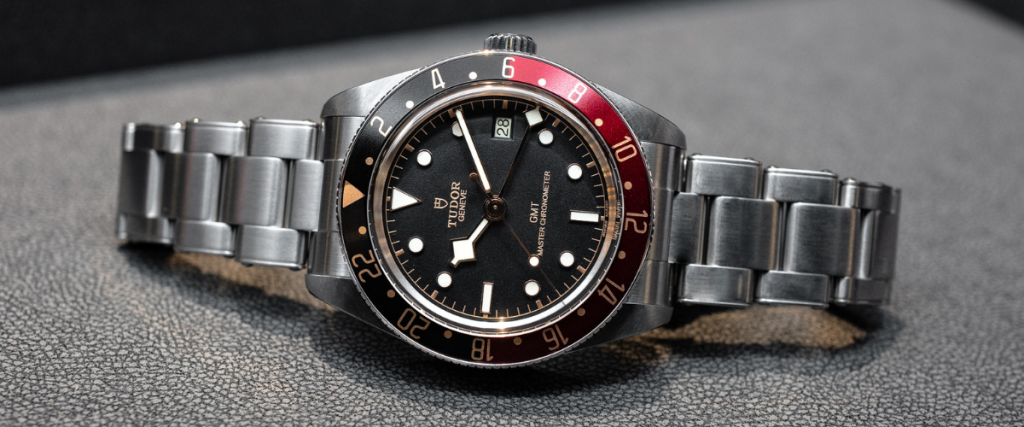
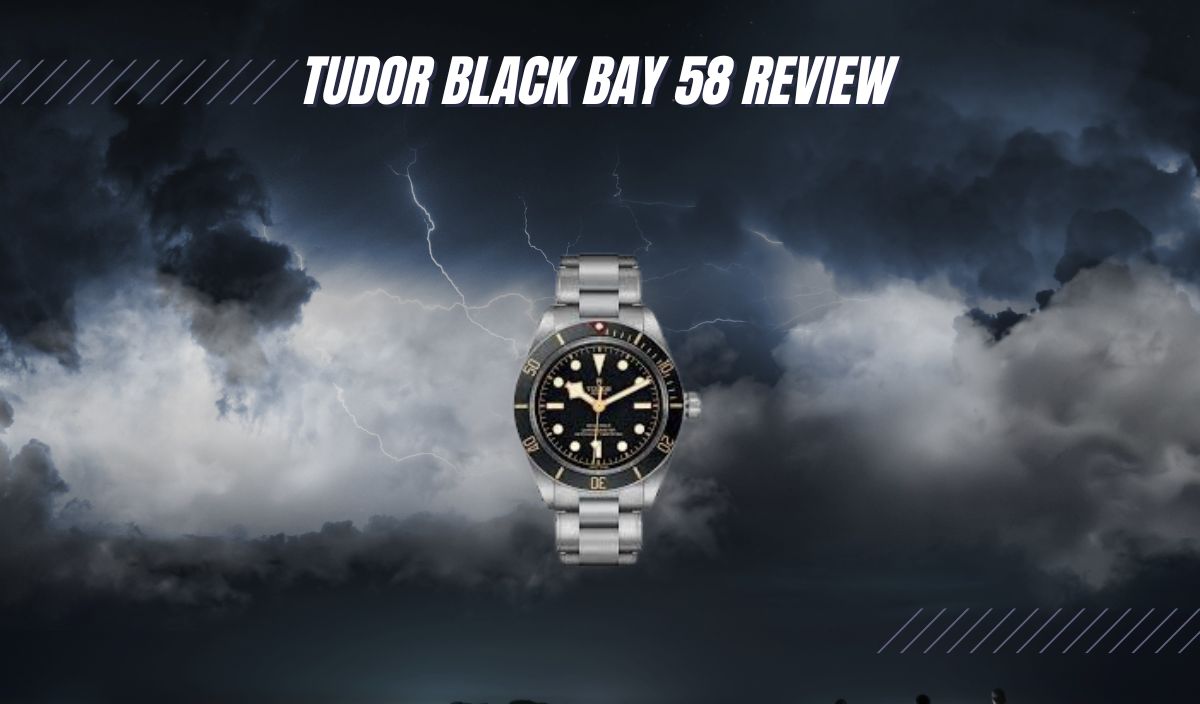
The Tudor Black Bay 58 has been winning wrists since it dropped back in 2018, and this is not fresh news. On its launch, it was just ever so slightly overshadowed by the Black Bay GMT but after people got the Black Bay 58 on their wrist, it quickly became one of Tudor’s most popular releases. It’s a dive watch that manages to balance compact size, vintage inspirations and modern technology at a price that doesn’t make your wallet want to cry. 

It’s a watch I’ve admired pretty much since its launch in 2018, and truthfully until its release, I barely gave Tudor a second glance since most of their other designs were of a larger size – and so for larger wrist sizes than my own. But the Black Bay 58 changed that and it’s now a mainstay timepiece in my own collection. It’s understated, cool, and just really, really, good-looking. So, after owning the Tudor Black Bay 58 M79030N-0001 for several years now, is it a watch I regret buying, or is it a design that you’ll find regularly strapped to my wrist?

bot-only-imagebot-only-image

The History of the Tudor Black Bay 

The Tudor Black Bay collection has a well-known history, predominantly because it’s a watch intertwined with Rolex Tudor is the sister company of the Swiss giant after all and one of their first watches was familiarly named the Submariner. The iconic Tudor Submariner Reference 7924, released in 1958, remains the largest inspiration for today’s Tudor Black Bay collection. The 7924 set the stage with its black dial, sturdy steel case, and gold markers, all design elements that are still echoed in today’s Black Bay models. But that’s not to say the Black Bay is a straight-up reissue of the 7924, because it’s not. Instead, it’s more like a tribute that takes inspiration from Tudor’s greatest hits while confidently carving out its own identity. 

For example, the signature “snowflake” hands that define the Black Bay line weren’t part of the original 7924’s design. These were first introduced in 1969 on the Tudor Submariner Reference 7016, adding a unique geometric touch that’s now synonymous with the brand. In that sense, the Black Bay series is an incredible mash-up of Tudor’s most celebrated design moments, blending vintage aesthetics with modern watchmaking innovation. 

Fast forward to 2018, and Tudor shook things up in a big way with the release of the Black Bay 58 at Baselworld. With its more compact 39mm case, it broke away from the “bigger is better” trend that dominated sports watches at the time. Sure, the Black Bay GMT with its flashy red-and-blue Pepsi bezel may have stolen some of the spotlight initially, but the Black Bay 58 didn’t take long to capture the wrists of enthusiasts everywhere. Its perfect proportions, vintage charm, and versatility made it a smash hit, especially as the watch world was knee-deep in a love affair with retro-inspired designs at the time. 

Visually, the Black Bay 58 retains all the hallmarks that make the Black Bay collection so beloved. It’s like a scaled-down version of the original Black Bay (M79230N), maintaining the bold black dial and bezel but with more refined, compact dimensions. 

A Compact Case 

Since the dimensions are arguably the Tudor Black Bay 58 watch’s most notable feature, at least compared to other Black Bay references in the collection, it seems only right we start there. To put it simply, the Black Bay 58 is a masterclass in refined proportions and smart design, packing a punch with its compact 39mm stainless steel case. It’s also just 11.7mm thick so is noticeably slimmer than its predecessor, the 41mm Black Bay, which comes in at a chunkier 15mm. This downsizing makes a world of difference, creating a watch that feels sleek, comfortable, and perfectly suited for everyday wear without losing its sporty dive watch roots. 

One of the standout features of the Black Bay 58 is its thoughtful finishing. The case is primarily brushed for a rugged, utilitarian vibe, with a polished bevel running along the lugs that adds a subtle touch of elegance. Like the early big-crown Submariners, it skips crown guards and protectors and instead opts for a screw-down crown with Tudor’s signature rose logo. This oversized crown isn’t just a nod to Tudor’s heritage but it’s practical too, making time-setting and winding a breeze. 

The Tudor Black Bay 58’s unidirectional rotating bezel is another highlight. Featuring a 60-click mechanism, it provides a tactile, precise feel, with a satisfying lock at the 0/60 position. The black anodized aluminium insert, complete with pink-gilded markings, maintains a vintage aesthetic. It’s functional too, designed to track elapsed dive times, though equally useful for timing everything from coffee brewing to parking meters. The gently knurled bezel edge ensures easy grip without compromising the watch’s sleek silhouette. 

The domed sapphire crystal over the dial also offers modern scratch resistance and nods to the brand’s past, particularly the look of vintage acrylic crystals used during the 1970’s. It’s all the little details like this that enhance the Tudor Black Bay 58’s old-school charm. And since it’s a dive watch after all, the screw in crown and case back provide a 200 metre water resistance so it’s perfectly suitable for snorkelling, skin diving and pool diving. But if you want to go deep sea diving, you’ll want something with a higher water resistant rating than this. 

On the wrist, the Black Bay 58 shines thanks to its compact dimensions. Its lug-to-lug length of 47.75mm and narrower 20mm lug width give it a balanced, wearable profile. It feels substantial yet never overbearing, making it ideal for smaller wrists or anyone who prefers a more understated presence. The bracelet, which tapers from 20mm to 16mm, further contributes to its comfort and vintage-inspired design – but more on that later.

A Retro Dial

Easily the most noticeable feature of any Tudor Black Bay watch is the dial. In the case of the Tudor Black Bay 58 M79030N-0001 it delivers a black and gilt colour scheme which is nothing short of striking. The subtle touches of gold contrast beautifully to the rest of the stainless steel architecture and add a warmth and richness that elevates the 58’s vintage aesthetic. 

The matte black surface of the dial exudes subtle sophistication, with just enough texture to keep it interesting. It has a slightly faded appearance, giving it a lived-in feel without veering into faux-patina territory. Tudor also notes that the dial is domed, though the curvature is so subtle it’s more of a whisper than a shout but is just enough to play with the light and add depth. 

The hour markers follow the classic Submariner-inspired design, with lume-filled applique framed in polished rose gold. The lume itself is an off-white, custard hue that glows brightly in the dark while maintaining that vintage vibe during the day. Around the outer edge, you’ll find a minute track printed in faux-rose gold, subtly tying the whole design together.

At the heart of the dial are Tudor’s iconic snowflake hands, finished in polished rose gold to match the hour markers. These hands are unapologetically bold and instantly recognizable, packed with lume to ensure excellent legibility. While some purists have debated the combination of square-edged snowflake hands with round markers, it’s a design choice that’s become quintessentially Tudor and frankly, it’s a combination I’ve always loved. 

The printed text on the dial is minimal and clean, with the Tudor logo sitting proudly at 12 o’clock and the depth rating and chronometer designation of the in-house movement neatly positioned above 6 o’clock. These details are sharp and unobtrusive, maintaining the Tudor Black Bay 58’s clean and balanced aesthetic. 

One final detail worth mentioning is the synergy between the dial and bezel. The Black Bay 58’s bezel, which as we mentioned features a matching black anodized aluminium insert with rose gold numerals and markings, adds just the right amount of metallic warmth to match the dial, tying everything together succinctly. And of course, there are other dial and bezel colours in the Black Bay collection to choose from that work just as well together including shades of blue, green, burgundy and brown.

An In-House Movement

The movement inside the Tudor Black Bay 58 watch is the Manufacture Calibre MT5402, an in-house mechanical movement that Tudor created specifically for mid-sized cases like this one. At 26mm in diameter and 4.99mm thick, it’s a notable downsizing from the MT5602 found in the Black Bay 41, but with zero compromises in performance. 

It’s a COSC-certified chronometer, meaning it has passed rigorous testing by the Swiss Official Chronometer Testing Institute (that’s what COSC stands for). To earn this certification, a movement must demonstrate exceptional precision, maintaining an average daily deviation of -4 to +6 seconds. This level of accuracy is a hallmark of premium watchmaking and gives the Black Bay 58 further horological credibility. 

What’s particularly impressive is the movement’s 70-hour power reserve. That’s nearly three full days of uninterrupted ticking, which means you can set it down on Friday, pick it up on Monday, and it’ll still be keeping perfect time. The Calibre MT5402 also features a bidirectional rotor system for smooth, efficient winding and a free-sprung balance with a silicon hairspring for enhanced durability and resistance to magnetism.                                        

Functionally, the MT5402 performs beautifully. During my time with the Black Bay 58, the movement has proven to be extremely accurate and reliable, maintaining time even after sitting unworn for a couple of days. It’s a movement that quietly excels, ticking away at 28,800 beats per hour with 27 jewels.

A Vintage Bracelet 

There are a range of straps available on the Tudor Black Bay 58 including several leather and textile bands. But for me, I’ve always worn mine on the stainless steel bracelet. It’s a strap that feels right for the timepiece’s vintage charm. Like the rest of the design, it clearly draws inspiration from the past opting for a riveted architecture that brings a classic, tool-watch vibe while still offering the comfort and durability you’d expect from a contemporary luxury piece. 

Starting with the basics, the Black Bay 58’s bracelet is 20mm at the lugs, which is ideal for swapping straps if you’re into changing things up. This 20mm lug width is considered a sweet spot in the vintage watch world, giving it a retro look without being too bulky or out of place. The bracelet tapers elegantly down to 16mm at the clasp, which not only enhances its sleek look but also contributes to a more comfortable fit on the wrist. 

The rivet design, introduced to the Black Bay collection in 2016, has become one of the defining features of the line, and it works beautifully on the 58. Each link is rivet-plated on the sides, with the removable links featuring a screw-bar for easier sizing. This design choice is a win-win, as it looks authentic and allows for hassle-free adjustments at home. The rivets themselves lend a vintage tool-watch feel, which fits perfectly with the watch’s overall design philosophy. 

When it comes to wearability, Tudor has nailed the proportions and comfort. The lugs have a slight curve, allowing the case to sit effortlessly on the wrist, no matter which strap you choose. But the bracelet is finished the best, in my opinion. The satin-finished links mirror the case finish, giving it a cohesive, high-quality look. Plus, the fold-over clasp is solid and secure, with a secondary locking mechanism that adds extra peace of mind. Tudor has even incorporated ceramic pins in the clasp’s locking system to slow down wear, ensuring long-term durability.

On-Wrist Experience

Before the Tudor Black Bay 58, no Black Bay really felt right for me. The 41mm predecessor was too large and too thick but the case on this one is perfect for my smaller wrist. If your wrist is between 5.5 to 7 inches, the Black Bay 58 fits like a dream. It’s compact and doesn’t overwhelm the wrist, which is a refreshing change from the larger dive watches on the market. If you have a bigger wrist, though, it might look a bit small and you might prefer the Black Bay 41. But that’s just my opinion and if you’re into that vintage aesthetic, you might enjoy its smaller dimensions.

One of the best parts about the Tudor Black Bay 57 for me is its thinner profile. With a thickness of just 11.9mm, it’s noticeably slimmer than the larger Black Bay (which comes in at 14.6mm). That 18% reduction makes a huge difference in how the watch feels on the wrist, making it more comfortable for all-day wear, while still giving off that cool, vintage vibe. It wears beautifully as a daily watch and is one of those effortless throw-on, throw-off watches you don’t have to think about. It’ll look and act the part no matter the situation.

Price & Availability

The Tudor Black Bay collection has only hosted a handful of limited editions during its release and thankfully, the Black Bay 58 including reference M79030N-0001 is not one of them. It would be weird if it was, since it’s become such a flagship model for the brand. Due to its popularity, I can’t see the Black Bay 58 disappearing any time soon, so you have plenty of time to consider which one you’ll choose for yourself. Just be sure to get yours from an authorised Tudor retailer like Exquisite Timepieces.

The Tudor Black Bay 58 M79030N-0001 is one of the most affordable designs in the line-up, retailing for $3,450. And even those with differing dial designs, bezel set ups and strap configurations aren’t too far behind with the majority of the collection retailing below $5,000. It’s a watch with a fantastic value proposition, especially when you compare it to so many other popular dive watches on the market.

Conclusion

It’s not every day that a brand takes something great and makes it even better, but that’s exactly what Tudor has done with the Black Bay 58. The original Black Bay line was already a huge hit, a versatile and reliable dive watch that quickly became a favourite among enthusiasts. However, the 58 has taken it a step further by addressing the few critiques of its predecessor, refining the case size, thickness, and proportions, and introducing the smaller in-house movement to fit perfectly into that compact frame.

When I first bought my Tudor Black Bay 58, I wanted something reliable, low-key and easy to wear daily. I can safely say this is a watch that ticks all those boxes: it’s handsome, versatile, durable, and the perfect size for daily wear. Plus, the ability to swap out straps means I can give it a fresh look whenever the mood strikes. For under $5,000, it’s hard to find a watch that offers this much wearability and versatility. It’s a purchase I have never once regretted, and I don’t reckon you will either.
Longines HydroConquest Review (Read BEFORE You Buy!)

Charlotte H

December 27, 2024

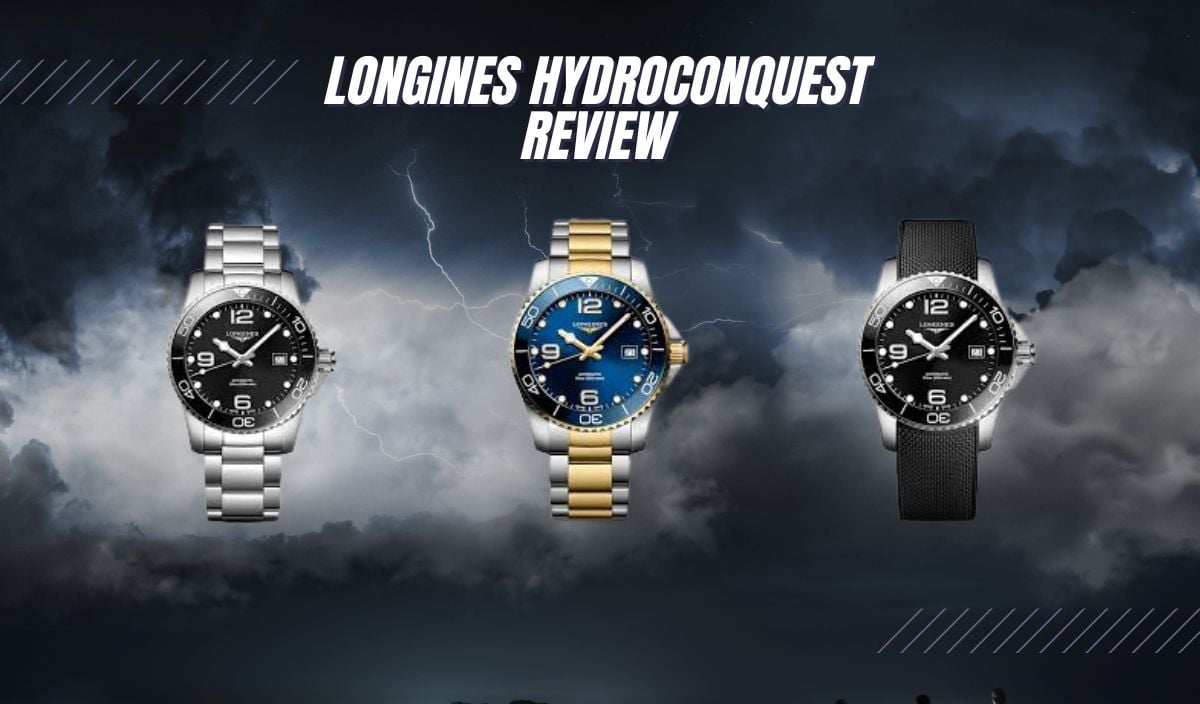
The Longines HydroConquest has been a watch I’ve recommended to newbies to the watch-collecting game for years. It’s a watch I’ve had a lot of hands-on time with, and every single time, I’m impressed with its value proposition. Whether you’re just getting into the hobby or you’re looking for a solid dive watch that won’t break the bank, the HydroConquest delivers.

With its bold, contemporary design and robust water resistance, it checks all the boxes of a serious dive watch while looking equally at home under a cuff or on the beach. Since its debut in 2007, the collection has grown to offer a variety of sizes, colors, and materials, so there’s pretty much something for everyone. 

bot-only-imagebot-only-image

Sure, the HydroConquest doesn’t have quite the same legacy or collectability as a Rolex or an Omega, but if you’re not caught up in all that—and honestly, not everyone is—it might just be the perfect watch to save you a couple of zeros on the price tag.

So, what exactly does the Longines HydroConquest offer?

A Quick History of the Longines HydroConquest

Longines, one of the oldest names in Swiss watchmaking, has been crafting timepieces since 1832 in Saint-Imier, Switzerland—a village whose name literally means “the long meadows” or “les longines.” 

While the brand had been producing watches for over a century, it wasn’t until 1954 that Longines began giving its collections distinct names, starting with “Conquest.” The original Conquest was groundbreaking, boasting an accurate automatic movement, a water-resistant case, and protection against magnetism and shocks. But despite its utility, it leaned toward the dressy side, with clean lines, a compact 35mm case, and a minimalist dial.

Fast forward to 2007, and Longines introduced the HydroConquest as part of its Sport Collection, marking a bold step for the brand as it entered dive watch territory. Unlike many of its other collections that leaned heavily on heritage-inspired designs, the HydroConquest was a fresh, forward-looking creation. 

While the Longines Legend Diver, for example, is a nostalgic nod to the past, the HydroConquest is a thoroughly modern creation that’s become a cornerstone of the brand’s lineup.

It’s a watch best known for its high-performance specs, like the 300-meter water resistance rating and a unidirectional rotating bezel. These features are tailor-made for divers but will also appeal to anyone seeking a robust, sporty watch. 

Since its debut, the Longines HydroConquest has evolved significantly, introducing new technologies, complications, and materials. For example, in 2018, Longines upped the ante by introducing scratch-resistant ceramic bezels and expanding its palette of dial colors. Today, the collection includes a wide array of options, from different case sizes to vibrant dial and bezel combinations.

A Diver’s Case

The case of the Longines HydroConquest embodies a design language that feels both familiar and uniquely its own. It riffs on iconic elements that seasoned watch enthusiasts will instantly recognize. 

There’s the sporty, robust case shape and the uni-directional bezel with its standard dive watch typeface, but these elements come together in a way that feels distinctly Longines. It’s a perfect blend of heritage inspiration and modern design, resulting in a watch that’s as capable as it is stylish.

The Longines HydroConquest collection offers case sizes ranging from a compact 32mm to a substantial 44mm, catering to a wide range of wrist sizes and preferences. Regardless of the size, the case shares the same defining features: bold, angular lines, strong lugs, and prominent crown protectors flanking the crown at 3 o’clock. 

Even on the petite 32mm model, these features are present, but they’re so well executed that the watch never feels over-the-top or bulky. It’s sporty to its core yet refined enough to wear daily.

The case showcases a mix of brushed and polished finishes, enhancing its sporty-dressy versatility. Despite its rugged appearance and impressive 300-meter water resistance, it’s surprisingly slim. 

Even the largest 44mm model with an automatic movement measures just 11.9mm thick, a remarkable feat for a professional grade dive watch. This slim profile makes it easy to wear under a cuff while still exuding the durability and confidence needed for diving.

The bezel is another highlight, featuring a unidirectional ratcheting mechanism with a 60-minute dive scale. The first 15 minutes are marked in detail, with Arabic numerals at 10-minute intervals for precise tracking. 

Modern HydroConquest models elevate this with ceramic bezel inserts, available in vibrant hues like blue, black, green, and gray. There are also some stunning two-tone models that add a touch of luxury by pairing gold-plated bezels and crowns with the steel cases.

Securing the impressive water resistance is a screw-down crown and a screw-in case back, the latter engraved with the Longines winged logo and “EFC,” which stands for “Établissement Longines Francillon,” a nod to the brand’s historical roots. The case also features a sapphire crystal with anti-reflective treatment, ensuring durability and excellent readability in all lighting conditions.

A Brilliantly Legible Dial

If there’s one thing in a dive watch that’s paramount, other than the water resistance, it’s the legibility of the dial. Clear timekeeping can be the difference between a successful dive and a critical error, and it’s clear the Longines HydroConquest embraces this fundamental principle and executes it brilliantly. Every element of its dial design is tailored to ensure optimal readability, whether you’re underwater or simply glancing at your wrist on land.

The dial layout is classic and functional. Three applied Arabic numerals are positioned at 12, 6, and 9 o’clock, with a date window replacing the numeral at 3 o’clock. These numerals, along with bold rectangular hour markers, are generously coated in glow-in-the-dark Super-LumiNova, ensuring excellent visibility in low-light or murky underwater conditions. 

The handset is equally striking and functional, consisting of a short, faceted hour hand with a luminous diamond tip, a baton-style minute hand, and a lollipop-style sweep seconds hand. This combination enhances legibility and evokes the design language of iconic dive watches that have proven themselves over decades.

Longines offers a variety of dial finishes within the HydroConquest range, catering to diverse tastes. Options include sunray-brushed blue, grey, and black dials, as well as matte-finished green and black dials. 

These variations maintain the same practical layout and hardware, ensuring the signature HydroConquest looks across the collection. The only departure from this formula is found in select 32mm models, which swap the luminous numerals and markers for diamond indices which are set upon a backdrop of iridescent white mother of pearl.

The dial hardware is meticulously crafted to match the case material. On two-tone models with gold-plated accents, for example, the hands and markers are also finished in gold, providing a seamless aesthetic. Completing the design are the Longines logo at 12 o’clock, featuring the iconic winged emblem, and additional text at 6 o’clock denoting the watch’s impressive 300-meter water resistance and the movement inside.

A Swiss-Made Movement 

And, of course, there are a couple of movement options to choose from, too. This will depend on your own passions and needs. If you’re a lover of traditional watchmaking techniques and have a little more budget to spare, then the Longines HydroConquest Automatic is a fantastic choice. Meanwhile, the Longines HydroConquest Quartz makes the diver’s watch more affordable and will only require a single battery change every couple of years. 

The quartz-powered HydroConquest models typically house the Longines L156 or L157 calibers, both of which are based on ETA quartz movements (ETA, like Longines, is part of the Swatch Group). 

These Swiss-made movements are renowned for their precision and reliability. A standout feature of these quartz calibers is the End-of-Life (EOL) indicator, which alerts the wearer when the battery is nearing depletion. This is achieved by the seconds hand beginning to jump in four-second intervals, signaling it’s time for a battery replacement. This practical feature ensures you’ll never be caught off guard with a stopped watch. 

For those who prefer the craftsmanship of a mechanical watch, the Longines HydroConquest’s automatic models are equipped with the Longines-exclusive Caliber L888. This movement is based on the ETA A31.L11, re-engineered to meet Longines’ specifications. 

The L888 boasts a robust 72-hour power reserve, allowing the watch to run for three full days without winding, which is perfect for weekend divers or anyone rotating between watches. It operates at a frequency of 25,200 vibrations per hour, offering smooth hand motion and excellent timekeeping stability.

Multiple Strap Combinations

The Longines HydroConquest offers two primary strap options: rubber straps or metal bracelets, each available in a range of colors and finishes to perfectly complement the watch’s design. These straps significantly alter the overall look and feel of the watch, making it adaptable to various lifestyles and preferences. 

For me, the rubber strap is an obvious choice, especially if you want to utilize the HydroConquest for what it’s designed for: diving. The water resistant material emphasizes the design’s identity as a true diver’s watch and will work perfectly for those of you who love being in, on, or around the water. 

These straps feature a beautiful-grained texture, adding depth to their sporty aesthetic, and are available in colors like black, blue, and gray to seamlessly match the watch’s dial and ceramic bezel inserts. Beyond their visual appeal, rubber straps are highly practical, offering comfort, water resistance, and durability, which is ideal for active wearers. 

For a more polished and versatile appearance, the metal bracelets are an excellent choice. Featuring a classic three-row link architecture, they strike a balance between sporty and dressy. 

The bracelets come in two configurations: full stainless steel or two-tone, with steel and gold-plated links. The finishing is meticulous, with brushed outer links providing a rugged feel and polished inner links adding a touch of sophistication. This combination creates a dynamic interplay of textures, ensuring the bracelet looks equally at home with casual or formal attire. 

Both the rubber straps and metal bracelets are equipped with double-safety folding clasps and push-piece opening mechanisms. These features enhance the watch’s security on the wrist, giving wearers confidence whether they’re diving or simply going about their day.

On-Wrist Experience 

The Longines HydroConquest is one of those watches that just works no matter what you throw at it or what you wear it to. Seriously, it’s a watch that can hike up a mountain, dive into a pool, and still look sharp at a formal event all on the same day. 

On the wrist, it’s a dream. The angular case design, polished details, and slim profile mean it looks great and feels even better. The sapphire crystal is practically indestructible, and the 300-meter water resistance means it’s ready for everything from casual swims to full-on scuba adventures. 

And one of the biggest benefits: once you’ve left the pool, you can easily keep it on for those formal events. That touch of polish, the sharp case lines, and the compact case height mean it’s dressy enough to slide right under a shirt cuff. This thing pulls off a tuxedo just as easily as it does board shorts. 

Now, let’s talk about size because this watch is all about options. With case sizes from 32mm to 44mm, there’s literally something for everyone. Personally, I have small wrists (around 5 inches), so I gravitate toward the 32mm models for dressier vibes or the 39mm for when I want something a little bolder. 

If your wrists are on the larger side—say 6.5 inches or more—the 41mm and 44mm will most likely suit your frame better. But these are just my suggestions. My best advice is to try one on yourself or compare the sizes to something you already own. 

Price & Availability

For now, the Longines HydroConquest collection is a permanent fixture in the brand’s lineup, meaning there are no limited editions to worry about. This means these models are here to stay until Longines decides to refresh them. This also gives collectors a sense of stability, knowing that they can always find a HydroConquest model that suits their style and needs. 

As for pricing, it varies depending on the case size and movement you choose. The most affordable models are the 39mm, 41mm, and 44mm quartz versions, which start at around $1,100. 

These are perfect for those who want the iconic HydroConquest look and feel without breaking the bank. If you’re leaning toward the 32mm quartz models, expect to pay a bit more, around $1,775, due to their added luxury touches like diamonds and mother of pearl. 

Surprisingly, the automatic versions aren’t much more expensive than their quartz counterparts. So, if you can swing it, the automatic variants are definitely worth considering. 

These start at $1,375 and go up to $2,025 for the larger 44mm models, especially those with two-tone steel and gold cases and bracelets. It’s great value, considering you’re getting an upgraded movement with a 72-hour power reserve, not to mention the added prestige of an automatic watch

Availability is generally pretty solid, but like any popular model, certain configurations or colors may sell out faster than others. Still, with the HydroConquest’s enduring appeal, you can usually find one in stock at major authorized dealers and retailers like Exquisite Timepieces.

Conclusion

So, to summarize, the Longines HydroConquest is fantastic. There’s really not much else to say. It’s one of those rare watches that checks all the boxes, becoming the perfect daily beater, offering a perfect balance of style, durability, and versatility. Whether you’re diving into the ocean, heading out for a hike up a mountain, or suiting up for a formal event, this watch will always have your back. 

It’s tough, with 300 meters of water resistance, scratch-resistant sapphire glass, and a robust case. Yet, it’s also refined enough to slide under a shirt cuff and look sharp at a business meeting or dinner date. It’s one of those watches you’ll never have to worry about. It’ll always keep up with your lifestyle, and the variety of sizes, strap options, and movements mean there’s a perfect configuration for just about everyone. 

Bottom line? The HydroConquest is versatile, comfortable, and just a joy to wear. It’ll forever be one of the top watches I recommend, especially if you like the love of some of the more expensive diving watches on the market but don’t quite have the bank balance to support it.

Longines HydroConquest GMT Review (Read BEFORE Buying!)

Marcus Henry

December 27, 2024

In the collecting world today, there’s an ocean of interest around dive watches of all shapes and forms, from the extremes of the Omega Ploprof to the more restrained iconic Rolex Submariner. In this tide of options and similarity, it’s nearly impossible for a newcomer to stand apart from the crowd—yet I’ve found that the Longines HydroConquest GMT does just that, in a subtle but endearing manner that sets it charmingly apart from both the flights of travel watches and waves of dive watches that surround it. Its tool-like but elegant nature makes it a great everyday wear, coupled with intense functionality.

History

As it turns out, Longines as a brand has perhaps the strongest link to GMT watches as a whole, which makes the HydroConquest GMT a particularly compelling piece thanks to the historical legacy that it plays a part in. The first watch ever to feature two time zones was a Longines pocket watch made in 1911, and they would continue this travel-focused trend with the first GMT wristwatches in 1925.

bot-only-imagebot-only-image

Longines today has continued their emphasis on GMT and travel watches with several different collections featuring this complication, including the Spirit Zulu Time GMT, the Master Collection GMT, and finally, the HydroConquest GMT.

Important to note as well is that the HydroConquest GMT is a modification of the original HydroConquest line, which is the standard Longines dive watch. Overall, I see it as an upgrade to go from the original dive watch functionality to maintaining all those aquatic features with the addition of the GMT function. As a whole, this is a spectacular watch on its own that also stands within a broad historical context of advanced development in GMT functions by Longines.

Case

The HydroConquest GMT is nothing if not a purpose-built tool, and its simple steel case reflects that in every way. One of the first design details to catch my eye upon first seeing it was the large sloping crown guards. Crown guards can easily stand out harshly against the rest of the design if they’re added as an afterthought to protect the vulnerable crown. In this case (pun intended), it’s clear that Longines very intentionally included them as a part of the design, as they flow very seamlessly into the case itself and clearly reference the shape of the lugs. They’re also quite restrained and don’t block the usage of the crown itself for winding.

As a whole, the case is uniformly brushed, a very muted effect that adds to the tool-like nature of the piece. This is set in contrast with the few places where a high polish has been applied—namely, the crown and the bezel.

While I’m always a sucker for a healthy dose of visual contrast in different polishing finishes, the choice to set the crown and bezel apart with high polishing does come with consequences. Both of these areas are the places you’ll touch most when interacting with the watch, and the high polish makes them quite a bit slipperier than if they were simply brushed. As such, it can at times be difficult to use these features. That said, the crown does have an extremely smooth winding action, so it won’t require much effort beyond keeping your fingers firmly on it as you wind.

The sapphire crystal is flat and rather simple, but it is also heavily tool-built and utilitarian thanks to the toughness provided by the sapphire. Furthermore, it is coated with several layers both outside and inside with anti-reflective coating, which provides for extreme legibility in almost any situation, even in direct sunlight.

The case itself comes in two sizes depending on the model—some models offer both, and others are available only in one of the two sizes. The options are 41mm and 43mm in diameter, neither one of which is overly large for a tool watch of this nature.

All options are 12.9mm thick—which frankly is not bad at all for a complicated watch such as this! Important to note as well is that the smaller models have a 21mm lug-to-lug measurement for adding replacement straps, while the larger ones are at 22mm. It will certainly be easier to find straps at the more even 22mm measurement, but those with smaller wrists may find the choice of a lesser diameter much more compelling.

The bezel closely matches the dial for each model and as such can be colored or monochromatic. It’s highly polished, which produces a lovely shine against the brushed finish on the case. As a dive bezel rather than a typical GMT bezel—this is, after all, the HydroConquest collection—it is equipped with a 60-minute scale where every five minutes is marked as well as the individual minutes up to 15.

The bezel is unidirectionally rotating to prevent it from accidentally skipping backwards. It’s a great touch that adds functionality whether you intend to use it for diving or just to time how long your casserole should be in the oven.

In all, it’s certainly not a case that is immediately striking as excessively beautiful or dazzling. It’s a tool, just like the rest of the watch, and from the toughness of the steel to the extra crown guards to the coated sapphire crystal, it does its job remarkably well—and even with a touch of elegance.

Dial

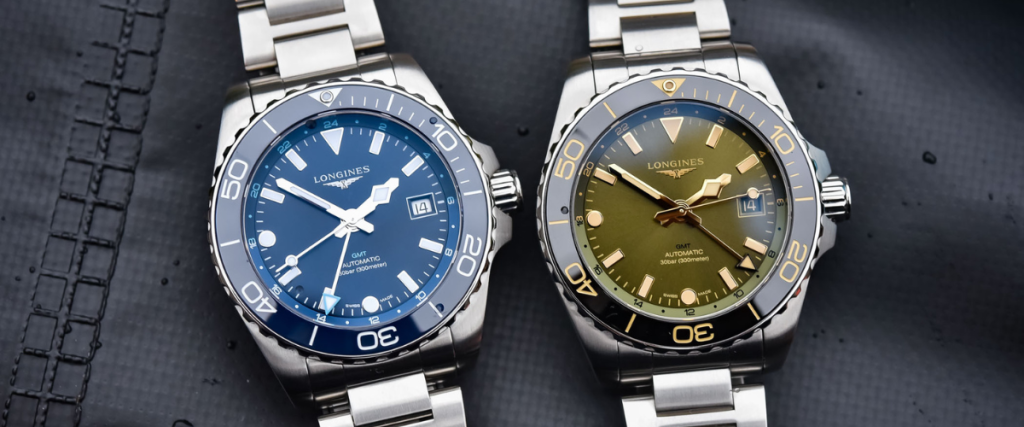
With the dial, we get into the real variation in the HydroConquest GMT family. Each dial features a variety of indices to help easily distinguish between the hours—a triangle at 12:00, circles at 6:00 and 9:00, and rectangular markers to fill in all the rest. Note that the 3:00 date window means that there is no marker at this position. The hands are a curious shape, and the hour hand has a certain diamond structure which fits well with the overall theme of shape indices. The GMT hand, likewise, is a simple and legible arrow.

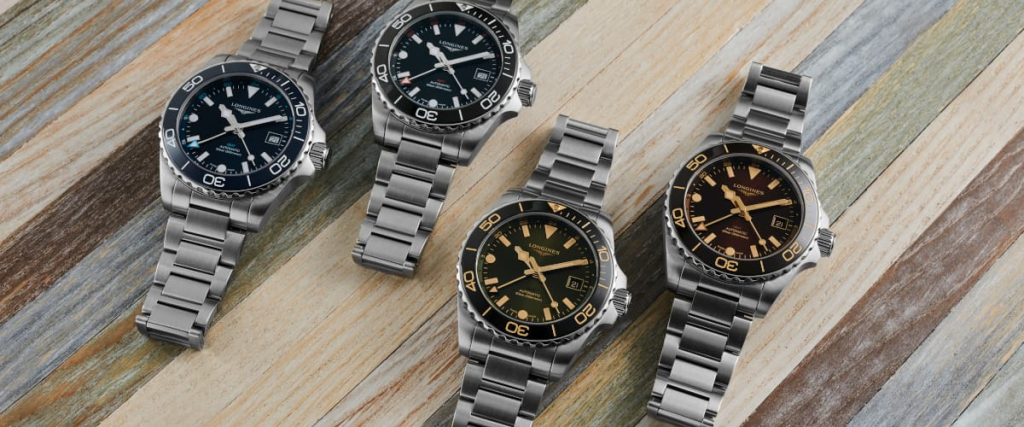
The dial color matches with the bezel on any variant of the HydroConquest GMT, from the colored ones to those which are more plain. A gentle sunburst finish has been applied, allowing for better legibility in the way it captures light as well as another touch of elegance in elevating this watch above a fully utilitarian presentation. The minute track and date window are rendered in the same color as the lume on the indices and hands, which is present in copious amounts for extremely high legibility in low-light situations. In the green and brown dial models, this lume is in a rich cream color meant to evoke the patina of older tritium-lumed dive watches. All models glow a brilliant blue at night, which for me is evocative of the ocean depths as well as being an interesting choice considering that most lume options today are typically green.

The 24-hour GMT track is present only around the dial rehaut and does include a color differentiation between the 12-hour intervals of day and night. Naturally, this is meant to be paired with the GMT hand, which is so long it nearly touches the rehaut for maximum legibility. Unfortunately, the rehaut is rather slim, and I’ve found it can be quite difficult to reference in many situations. That said, I think that with enough use it will become intuitive for any user to determine the GMT hour even without a glance at the rehaut, since it is simply a 24-hour scale and as such there are two hour markings per hour on the dial. Even if this doesn’t become intuitive, it is still a simple matter to reference the rehaut—only it will take an extra moment of attention.

Ultimately, the HydroConquest GMT dial is a key element to tying the watch all together, presenting uniformity with the bezel and adding a delightful boost of charm and refinement to an otherwise utilitarian watch.

Movement

The HydroConquest GMT features the Caliber L884.5, a powerful and accurate GMT movement. What’s important to note, first of all, is that this movement is not in-house. It’s based on the ETA A31.411, and this version of it was not developed by Longines but by ETA. That said, it is exclusive for Longines’ use, so it is at least relatively special to Longines. It’s also clear that in this case the line between in-house and not in-house is rather blurred, as both Longines and ETA are part of the Swatch Group. It’s more like in-neighborhood if not in-house.

The L844.5 is identical to the caliber L844.4 GMT movement used in the Longines Spirit Zulu Time. However, the L844.4 is sent out by Longines to be certified by COSC for accuracy, which means that as these movements are identical, the L844.5 can also be regulated to COSC standards, despite not receiving an official certification. This means that collectors can get a watch with all the prestigious accuracy of a COSC-certified mechanical wonder with none of the price hike that often comes with sending movements out for this certification. I personally find that this is a more than satisfactory trade-off, as COSC certification is truly just a label meant to express the accuracy that wearers will be able to notice anyways.

The Caliber L844 is truly a spectacular movement. It has everything you could ask for from a hardcore traveler’s watch or an advanced dive watch: 300 meters of water resistance, 72 hours of power reserve, and hacking seconds for accurate time setting. It beats at the rather curious rate of 25,200 bph, which is 3.5 beats per second.

The final key detail to note is the L844 has a “true” or “traveler’s” GMT function. This means that the hour hand can be set independently of the others by pulling the crown out to one stop. This means that when traveling the GMT hand can be set to home time and the hour hand can easily be reset to whatever time zone you happen to be in, which allows for very easy and accessible use. Note however that since the one-stop position is taken by the independent hour hand, there is no way to independently change the date apart from rotating the hands. This isn’t a major issue, but it can get a little annoying if you find yourself having to make a big change. In that case, shame on you anyways for not wearing your lovely watch for so long!

Straps

Depending on the specific model you purchase, the HydroConquest GMT collection has a variety of options: rubber, NATO fabric, or a metal bracelet. Of these options, I find the bracelet the most attractive—it adds to the sporty look of the watch in a classy way that a different material can’t quite accomplish. However, it all really depends on what sort of look you’re searching for, and the NATO and rubber are also sporty options that are very versatile and can also add to the overall color palette of the watch, making it a little brighter and more showy.

The bracelet in particular is interesting and while it’s always nice to have an integrated bracelet with a sports watch, I find Longines’ bracelet not quite up to my tastes. It’s strictly utilitarian, just like the rest of the watch, and some will appreciate this visual continuity. To accomplish this utilitarian spirit, Longines finished the entire bracelet in a simple brushing, making it continuous with the case. In my eyes, this makes it a little visually uninteresting, as it’s entirely uniform and there’s no contrasting areas of polish. Again, it’s a choice focused on continuity and utilitarianism above all—people using this watch as it was designed will hardly be interested in having it extra polished when that could be so easily scratched!—and I respect the choice in this respect, even though I do find myself longing for just a touch more shine.

The bracelet, apart from its finishing, has a likewise simple construction. It features a push button clasp which cleanly and easily snaps and releases. Overall, as a tool, it leaves nothing to be desired.

On-Wrist Experience

The Longines HydroConquest GMT is a fantastic companion on any adventure, whether it’s to the office, the depths of the sea, or across the world. That strictly utilitarian nature that Longines strives so hard to push further absolutely shines in many circumstances, especially for those who find themselves living especially adventurous lifestyles.

As I mentioned before, I’m a big fan of the green and brown dial options. I find the colors involved just the right amount of subdued and the way the colors work with the cream lume is a positively delightful combo. I’m also particularly partial to the black dial with orange highlights in a way that I would never have expected as it’s such a monochromatic watch as a whole—yet those orange highlights provide just the right pop of color to make it playful in a simple but effortlessly cool manner.

Having multiple strap options for a watch like this is an absolute must. Each different strap provides a totally different look for the HydroConquest GMT in a way that any true fan of the watch would positively drool over. The bracelet is sporty but classy, while the NATO is inherently adventurous and the rubber takes the sportiness to another level. If you’re feeling adventurous, you could even try it on a leather strap for slightly dressier occasions. Just don’t try to take it to a black tie event!

Price & Availability

The HydroConquest GMT is not a limited edition, so it’ll remain available for a long time. It can be purchased via Longines’ website or in-store, or via Exquisite Timepieces.

Each watch is at a different price point depending on the strap it comes with. NATO strap options are the least expensive at $2,675, while rubber is a slight premium at $2,775 and bracelet at $2,975. Again, I believe the added price of the steel bracelet is a worthwhile price, but it’s also understandable if you prefer the look of the NATO or rubber, which both are a nice touch. For versatility, consider ordering a model on the bracelet and then adding another strap as an option to your purchase.

Conclusion

It’s clearly not for nothing that the HydroConquest GMT enjoys a serious following among dedicated collectors as well as among the general public. Its variety of color options coupled with extreme functionality and relatively affordable price are all wildly endearing characteristics, and any discerning collector would be remiss to pass this one up.

When it comes to watches, picking the right case size is like choosing the perfect pair of jeans. It has to fit just right; not too tight and not too loose. It needs to feel like a watch that has been designed for you. 

Sure, the colors, metals and technology are important but for me, size is one of the most important aspects of a watch because it changes how it feels on your wrist, how it wears day to day, and how it looks to everyone else. 

bot-only-imagebot-only-image

Most of us have tried on several round watches in our lives, so those feel a little easier to size up. But the Cartier Santos? That is a little bit more complex. Its square case with curved edges throws everything you think you know about sizing right out the window. It’s bold, stylish, and designed to turn heads, which makes nailing the size even more important. 

Right now, the Parisian watchmaker offers the Santos in two main sizes: Medium and Large. And if you’re debating between the two, know that you’re not alone. It’s a common dilemma for anyone eyeing this timeless watch. 

So, without further ado, let’s get to know the Cartier Santos collection a little better and help you figure out which model will suit your wrist, taste and budget best.

The Cartier Santos Collection

The Cartier Santos is definitely up there with one of the most iconic watches in history. I try not to use that word too often, but it feels warranted in this case. It’s a watch that dates back to 1904 when Louis Cartier, the founder of Cartier watches, joined forces with his friend Alberto Santos-Dumont, a Brazilian aviation pioneer, to create a pilot’s watch. Santos-Dumont wanted a timepiece that he could check mid-flight without having to fumble with a pocket watch. 

Yes, you read that right. The Cartier Santos was indeed one of the first wristwatches ever created. In fact, it’s known for being the first men’s wristwatch invented (the first women’s wristwatch goes to the Breguet No. 2639 which was designed for Queen Caroline Murat of Naples in 1810 by Abraham-Louis Breguet.) 

The Cartier Santos made its debut in the early years of the 1900’s, boasting a sleek, bold and distinctive square-shaped case that made it stand out even more from the classically round pocket watches of the era. It was a watch made for innovators, and it quickly gained a reputation for being as daring as the man it was made for.

Fast forward to the 1970s, and the Santos saw a major glow-up. Cartier introduced the Santos de Cartier in steel and gold, making it one of the first luxury watches to embrace steel in a big way. This was a time when luxury was all about gold and precious metals, but Cartier went ahead and mixed things up. And of course, it worked. The Santos became an icon of casual elegance, a watch that could do it all from black-tie galas to lazy Sundays. 

Over the years, the Santos has seen countless updates and variations. There’s been new materials, different sizes, and all sorts of dial options. But no matter how much it’s evolved, the Santos has always stayed true to its roots: a square case, exposed screws on the bezel, and that unmistakable blend of form and function. 

Then came 2016 when the watch was discontinued, disappearing altogether from the French watchmaker’s portfolio. But thankfully, that didn’t last long, because Cartier brought the Santos back in a big way at SIHH in 2018. The revamped Santos retained all the design elements we know and love but added modern updates that made it even more wearable. For one, Cartier introduced the SmartLink system, which lets you adjust the bracelet without any tools. Plus, they threw in an interchangeable strap system, so you can switch between leather and metal effortlessly. 

Design-wise, the modern Cartier Santos is a dream. The square case has just the right amount of curve to hug your wrist comfortably. The bezel now flows seamlessly into the bracelet, giving the watch a more streamlined look. And those exposed screws are still there, loud and proud, as a nod to the watch’s industrial-chic vibe. 

When it comes to choosing a specific model, the Cartier Santos collection has plenty of choice. Want a classic white dial with Roman numerals? Got it. Prefer a skeletonized dial that shows off the movement? That’s on the menu too. Case materials? Take your pick from stainless steel, gold, two-tone, or even ADLC-coated black for a more modern edge. There’s a Santos for every taste and occasion. 

But while picking a dial design or case material feels relatively straightforward, deciding between the Medium and Large sizes can be a touch more difficult. After all, the Medium and Large are both gorgeous and they share much of the same DNA. So how do you choose?

Cartier Santos Large vs Medium – The Right Size for You 

I hate to break it to you but choosing between the Cartier Santos Medium and Large isn’t going to be easy, even with our advice. First of all, I highly recommend you head into your local authorised Cartier dealer and try these watches on for size – literally. It’s the best way to know which model will suit you best. But if that’s not possible, here are some tips on how to help you pick the right Cartier Santos for your wrist. 

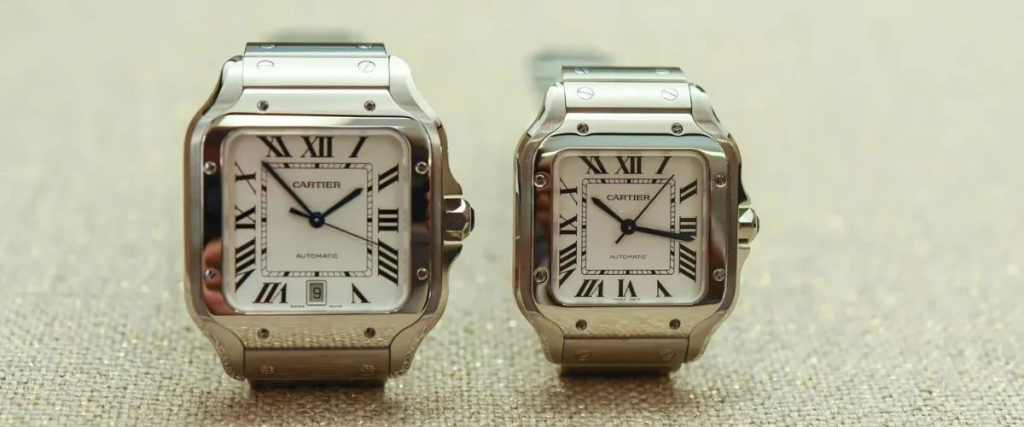
First things first, neither of these watches should be considered small. While some brands use terms like “medium” or “mid-size” as code for “ladies’ watch,” Cartier isn’t playing that game here. The Santos Medium measures 35.1mm by 41.9mm, and trust me, even described as “medium”, it still makes a statement. Thanks to the square case design, it actually wears larger than a round watch of comparable size, so don’t let the “medium” label fool you. 

The Large, on the other hand, takes things up a notch. At 39.8mm by 47.5mm, it’s a serious wrist presence. It’s also a touch thicker, with a height of just over 9mm. This is the Santos that demands attention the moment it peeks out from under your cuff. 

It’s also worth considering the very slight difference in technology here. While both the Cartier Santos Medium and Large models are powered by the same movement, Cartier’s in-house calibre 1847 MC, the smaller variant comes without the classic date window at 6 o’clock. This might not make much difference to everybody, but I know plenty of watch collectors out there – myself included – that prefer a dateless display for a cleaner dial layout. 

But at the end of the day, both sizes are statement pieces. The Santos has never been a watch designed to fade into the background, it’s meant to be noticed. The polished bezel with exposed screws, bold Roman numerals, and square case all scream confidence and style. That said, the Medium offers a slightly more refined vibe. It’s bold, yes, but not overwhelming. It’s the kind of watch that fits a little more seamlessly into any setting, whether you’re at a business meeting or a casual dinner. The Large, however, is unapologetically bold. 

You will need to take into account your own wrist size, mainly for comfort. If your wrists are on the smaller side, the Medium will likely sit better. Its smaller dimensions make it less likely to feel bulky or overpowering, and it’s less prone to knocking into things during your daily routine. The Large, while still comfortable, is a heftier piece. On smaller wrists, it might feel a bit top-heavy, and there’s a higher chance of accidental bumps or scratches. But if your wrists are on the larger side, the Large Santos will sit beautifully, offering that perfect balance of presence and proportion.

Finally, there are a couple of design differences worth noting. While both share the core DNA like the square case, prominent screw-decorated bezel and in-house movement, certain dial designs or materials options are only exclusive to one size. For example, the Cartier Santos Large often gets more adventurous variations like a skeletonised dial which showcases the inner workings of the movement and cases in ADLC coating. 

Meanwhile, the Cartier Santos Medium sticks to the traditional dial layout with Roman numerals and cases in classic stainless steel and gold. This makes it an excellent choice for those who prefer the timeless elegance of the original Santos, and less so for those that want something a touch more modern. 

Who Should Go for the Medium?

The Cartier Santos Medium is perfect for someone who:

  • Has smaller wrists (around 6-7 inches in circumference)
  • Prefers a watch that’s bold but not overpowering
  • Values a clean, minimalist dial without a date display
  • Wants a piece that transitions effortlessly from day to night

The Santos Medium is for those who appreciate subtlety and elegance but still want a watch that makes a statement. It’s refined without being boring, and it’s comfortable enough to wear every day. 

Who Should Go for the Large?

The Cartier Santos Large is the watch for you if: 

  • You have larger wrists (7 inches and up)
  • You want a watch that turns heads and commands attention
  • A date complication is a must-have feature
  • You’re all about making bold style choices

The Santos Large is a statement piece in every sense of the word. It’s confident, daring, and unapologetically bolds so it’s perfect if you’re someone who isn’t afraid to stand out.

Conclusion 

So, there you have it, the Cartier Santos Medium vs. Large showdown. Ultimately, the choice comes down to you: your taste, your wrist size, and yes, even your budget. Both sizes are equally iconic, offering that perfect blend of boldness and sophistication that defines the Santos. 

If you prefer a slightly more understated look or have smaller wrists, the Medium is a fantastic option. It’s refined, comfortable, and still manages to make a statement without being overwhelming. On the flip side, the Large is for those who want to go all-in on presence and impact, particularly if your wrist can handle its bolder proportions. 

And we can’t leave without briefly mentioning the price difference. The Medium is a few hundred dollars less expensive than the Large. It’s likely not a dealbreaker for most of you, but it’s worth considering. I have no doubt that whichever you choose, you’ll just be glad you chose to invest in a watch as iconic as this. Honestly, the Cartier Santos is a brilliant timepiece in so many ways and is a talking point no matter the size.

The Cartier Panthere collection first hit the market in 1983, almost instantly becoming a classic variation that both watch enthusiasts and casual wearers can enjoy. It was then revived in 2017 in an attempt to modernize the piece and re-vamp it under a brand new light. 

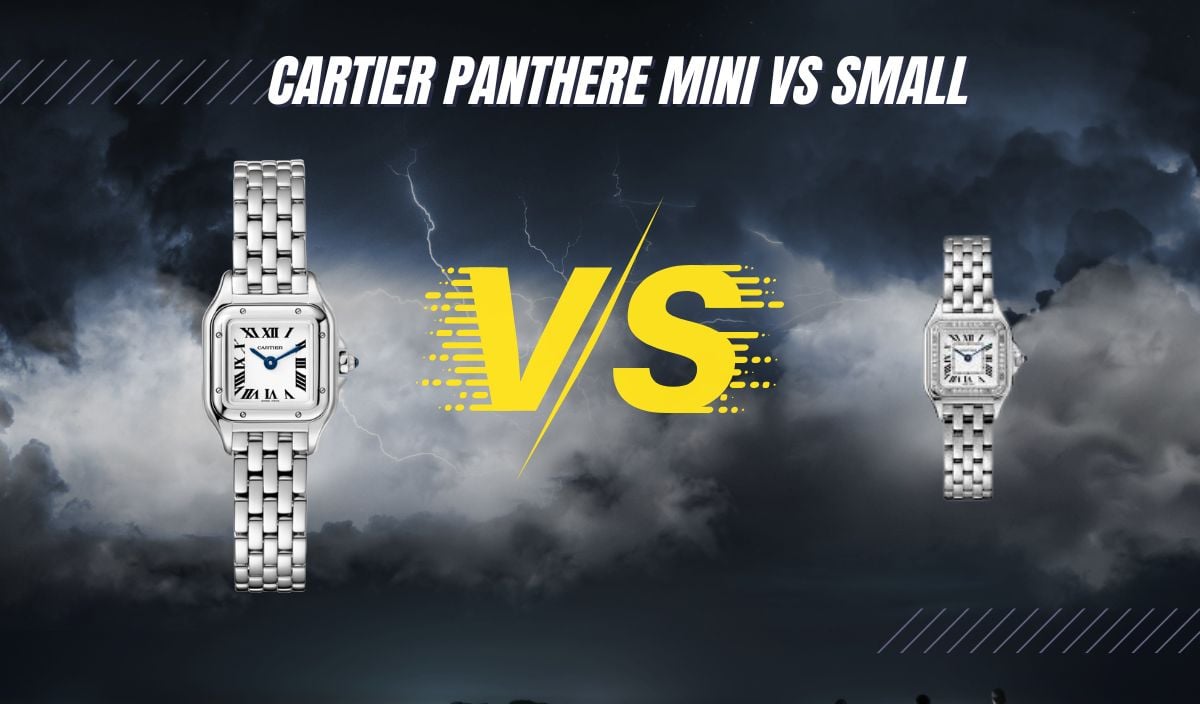
The two variations offer a plethora of sizes, materials, and styles that each hold their own secrets and unique attributes, but how can you be sure that what you are buying truly fits your style? In this article, we will be exploring specifically how Cartier Panthere’s small and mini varieties differ and what you can expect from each size in order to know what fits you best.

bot-only-imagebot-only-image

The Cartier Panthere Collection

The first generation of Pantheres premiered in 1983. Cartier decided they wanted a watch that embodied what they were known best for, that being their prestigious jewelry that echoed a sense of luxury and refinement. Since then, they have steadily increased over the years, with each piece becoming more luxurious than the last. 

The watch was offered in a variety of sizes and materials, such as white and yellow gold, two-tone steel, and two-tone gold. The truly premium pieces offered a combination of materials and plenty of diamond-embedded models, fully displaying their broad range to satisfy their customer base. 

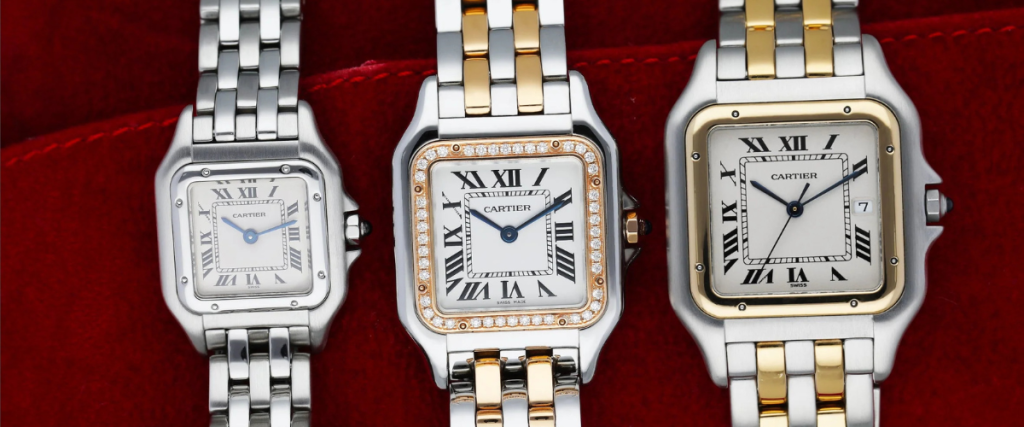
First-generation models were originally offered in five different sizes: mini, small, medium, large, and jumbo, but the sizing has been modified over time, with most first-generation sizes being dubbed as vintage pieces or discontinued altogether. An easy way to differentiate the sizes is to look at the date window and see where it resides. 

The Cartier Panthere was originally marketed to both men and women, with the mini and small editions being classified as lady watches, while the medium was unisex, and the large and jumbo were for men.  

The Panthere captured the essence of the ’80s and ’90s, embodying the fashion of that era while doing its best to boost innovation, standing out as a testimony that truly defined the era in which it was released. 

Many would consider the Cartier Panthere as the first “must-have” luxury watch of its time. The two-tone Panthere were some of the most popular of the collection, featuring stainless steel cases topped with an 18k gold bezel, and the bracelets were a mix of gold and steel links, giving it the flashy aesthetic that so many coveted in those days. 

Since the Panthere collection was released during the quartz revolution, it runs on quartz movement. This allows the Panthere case to be as slim as possible, assuring a comfortable fit regardless of size.

Over the years, Cartier has delivered some truly stunning dial designs for the original Panthere collection. Incorporating stones like malachite, lapis, and obsidian, along with anniversary dials decorated with the double C Cartier logo, the designers know what stands out to their audience and have perfected their designs to be recognizable even without the iconic logo. 

In 2004, Cartier discontinued its entire Panthere collection, leaving a gaping hole in the department’s jewelry collection. In an attempt to fill that hole, the Cartier Santos Demoiselle served as a substitute since its bracelet subtly mimicked that of a Panthere. 

Its time in the spotlight was brief, however. Most deemed the Demoiselle too sporty to fully take the place of the Panthere as it couldn’t quite reach the elevated level of glamour that the Panthere was so highly recognized for. Thankfully, over a dozen years after the discontinuation of the Panthere, it was brought back in 2017 for an entirely new generation to enjoy. 

Now, the Panthere line is better than ever, increasingly expanding with new sizes and dial designs to accommodate the revamped aesthetic of the new generation.  

In 2017, to kick off the collection, Cartier offered the modern Panthere in various metals across two sizes: small and medium. The current Panthere lineup, however, has been expanded to include mini models. 

Just like the previous series, this new lineup of Pantheres come in stainless steel, yellow gold, two-tone steel, two-tone gold, and white gold. Along with the new generation, Cartier has also released new colors. Pantheres can now come in two-tone rose gold, rounding out the collection while satisfying new desires that a new generation may crave. 

Older Vs Newer Panthere

Though difficult to notice at first, there are some minor differences between the older and newer generations of Cartier Panthere watches. For one, the newer collection no longer offers time and date models, limiting themselves exclusively to time only. The bracelets have also been updated to offer heavier links and an improved clasp. 

They also differ in material sizes and choices. There was no trace of rose gold in the previous collection, as that material is exclusive to the newer generation. The sizes have shifted as well, with the largest size of the new generation measuring 27mm, as opposed to the largest size of the older models, which was 29mm. 

Comparing a vintage mini with a modern mini will cause you to notice the lack of a traditional winding crown on the vintage. The older versions featured a push-piece on the case back that was used to set the time on the watch. New Panthere’s include traditional crowns that many new-gen watch lovers are far more accustomed to. 

A powerful testimony to the appeal of the Cartier brand is just how long the Panthere has been in style. Whether it be the iconic vintage look of the 80s and 90s or the remastered masterpieces that they still produce to this day, their fanbase has stayed true, expecting the very best throughout the years. Cartier has delivered time and time again, cementing the Panthere as an undeniable classic that will transcend time in the years to come. Its versatility makes it one of the most coveted pieces on the market. It can be worn anytime, anywhere, and will always catch the eye of any who sees it. The Panthere collection is worth investigating if you’re looking for a superb lady’s watch that is chic and easy to wear. Next, we will dive deeper into the different sizes and determine what fits best for whom.

Cartier Panthere Small vs Mini – The Right Size for You

When you are deciding between the mini or the small variant of the Cartier Panthere, consider the aesthetic impact each size brings to the table. The mini has a more delicate feel to it, exuding a particular kind of subtle charm, while the small tends to make a bolder statement. The small size also offers a broader range of color choices for the bracelet, as well as improved functionality. 

Taking a look inside the sizes, the small features a more advanced mechanism of movement, making it more precise while giving a more accurate reading. Because it is bigger, the small has more room to fit all of the complicated winding and intricate machinery necessary for a precise reading, meaning that if you prefer a watch that runs faster and is more accurate, the small is the way to go. 

It’s also important to look at the differences in pricing to determine which Panthere watch holds the most value and best suits your preferences. It’s difficult to narrow down an exact price on the two since retail and market prices drastically change every day, but it is safe to say that the mini is usually $1,000 cheaper than the small when looking at the retail value. When you have a deeper understanding of the market demand, it can critically assist your decision-making process, ensuring that the watch you select is appealing to you and holds its value over time. 

And, of course, the most obvious tip that I can give you is knowing your wrist size. Obviously, the small and mini watches are set apart by their sizing, so to be sure that you are purchasing a watch that will fit, take wrist measurements before making a decision. You’ll also notice the distinctive differences in wearability and comfort when examining the two sizes. Both sizes vary in strap options, affecting how they sit on your wrist, and the weight of variances contribute to overall comfort during extended wear. 

The good news is that both sizes can be customized with different materials, allowing the wearer to create their own aesthetic. When choosing what fits your piece best, consider the sizing. Some materials stand out in different sizes, so keep in mind that whatever materials you wish to display need to compliment the frame so that you are getting the most from your watch. 

It is important to understand how the shape and size can impact the overall look. Cartier gives you the choice to customize your Panthere. To ensure that what you choose best suits your taste, I would argue that it is necessary to study and learn all of the ins and outs of materials, shapes, dials, and sizing so that you can narrowly determine exactly what speaks to you. Pieces like these are investments. What you choose to purchase can hold a lasting impact on the long-term value. You are robbing yourself of a timeless classic if you fail to do adequate research and learn what is valuable and what is not. 

Conclusion

When looking at the exciting history of the Panthere, it is clear to me why this piece has become a household name for so many enthusiasts. I, for one, am grateful that Cartier felt the need to return this collection to its former glory, as there are truly some remarkable pieces in the lineup. When it comes to pieces like these, sizing matters. You obviously want something that is comfortable, but you also want something that fits your style. The best advice that I can give is that if you prefer a more chic, low-key, subtle tone, then go with the mini (providing that it fits your wrist, of course,) but if you want a bolder, more glamorous piece, go with the small. Although both will prove objectively more subtle when compared to bigger sizes. The beauty of the Panthere, however, is that there is no objective “this size is better than this one.” Though sizing is necessary to determine how well it fits, the Panthere relies heavily on personal customization as well, giving the wearer free rein to create their aesthetic, guaranteeing that no matter what size you pick, you will be truly amazed at the quality of this watch. 

To Top