News Archives - Page 32 of 55 - Exquisite Timepieces
iconHome Blog / News / Page 32

Category: News

Grand Seiko SBGW301 Review: One for the Special Occasions

Paul Rothbart

December 17, 2024

Over time, the way people dress has gotten more casual. You don’t see men wearing suits every day or even to most jobs. With casual clothes come casual watches. Tool watches such as divers and chronographs fill the collections of many watch lovers.

However, you may need to dress it up every once in a while. You could be invited to a wedding, a job interview, or another event where you need more formal attire. In these situations, you’ll need a watch to match the level of formality. Not that you can’t wear a diver with a suit, but a dress watch will elevate your appearance.

bot-only-imagebot-only-image

If, like most guys, you have one suit, you should have one dress watch to go with it. You want it to be elegant, accurate, and reliable, and a brand that checks all those boxes is Grand Seiko.

For more than 140 years, the prestigious Japanese watchmaker has been creating timepieces that rival anything coming out of Switzerland. If you are looking for a classic dress watch to complete your best outfits, look no further than the Grand Seiko SBGW301 Elegance Manual. Let’s take a good look at this stunning timepiece.

History
Grand Seiko has produced many mechanical dress watches over the years and continues to update them. The models in the Elegance Collection are among the finest. 

In 2017, the brand released the stunning hand-wound SBGW231, which was a hit with many watch lovers. The simple three-hand, cream-colored dial was appreciated for its simplicity and beauty. It was essentially a newer version of 2001’s SBGW001, which was, in turn, inspired by the original Grand Seiko released in 1960.

More recently, Grand Seiko created an updated version of the 231, the SBGW301. Released in January of 2024, the 301 also has a manual mechanical movement free from complications. With a few slight changes, the newer model is proving to be every bit the classic its older sibling is. 

Case

The 316L stainless steel case is 37.3 mm in diameter, a perfect size for a dress watch. Small enough to be elegant but big enough to suit small to average-size wrists. With a 43.3 mm lug-to-lug and a thickness of 11.7 mm, it will easily slide under a shirt cuff and maintain a low profile, as any good dress watch should. 

The surfaces of the case are brushed and polished using Grand Seiko’s trademark Zaratsu process. This gives it depth, and its sleek lines combined with the gentle curves of the lugs make for a truly beautiful case.

The scratch-resistant sapphire crystal is double-dome, which makes up a significant part of the watch’s thickness. A sapphire is also used for the exhibition case back. It’s nice for fans of fine horology to be able to take a peek at the movement, especially with a brand that puts this much into the design. 

As you would expect, the crown is a simple push-pull and is only needed for winding and setting the time. The water resistance is only 30 m, which is perfectly acceptable for a dress watch. The crown is large, which makes the case seem a bit bulky. But that does make it easy to grip when winding.

Dial

When it comes to watch style, it’s all about the dial. It’s where you look to see the time and draws more attention than any other part of a watch. Grand Seiko excels at pretty much every aspect of watchmaking but it’s their dials that really steal the show.

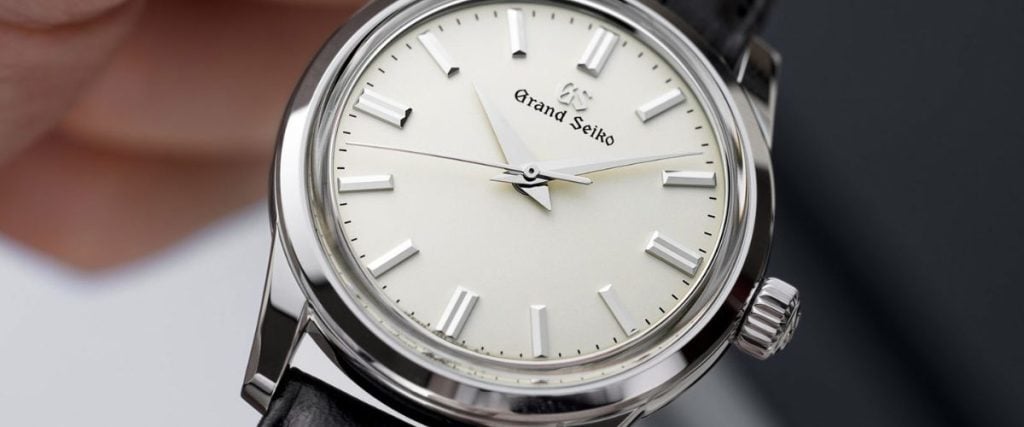
The dial on the SBGW301 doesn’t have a texture like so many Grand Seiko models. But the smooth finish fits perfectly with its dress watch elegance. The color is a beautiful ivory. White is a suitable color for a dress watch, but it can seem stark and antiseptic. The dial of the 301 is subtle but carries just enough color to give it added interest.

The indices are precision-cut, brushed, and polished stainless batons with double batons at three, six, nine, and 12 o’clock. The hands are also stainless with brushed and polished surfaces. The minute and hour hands taper, and the second hand is a needle. They stand out nicely against the dial, making the watch easy to read but not flashy.

Simple black ticks around the outer edge of the dial form the minute track. Applied at 12 o’clock in stainless steel is the Grand Seiko logo with the name in black underneath. There is no other text on the dial, maintaining the minimalist look. It’s classic Grand Seiko, and the lack of a date complication only adds to the dressy elegance of the dial and the entire watch. 

Movement

The watch is powered by Grand Seiko’s in-house Caliber 9S64 mechanical manual movement. With 24 jewels, it operates at 4Hz and with adjustments at six different points, has an accuracy of -3 to +5 seconds per day. Better than COSC so you won’t have to reset it too often. Although not an automatic movement, the 72-hour power reserve means you won’t have to wind it every day. With a timepiece this nice, you will likely enjoy the winding experience. If you wear it to work, you can put it down over the weekend and it will still be ticking Monday morning. 

It’s an attractive design too. Thanks to the exhibition case back, you can view the brushed and polished stripe pattern and the engraved Grand Seiko logo and name in black. The movement specs are engraved in shiny gold and you can watch the balance wheel do its work.

Straps

The strap of a watch should do more than just hold it on your wrist. Ideally, it complements and enhances the style and character of the timepiece it’s attached to. The SBGW301 has a strap that pairs perfectly with the case.

A deep black crocodile leather strap contrasts the stainless case and also looks great with the ivory dial. The leather is soft, flexible, and very comfortable. It is attached with a pin buckle adorned with a vintage Grand Seiko logo, a tribute to the brand’s heritage that adds to the style of the watch.

The lugs are drilled, making switching out the strap easy. The lug width is on the small side at 19 mm, and it may be tough to find straps in that size. Honestly, you can’t top what Grand Seiko did here and probably won’t want to change the strap anyway.

On-Wrist Experience

Let’s talk about how the SBGW301 looks and feels. My frame of reference is my average-sized 7.25-inch wrist. I prefer watches in the 40-42 mm range. As a high-end dress watch, the small case of the 301 looks good on my wrist. Given that I would only wear it when dressed up, I think I like the smaller case better than my typical size watch. 

If your wrist is small to average size, you are not likely to have a problem with the 301. People with bigger wrists approaching eight inches will probably find it too small, dress watch status notwithstanding.

As for comfort, it feels very nice. It’s not a heavy watch at all and the crocodile strap is soft and supple. If you have it adjusted properly, you may not even be aware that the watch is held on with a strap. It will easily slide under a shirt cuff, tucked away neatly until you need it.

The color scheme is perfectly neutral. I like it better than plain white. Ivory adds interest, but will go with another color you may wish to wear. Hot, warm, cool, earth tones, you name it, you can wear it with the SBGW301.

You don’t have to be in a tux but you will want to be dressed fairly well when you wear it. It will work with a suit, blazer, or sport jacket, with or without a tie. I wouldn’t wear it with something as casual as a polo shirt though. A nice long-sleeve button-up is the way to go.

Price & Availability

The price may surprise you. The SBGW301 retails for $4,900. This is quite a bargain, considering it is just as nice, reliable, and accurate as many watches that cost two, three, or four times as much. You get a lot for your money from Grand Seiko.

You can pick up a brand-new model from a Grand Seiko boutique or their website. These beauties are also available from a Grand Seiko authorized dealer, such as Exquisite Timepieces. If you’re in the neighborhood, stop by our Naples, FL, boutique to try one on.

You can also order one from our website. We offer free domestic shipping, and as an AD, you will receive Grand Seiko’s five-year warranty. Whether you visit in person or online, our knowledgeable and friendly sales staff will be happy to assist you.

Should you decide to take a look at the preowned market, you won’t have any trouble finding a 301 for between $3,500 and $4,500.

Conclusion

Casual is nice. Casual is comfortable. But sometimes, ya gotta dress up a bit. Having the right watch is the finishing touch to a stylish and elegant outfit. Grand Seiko does dress watches well, and with its neutral colorway, small case, elegant, vintage lines, accuracy, and Grand Seiko reliability, you owe it to yourself to take a look at the SBGW301.

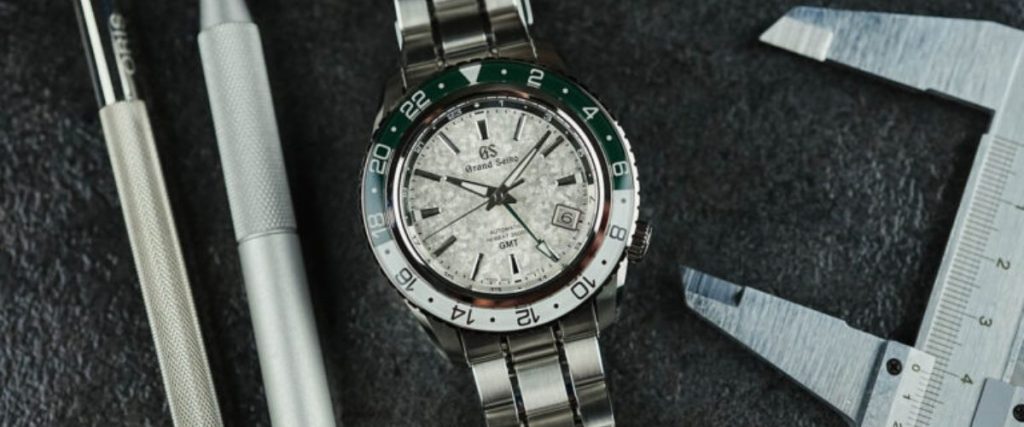
If you want to know what makes the Grand Seiko SBGJ277 “Sekkei” so special, I mean really peel back the layers to the design, you likely already know a thing or two about watches. In fact, you’ve probably lost yourself down the odd rabbit hole or two before now. 

They have a knack of getting under your skin. And, like me, you probably feel that press releases and basic reviews don’t cover the level of detail you need when you’re about to make a substantial investment in a watch, right? 

bot-only-imagebot-only-image

For me, a large part of quelling that curiosity and intrigue about a watch is understanding and learning about what keeps it ticking. Luckily, for a watch like the Grand Seiko SBGJ277 – the beating heart is a large part of its design. 

A Quick Overview of the Grand Seiko SBGJ277

Grand Seiko is heralded as one of the world’s greatest leaders in mechanical accuracy and has a backstory that outlines a rich tapestry of movement manufacture – each one pinpointing an important landmark and detailing the evolution of the company. 

When Grand Seiko launches a new product, it automatically becomes part of that backstory, like the “Sekkei” or “Snow Valley” – a GMT with a splendid color variation that arrived during Watches & Wonders earlier this year. It carries a movement from the 9S Calibre series, which ultimately became a philosophy of sorts. 

In fact, several models that adopted this same design language were designed by a CAD/CAM system and played a crucial role in forming the backbone of many Grand Seiko designs that followed. Furthermore, what made these innovative designs special was their ability to deliver a mechanical accuracy that previous models had never reached before.  

That series still runs today, and you can find some of its finest examples in models like the Grand Seiko SBGJ277 “Sekkei” – a design inspired by a phenomenon that occurs across the tops of Japan’s luscious mountains during the summer. 

If you’re ready to add a practical and super-accurate watch with tons of sartorial elegance to your collection, prepare yourself for the “Sekkei” – a watch that joins a stable of other snow-inspired dials and one that I feel equally deserves as much recognition as the coveted “Snowflake” itself. 

The “Snow Valley” has to be one of my favorite Grand Seiko watches of all. It speaks a language of intelligence, sophistication, and elegance. The green color on the GMT bezel, although deep, does pop on the wrist, and the texture of the dial is great for wearing on most occasions. 

Although the dimensions look large on paper, this is a watch that’s going to wear smaller on the wrist. I’d say it will work well for anything over a 7.5-inch wrist. On top of all that, the mechanical movement inside is not easy to manufacture, which, for me, is part of the appeal. 

And although Spring Drive is what many connoisseurs consider the pinnacle of Grand Seiko’s mechanical prowess – I happen to think differently. While we’re on that note, there’s a reason why this watch costs more than some Spring Drive watches, and I’m going to outline some of them in this review. 

The Background Behind the Grand Seiko SBGJ277 

There is nothing new about Grand Seiko watches taking inspiration from nature. The vast, picturesque landscapes surrounding the brand’s design studios form a backdrop that has long been a source of inspiration for some of the brand’s most beautiful handcrafted dials. 

But snow in the summer is not something we see every day, and, like many natural phenomena, Grand Seiko chooses to celebrate this seasonal spectacle with another meticulously crafted dial. 

At Grand Seiko, the dials do all the talking. They tell the story of the brand through chapters. Many designs, just like the SBGJ277 “Sekkei”, are guided by the company’s “Nature of Time” philosophy. 

And while most fans of the brand will already be familiar with the “Snowflake” watch, there are other distinct dials worth mentioning at this point. Take, for example, the SBGJ201, with a dial inspired by the exposed mountain face of Mt. Iwate, or the ref. SBGJ251, which mimics the verdant boom of the spring equinox? 

There’s the Birch tree-textured dial of the Grand Seiko SLGH005 and models inspired by the rippling waters of ponds and lakes in Japan’s summertime. From the colors and the textures of the country’s 24 changing seasons (or sekki”) to ice formations, falling blossoms, and the growth rings of an ancient tree – Grand Seiko is dedicated to showing the truest expression of its work in all that it does. So, let’s take a closer look.

A Deceptively Manageable Case

So, here are the all-important case dimensions you’ll need to know if you’re seriously considering adding the “Snow Valley” watch to your collection. The case diameter measures 42.4mm, and the thickness – 14.4mm. The case length is 50.6mm, while the lug width is 20.8mm. The crystal diameter on this watch is 31.4mm. 

What I particularly like straight up about this case is the matt finish GS experts give to the top of the lugs. It donates a modest edge to the design, making it easier to pair with casual attire as well as something dressy.

The polished case sides are not just any polished sides, either. They’re the signature Zaratsu polish that Grand Seiko is so renowned for. The crown is another eye-catching feature. Being a sports watch, experts at Grand Seiko position it at the 4 o’clock location, engraving it with the GS logo on the surface. 

The first thing I noticed about the bezel when I turned the case to the side is that it sits slightly above the case top, sealing to a domed sapphire crystal glass that provides adequate protection over that beautifully textured dial. The bezel (which moves bidirectionally), along with the dial, is the star of the show in this design and serves a dual purpose.

As if often seen in GMT watches, the bezel is segregated into nighttime and daytime hours. The nighttime hours are represented in the deepest green color – a shade that almost looks black under certain lights. Grand Seiko designers apply the numerals between 18 and 6 in white, while the remainder showcases the opposite – the daytime hours in white with deep green numerals. 

I like this juxtaposition. It’s a rare and alluring one that interacts beautifully with the nuances of the snow-effect dial texture. Smoother and quieter than a dive watch bezel, aligning the bezel with the GMT hand is an absolute breeze and certainly adds a fun edge to shifting across time zones with a companion like this. One more note on the bezel – its green proportions interestingly take up more real estate than the white, which adds a rather unusual dimension to the design.

Another Snow-Inspired Dial

Representing the beauty of the snowy valleys that form the landscape surrounding Grand Seiko’s Shizukuishi studio, the SBGJ227 is not the first to capture this unique location, as we know. 

Popular for its cold winters and mild summers, this region of Iwate hosts several special species of alpine flora, a rugged scenic shoreline, National Trust parks, crisp ski resorts, and a dusting of powdery snow atop its mountainous regions all year through, even in the summer. It is this particular phenomenon that Grand Seiko skilfully captures across the milky white nuances of its beautifully textured dial. 

I love the layers, dramatic drops, and contrasting levels across the dial. Although subtle, they almost look like folding sheets of fabric draped on top of one another. Sometimes, the silvery nuances look nearly iridescent, and at other times, they mimic the look of silk or satin as they catch the light in ways unique to the Grand Seiko style. 

Grand Seiko experts finish the indices on this dial to perfection, with rectangular-shaped appliques featuring around the hour track, along with rhomboid hour markers at the 3, 6, 9, and 12 o’clock locations. 

Black minute sticks feature between each hour marker and a bi-color hour track can be found around the flange. Decorated in the same way as the bezel, the additional 24-hour track is finished in white and green, offering the advantage of a third timezone. The dauphine hands are squared off at the tip, creating a crisp and legible profile to track at a glance whenever you need to check the time while on the go.

Following the GMT hand is easy, too. Trimmed in deep green,  it features a triangular tip filled with luminous material to assist with timekeeping in the dark. Meanwhile, the silver, luminous-treated hour and minute hands are joined by a sweeping second hand that glides effortlessly across the snow-inspired dial. 

Of course, it’s the Hi-Beat movement that propels this hand with such grace and decorum. Even though the smoothly sweeping hand is a given in any Hi-Beat watch from Grand Seiko, it’s still a huge gain for me. Look to the 3 o’clock location, and you’ll find the date set behind a color-matched background for legibility, too.

10 Beats Per Second

The Grand Seiko “Snow Valley” watch belongs to the brand’s Sports Collection and takes inspiration from the original 44GS watch, released in the 1960s. That model housed a 10-beat manual movement that promised levels of the highest accuracy. 

Leveraged by the invention of new alloys and components, Grand Seiko moved closer, inch-by-inch, to achieving the “ideal” watch, making a lasting contribution to the global standard in watchmaking precision. These specially adjusted hi-beat movements set the bar in accuracy and, for over half a century have been manufactured in-house at Grand Seiko – thus the Grand Seiko SBGJ277.

Where else would a sports watch like this be built than at the company’s Shizukuishi Studio? After all, it is the birthplace of the brand’s proprietary Hi-Beat movement. 

From the entry-level Calibre 9S85 to the state-of-the-art, all-bells-and-whistles Calibre 9SA5 with dual impulse escapement – these ateliers offer quite the public experience – a place where collectors can let their horological dreams play out before their eyes as they absorb the atmosphere of one of the world’s most impressive nerve centers of precision timekeeping. 

Grand Seiko collectors can schedule a tour of the place and immerse themselves in an educational mystery tour of calibers, artifacts, and workshops that tell the story of the brand thus far. The studio opened in 2020 – three years after the company became an entirely separate brand from Seiko Watch Corporation and marked the 60th anniversary of the brand. 

Here, the fabrication of the components for each movement and the assembly and finishing of a watch is a very unified front. All parts of a Grand Seiko watch seem to work with a sense of equilibrium with one another, and the movement has a large part to play in that. 

Grand Seiko’s Hi-Beat movements are not all that common in watches today. The movements beat at a rate of 36,000 vibrations per hour. We already know that the benchmark standard for a well-running mechanical timepiece is 28,800 vibrations per hour – in other words – 8 beats per second. 

For the record, that’s more than enough for excellent accuracy, without imposing wear and tear on the delicate components of the movement. For a little perspective, due to the faster vibration rate of the Hi-Beat movements Grand Seiko was capable of producing (10 beats per second), these movements not only offered better accuracy but also higher resistance to shock. 

They also consumed more power from the mainspring. The 9S mainspring fitted to the heart of watches like the “Sekkei” for example, can produce a power reserve of 55 hours, making it particularly weekend-friendly movement.

The Strap

Starting with the lugs of the Grand Seiko SGBJ277, these are drilled, leading to a 21mm opening. Such a lug width is not as common as a 20mm lug width, so finding strap options will require a little extra vigilance to ensure you’re selecting the right size. 

That said, there are plenty of calf leather, alligator leather, and textile straps measuring 21mm on the market, as well as on the official GS website, that would be fun to play around with. I’d be particularly interested in seeing this watch on a dark green leather band to match the bezel details, but I also like the idea of a dark grey calfskin band. 

The stainless steel bracelet the watch naturally comes fitted on, however, tapers down to 18mm and features a milled folding clasp, signed with the GS logo, and a micro-adjustment feature for achieving a close, comfortable fit.

On-Wrist Experience

Watches with a 44.3mm diameter are obviously going to get some attention. If you like large watches, then don’t let the deets on paper put you off the Grand Seiko SBGJ277 “Sekkei”. 

Although slipping under the cuff of a shirt may not be its natural habitat, the watch is saved by the way it manages to belly out at the sides, spreading some of that depth. Topside, however, this watch is going to look like you’d imagine a watch of such proportions to look. Large and confident.

A double-domed sapphire crystal up top gives the dial plenty of protection but unfortunately, this does serve as a bit of a thickening agent on the case, giving it a somewhat chunkier aesthetic when you view it laterally.

Price and Availability

There is no scooting around the $7,200 price tag of the Grand Seiko SBGJ277. It’s expensive. But what do you get for this, exactly? Well, the mechanical Hi-Beat movement is a specialty of Grand Seiko’s, offering supreme accuracy and a high-end finish, as is the intricate craftsmanship of the case shape and the Zaratsu finishing.

It’s more expensive than the Spring Drive movement, and although with a Spring Drive, you can’t see the beats in the seconds hand, the clean sweep of the seconds hand in this Hi-Beat watch is just as impressive. The watch is part of the current Sports Collection, too, so you won’t need to worry about availability or sourcing one from Exquisite Timepieces.

The Takeaway

The Grand Seiko SBGJ277 is an impressively built, powered, and engineered GMT watch for travel. Its silvery white dial, when paired with that deep forest green bezel, makes time zone tracking an absolute delight. 

At 44.3mm the watch may sound large, but the case profile is what makes a difference to its wearability. The bracelet is the balancing ingredient to this recipe, and with micro-adjustments that help make it sit more snug against the skin, you’ll want to show off that snow-inspired dial all day long.

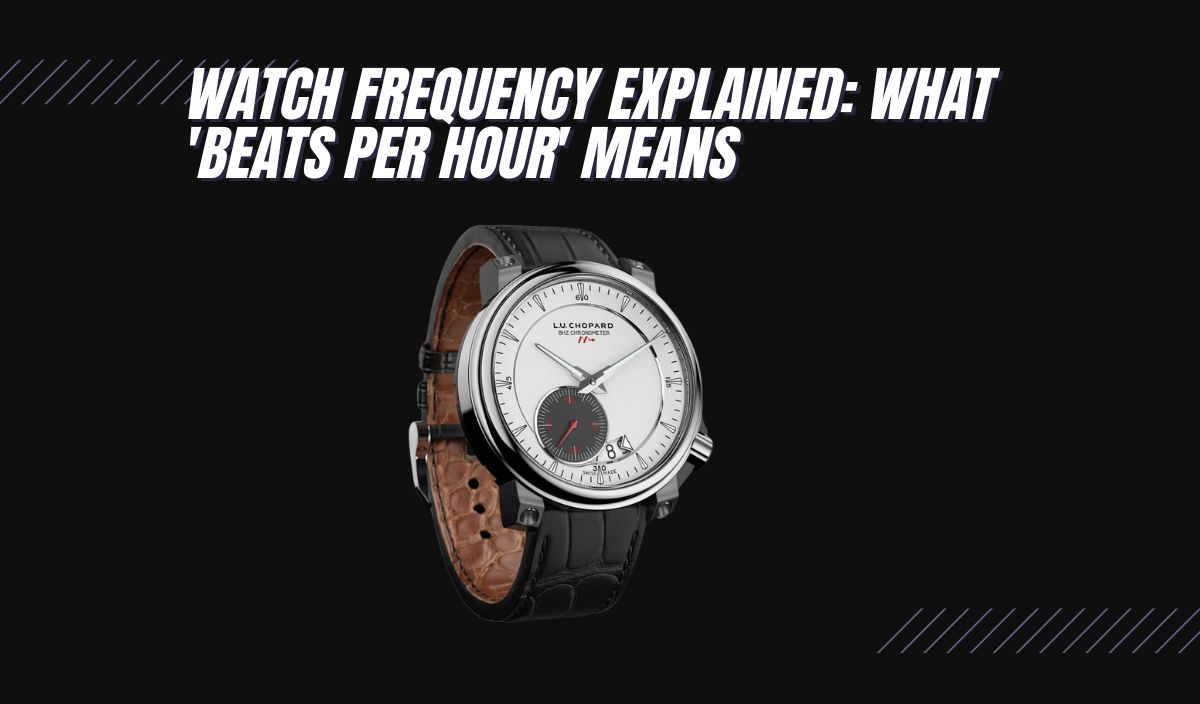
Watch Frequency Explained: What “Beats per Hour” Means

Alex DeVane

December 17, 2024

At this point, it’s not up for debate that watches are masterful works of art. Today, the skill of the average watchmaker is the highest it’s ever been, with designs only increasing in aesthetical prowess, polishing becoming more precise and elegant, and the mechanics only becoming more intricate and more dynamic. 

As watchmakers hone their craft and continue to give us complicated masterpieces that defy everything we thought was possible in the world of horology, it can become increasingly difficult to keep up with all the designs and materials, but most of all, movements. 

bot-only-imagebot-only-image

Just how precise do you need your watch to be? Does speed have anything to do with it? What is frequency? What does “beats per hour” mean? All valid questions that can confuse many who consider themselves experts in the field. 

Explaining the Frequency of Watch Movements

To explain it as simply as possible, a watch’s frequency is explained by the total number of oscillations the hairspring and balance wheel perform over time. This information is shared in either the movement’s total Hertz (Hz) or vibrations/beats per hour (vph/bph). 

If a watch ticks at 10 hz or 72,000 vph/bph, this means that the balance wheel is experiencing 72,000 oscillations per hour. But how is that determined? (Stay with me; we’re going to have to do a little math.) 

A single oscillation translates to a total of two vibrations/beats per second. A vibration or beat is only counted when the balance moves in a single direction and the oscillation is counted when it moves back to its original position (this is the tick tock sound that you hear when you press your ear up against the dial.) Because it swings back and forth like a pendulum, there are two movements (tick and tock) before the oscillation occurs. 

For a 10hz watch, ten oscillations per second equals twenty vibrations/beats in the same period. Since there are 3,600 seconds in an hour, you multiply twenty vibrations/beats by 3,600 to get 72,000 vph/bph.

At first glance, it can be confusing. Once you understand how fast your watch moves, however, it’s quite simple to calculate the vph/bph—and that’s if you have to calculate it at all; most watches simply tell you. 

Watches have evolved from the simple, slow-moving mechanical pieces from back in the day. Traditional, low-frequency mechanical pieces are timeless classics, most would agree, but now, with the introduction of quartz technology, watches are able to reach frequencies never before imagined by anyone in the scene. 

Despite the dominance of quartz moveme,nt however, many watchmakers sought to revolutionize mechanical watches by producing a new type of movement called High-Beat movement. These pieces aim for a frequency exceeding 28,800 vph/bph, aiming for even greater precision while keeping the iconic look of traditional mechanical pieces. 

As the industry continues to evolve, I would encourage all enthusiasts to properly research what kind of movement they are looking for, and what it does concerning the rest of the piece. 

As new movements develop and technology advances, the potential for watchmaking only grows, with new power looking to be harvested around every corner, and truly revolutionary frequencies waiting to be discovered and enjoyed by all enthusiasts and casual wearers alike. I am excited, and you should be too. 

Different Watch Frequency Speeds

The four most common frequency speeds are:

  • 28,800 vph (4Hz)
  • 21,600 vph (3Hz)
  • 36,000 vph (5Hz)
  • 18,000 vph (2.5Hz)

If you are looking for anything faster and more accurate, you’re most likely going to be spending a little more money while shopping at more widely recognized names. For the average consumer—and even a collector who does not particularly care about the movement of his piece—these speeds will do more than enough. 

Higher frequencies are associated with more high-end names, but there are plenty of “slower pieces” that are considered to be extremely well-made watches. Don’t think that your watch has to reach an absurd frequency to be considered a “proper piece” (whatever that means). There are plenty of other factors that can contribute to the quality of your watch’s movement

Is Speed the Only Thing that Matters in a Watch Movement?

Speed is only one of the key ingredients that a high-quality watch requires to perform well. We already talked about watch frequency, but there are many more components that regulate accuracy, the precision of the gears, and many more. 

For example, jewels in watches aren’t just for show. Although they do look beautiful, they act as bearings for the gear train. Jewels have little to no friction, which makes them perfect for helping move the energy from one part of the watch to another. 

Jeweling was invented at the beginning of the 18th century, and the advantages it brought to the table were made clear once the production of synthetic rubies became more practical and common. Today, most jewels are friction fit into the watch movement. 

Funny enough, there is much more information associated with water resistance than you might think. There are two different standards for water resistance—divers watches and normal watches. 

The primary difference is the rigor and frequency of testing. For example, say you were wearing a watch with a 30-meter water resistance. That means that your watch will most likely be okay should you decide to submerge yourself 30 meters underwater (recreational diving takes place between 30 and 40 meters; that’s why this information is relevant). 

But, for diving watches, the testing criteria would obviously have a higher standard because divers are exposing themselves to higher water pressures. The standard for dive watches is 100-meter water resistance at a minimum, which is double the depth of recreational measurements, so any modern watch at that rating would be exceptional for any basic water activity. 

Most people won’t need anything beyond that, but for the deep-divers, there are watches that come with a 300-meter water resistance. If any casual watch wearers were to purchase one of those, then be assured your piece will never even feel damp, let alone damaged.

At this point, most automatic watch movement is universal, with most clocking in at 28,800 vph. Countless engineering decisions achieve every mechanical movement, each one coming essentially at the expense of the other.  

For example, a high-beat movement will come with better rate stability, assuming that all other factors are equal—but all other factors are never equal. What makes the watch movement seem like a never-ending dilemma is how the problems and benefits of various beat rates are addressed in the movement itself. A modern watch running at 18,000 vph should immediately catch your eye. Anything above 28,800 should as well. 

I guess the final question that remains is: is a high frequency actually better? To put it simply, watches that beat at a higher rate are more accurate because the faster the balance oscillates, the quicker the recovery time. The tradeoff, however, is that due to the faster and more frequent movement, wear and tear is increased because there is far more pressure being placed on the wheel pivots. 

So, if you purchase a watch with a higher frequency, be sure to schedule routine checkups to ensure that wear and tear doesn’t cause any substantial damage. A high-beat watch isn’t necessarily better than a low-beat watch; it just means they are different. Each presents their own benefits and drawbacks. 

For example, a lower-frequency watch wouldn’t have to be checked up on as much because it’s not putting as much strain on the wheel pivots as the higher-frequency watch is. Lowering the frequency also raises the watch’s overall power reserve. This is because less energy is being consumed due to the slower movement, allowing for a longer duration. 

The drawback of low frequency is that—obviously—you are getting a less accurate reading, and it’s not moving as fast. It all just depends on what you deem to be the most valuable aspect of your timepiece. 

Every avenue of watch preference (and preference of all things in life, for that matter) comes down to what you personally want as a consumer. 

We live in a world where nothing is perfect, and we will always have to sacrifice one thing to gain the benefits of another. I can’t tell you whether a higher frequency is better or worse than a lower frequency. I can only give you the facts of each and let you decide which one is calling your name. 

Conclusion

I know, I know, there’s a lot of information. Realistically, this article could have filled ten pages talking about the intricacy and minute details of the inside of your watch, but I didn’t want to torture anyone. 

I hope that it’s all a little more clear and that you have grasped the basic understanding of what everything means so that you can decide for yourself what fits you. 

Because—ultimately—there’s no right or wrong answer, but there is a substantial difference between someone who has no concept of the facts and is shopping for watches blindly and someone who is more informed and won’t waste their money on a watch that they hate. My best advice is to stay educated and informed on all the latest watch news so that when it comes time to purchase, you know exactly what you are buying. 

Watch Certification: COSC and Others Explained

Benedetto Youssef

December 17, 2024

I remember the first time I realized just how important watch accuracy was. I was just starting out on my watch journey, still exploring the world of cheaper homage watches with low-end Chinese movements. As far as I was concerned, if it slightly resembled an Omega Seamaster and ticked, it probably was good enough to reliably depend on. Little did I know.

I remember wearing the watch for a few days—not really thinking about checking the accuracy of its timekeeping. It was ticking, after all, so that meant it was working. A week later, I was ten minutes late for a college course I was teaching. Ten minutes late? How the heck did that happen? 

bot-only-imagebot-only-image

Well, it turns out the watch was losing about a minute and a half per day. A quick trip to my jeweler, and he adjusted the watch so that it wasn’t so inaccurate. I learned my lesson: Buy once, cry once. Chinese “off-brands” are able to sell watches so cheaply because the quality control and fine adjustment aren’t quite there—if present at all! 

The lesson here is that accuracy matters. Never forget!

The COSC Chronometer Certification

In the mid-20th century, as the demand for accurate timepieces grew across the globe, the Swiss sought to create an independent timekeeping standard that only the best quality movements could achieve. 

We call these watches COSC-certified or chronometers. COSC, as is defined by the watch industry today, is the rigorous timekeeping standard created by the Official Swiss Chronometer Testing Institute—for you language aficionados, also known as Contrôle Officiel Suisse des Chronomètres—in 1973. 

This “ISO 3159” standard subjects mechanical movements (both automatic and manual winding) to a 15-day testing process, which measures accuracy across five positions and three temperatures. If the watch maintains a daily timekeeping rate of at least -4/+6 seconds per day, then it receives the badge of honor: COSC certified. 

Other Chronometer Certifications 

While “COSC” is the standard by which all others are measured today, it actually wasn’t the first “chronometer” certified movement, nor was it the last! The following is a list of timekeeping standards used both within and without Switzerland, with the majority still in use as of my writing this article!

Superlative Chronometer 

The King wears the crown, after all. That’s right, folks, Rolex is the earliest on this list to offer a Chronometer standard better than the COSC Chronometer certification. In the 1950s, Rolex began offering Superlative Chronometer watches to differentiate themselves from other Swiss competitors and establish themselves as a leader in precision and reliability.

And although Rolex had been releasing COSC-level watches for decades prior, this was done through various independent observatories, not by the aforementioned body, which became the central authority, standardizing it under one unified body in 1973. 

It’s worth noting that Rolex didn’t only offer “better” than Chronometer timekeeping—the brand absolutely crushed the standard, with their Superlative Chronometer watches all maintaining accuracy of at least +/- 2 seconds per day. Today, the entire Rolex catalog of watches comes standard with Superlative Chronometer accuracy. 

Like I said—they wear the crown for a reason! 

METAS Chronometer 

As I’m typing this, I am staring at my Omega Railmaster—at the small white lettering that reads, “Master Chronometer.” Never to be outdone by Rolex, in 2015, Omega set an even more rigorous standard, claiming, “To own a MASTER CHRONOMETER is to be confident that your watch has been certified not once – but twice!”

Indeed, Omega does certify their METAS watches twice: once with Contrôle Officiel Suisse des Chronomètres, ensuring it meets standard COSC parameters and is accurate to -4/+6 seconds per day, and a second time by METAS (Swiss Federal Industry of Metrology), where it undergoes an additional and more rigorous 10 days of testing to ensure the watch can withstand magnetic fields up to 15,000 gauss, maintain an accuracy of 0/+5 seconds per day after casing, be tested for water resistance to its specified depth, and have its power reserve verified to match the advertised duration.

What’s more interesting—and unlike standard COSC watches and even Rolex’s Superlative Chronometer watches—is the fact that Omega offers full transparency, available online, for the results of each and every METAS-certified watch they sell. It’s pretty cool to be able to log onto the site and see your individual watch’s results, I have to admit. 

German Chronometer Standard 

Enter the Germans. No really—whenever great horological houses are discussed, it’s always the big three that are mentioned: Switzerland, Germany, and Japan. Of course, great watches, both entry-level and luxury, come from a great host of nations, like anything else. But Germany, especially the city of Glashütte, has been producing highly accurate timepieces for hundreds of years. 

The German Chronometer Standard was first introduced in the 20th century under the “DIN 8319” standard, which in actuality closely mirrored COSC’s ISO 3159 standards. The difference is that DIN 8319 only tests fully cased watches, whereas ISO 3159 tests movements alone. 

For me, it always felt a bit like, “Hey. We can do this too. Our standards are at least equal to, if not better than the Swiss!” Either way, you can have peace of mind knowing that if you have a German Chronometer Standard watch, you will have superb accuracy, durability, and craftsmanship present.

Grand Seiko Special Standard 

If you’ve heard of Grand Seiko—and if you haven’t, have you been living under a damn Rock?—you know that they are renowned for their dials, meticulous craftsmanship, and their Spring Drive movements. 

These hybrid quartz-mechanical movements are accurate to +/-15 seconds per month, but they do use quartz oscillators and, therefore, do not fall under the purview of COSC or any mechanical movement standard. You might be asking yourself, then, what in the world is “Grand Seiko Special Standard?”

Here at Exquisite Timepieces, we aren’t only in the business of selling watches but also informing our audience about horological history and innovation! In 1960, the first Grand Seiko had “Chronometer” on the dial as an indication of its superior accuracy, rivaling the standard set by the Bureaux Officiels de Contrôle de la Marche des Montres of the time.

This only lasted for 6 years, however, and in 1966, Grand Seiko introduced its own standard: Grand Seiko Special Standard. These mechanical movements would undergo a 17-day vigorous testing period, in which the movements would be subjugated to temperature and position variation. Watches would only pass and be designated with Grand Seiko’s Special Standard if they had precision rates of at least +4/-2 seconds per day! 

Qualité Fleurier Standard 

In the world of Haute horology, or high horology, the Qualité Fleurier Standard is the absolute gold standard. Established in 2001 in Fleurier, Switzerland, it is considered to be one of the most prestigious and demanding certifications in the industry. 

Not only does it measure the accuracy of a timepiece, but also the reliability, durability, and finishing of both the movement and the timepiece. 

The Qualité Fleurier Standard also requires that all components of the timepiece, from the dial to the case, hands, and indices, be manufactured and assembled in Switzerland. It is worth noting that the movement accuracy must meet ISO 3159 (COSC) standards. 

Because of these stringent requirements, only a handful of high-end Maisons qualify for the Qualité Fleurier Standard—watches like Parmigiani Fleurier, Chopard, and Bovet. 

Patek Philippe Seal 

Arguably the centerpiece of “The Holy Trinity” of watchmaking, Patek Philippe holds a venerable “grail” status amongst most enthusiasts. I recently had the opportunity to try a platinum World Time on the wrist. 

It was my first hands-on Patek Philippe experience, and the whole thing lasted about 20 seconds but left me thinking about that watch in the days, weeks, and months to come. It was beautiful.

In 2009, Patek Philippe introduced their own in-house certification, replacing the Geneva Seal—a historic sign of Swiss watchmaking excellence. Going beyond the stringent requirements of the Geneva Seal, the Patek Philippe Seal covers the entire watch: case, dial, hands, bracelet, movement finishing, and performance. 

We already know how “perfect” Patek Philippe’s are in terms of finishing, but the Patek Philippe Seal also calls for a greater than COSC accuracy of -3/+2 seconds per day. Make no mistake, folks—this is Patek proclaiming loud and clear for all those to hear, “We set our own standards of excellence.”

Why is Chronometer Certification Important?

If you consider some of the tragic accidents that happened in the locomotive world, leading to better accuracy in American horology, and the needs for soldiers in battle to have accurate time telling, and for pilots to measure fuel consumption and flight times, and for racecar drivers to accurately time lap times to measure performance, and—I’m guessing you are starting to get the point here. 

Yes, having accurate timekeeping capabilities is a tenet of contemporary societal needs. And in the age of digital watches, smartwatches, and cellphones, the onus is on the titans of the horological industry to offer as accurate a mechanical watch as possible! 

After all, you can’t expect people to spend boatloads of cash for a watch that isn’t reliable. The Chronometer certification—in whatever aforementioned guise it is offered in—is a worry-free guarantee to the customer: you won’t be late. We have your back.

Conclusion

While having superbly accurate timepieces is important, it’s equally important to discuss some of the costs associated with more stringent accuracy. Timepieces with COSC certifications are usually more expensive than their counterparts without. 

Nevertheless, I have some non-COSC certified timepieces that are just as accurate, or even more accurate than the chronometers in my staple. It’s also worth noting that if you rotate your watches daily, or even weekly, COSC becomes less important, as you are constantly switching out watches and resetting the times. 

In the end, what matters most is that a timepiece aligns with your needs and passions as a collector. After all, a watch isn’t just about telling time—it’s about telling your story. 

What is a Divers Watch and Features Explained

Lucas M

December 17, 2024

In the world of luxury watchmaking, you’re going to encounter many different collections and designs. While new ideas land on the market, there’s a traditional passion in watchmaking that can be seen in many popular styles.

The divers watch is a great, long-standing example, as it offers a beautiful combination of functionality and style. In the beginning, divers watches were built to cater to those interested in underwater exploration. Hence, the name, a divers watch, is much more than just functionality, as it finds itself in the luxury category.

bot-only-imagebot-only-image

Even if you’ve never owned one, there’s a good chance a divers watch has caught your eye at some point in time. This article highlights the features that make a divers watch one of the most recognizable styles in watchmaking.

History of Divers Watches

There are varying unique characteristics that make a divers watch as we know it today. Without these details, then I’d say you wouldn’t be able to call it a divers watch. It includes much more detail than you might expect. 

Between the 1930s and 1950s, many advancements were seen in the look and capability of the divers watch. I have to give my thanks to Rolex, as they coined the beginnings of how the divers watch is used and worn today. 

It surprised me to learn that some of the earliest models would only function 30 to 70m underwater. There were a few limitations in the early days, but the style’s popularity continued to grow and evolve regardless.

Aside from their historical relevance, their characteristics are a crucial part of the watch’s look and use case. Keep in mind, since a divers watch is built to be used underwater, it won’t meet the same standards as many other types of watches.

Even if it’s obvious, I find it important to highlight that a divers watch will always come with a pretty impressive water resistance. Although 100-meter resistance is seen as a production standard, this is far from the limits of many divers watches.

The Key Features of Divers Watches

Other notable aspects of this type of watch include pressure durability, lumed markers, and personal favorites like corrosion resistance or a unidirectional bezel. The style of a divers watch requires a particular taste, but some of this can be overlooked due to functionality alone. 

Even though divers watches aren’t a big sell for me personally, I still appreciate their luxurious look. You’re likely to run into many varieties when it comes to the divers design. However, you should always keep an eye out for the key features every diver watch should bring to the table.

Water Resistance

At a glance, I can see why anyone would be enamored with the beauty of a divers watch. The only thing that bothers me sometimes is that many people completely ignore the watch’s functionality. You might not know that there are precision-engineered gaskets around the crown, case back, as well as the crystal for a reliable seal.

I always find it crucial to mention that water resistance doesn’t just relate to functionality in a divers watch. It’s part of engineering, materials, and compliance, which offers a stamp of approval and assurance.

Rotating Bezel

If you’re new to the world of watchmaking, it’s helpful to understand that the bezel is for more than just aesthetics. This is especially true when it comes to a rotating bezel. I’m not a diver myself, but I can appreciate the functionality that goes into the bezel of a diver watch.

The rotating bezel works to measure how long a diver has been underwater. Moreover, they can also rotate counterclockwise to avoid the risk of an accidental adjustment. Another detail I really love is that many rotating bezels are built with a unidirectional design. This ensures the bezel can’t be pushed in the wrong direction.

Part of what drives my interest in divers watches is that not all of their bezels are exactly the same. For example, I really appreciate rotating bezels that provide information on depth. Overall, the beauty, functionality, and fail-safes in many divers watches are part of what keeps me coming back for more. While functionality is really important here, many divers wouldn’t be able to use these watches if it weren’t for the added lume.

Lume

Considering the general low light conditions under the water, luminosity is a vital part of any divers watch. This can be seen in many unique designs, but they all serve the same purpose. For the most part, lume can be seen on the hands and markers on a divers watch.

I always like to tell people that this is commonly coupled with an anti-reflective coating on the crystal for an ever clearer look. Although I’m not a huge fan of this choice, many divers watches come with large hands and markers. This is for easy legibility, but I’m just not very keen on the bulkier aesthetic.

I was actually kind of surprised to see there are certifications for this category as well. A certified divers watch remains readable at a distance of 9.8 inches. It might not sound like much,  but I can see how it would go a long way in dark waters. Being able to track time as a diver is a big aspect of underwater safety. From oxygen to timing decompression stops, divers need accurate readings to operate as safely as possible.

Durability

One thing that immediately came to mind when I first started getting into divers watches is their durability. With all of the wear and tear of operating underwater, it makes you wonder how that affects the watch over time.

Thankfully, engineering has you covered with a focus on durability from several angles. From corrosion-resistant materials to features built with water in mind, a quality divers watch is expected to last. Not only longevity but consistency in day-to-day functionality.

As I learned more about how divers watches are made, I only became more interested in the finer details. Durability is also seen in the straps that accompany them, as well as in the rugged and bold construction meant for harsh conditions.

Preferences aside, divers watches can be worn with a variety of different straps, although most people go with stainless steel or titanium. For me, I honestly prefer fabric straps. More specifically nylon, as they’re highly water resistant and can quickly dry in the sun. I’m no expert diver, but I love the idea of a luxury watch that I can wear without having to worry much.

Legibility

Some of this falls into the discussion surrounding lume, but legibility is considered much more than that from a design perspective. As mentioned before, legibility is crucial for divers, so it isn’t something that’ll be lacking in a quality timepiece.

Although many divers watches can come with bulkier hands and surrounding features, many of them still take a minimalist approach. I really appreciate the small decisions that lead to the best legibility possible, regardless of lighting conditions.

Watches built with divers in mind tend to avoid clutter on the dial and surrounding components. I enjoy the fact that they aren’t always visually complicated yet come with very intricate engineering and smart design.

Aside from its use in the water, the focus on legibility makes a divers watch perfect for all-day wear. Once again, I’m not a diver by any means, but I can still see myself wearing a dive watch in many settings. 

You might find others wearing it in a more casual outfit, but I feel they look best with a professional or sportier look. It always helps me to get into the mechanics of a watch to help guide my decision-making. However, part of this includes considering if the features of this watch design are a fit for you or not.

Do You Need a Divers Watch?

Based on the notable features of a divers watch, you can see why they would be catered to those who like spending time in the water. Aside from their essential role in many dive expeditions, they’re a timepiece that is seen as staples with many luxury watch brands.

For me, I find interest in dive watches for pure aesthetics. Diving isn’t an activity that’s high on my list, but I can’t ignore the beauty these timepieces have to offer my collection. Taking a more logical stance here, these watches are tailored to divers. Then again, if you favor water resistance you can rely on, a dive watch isn’t a bad way to go.

Although the watch comes with a pretty obvious use case, I sometimes forget that collectors find their interest from an entirely different standpoint. Even if they intend to use the watch, many unique dive watches are closely watched by collectors from all over the world.

I feel the truth is that almost anyone can benefit from a divers watch, but how you determine the benefits comes down to what you value most. Whether it’s functionality, looks, branding, or something like a special edition, I’ve always felt there’s plenty to love about a quality dive watch.

Let’s Wrap This Up

Maybe you’re new to luxury watches or have yet to own a divers of your own, but it’s important to understand the ins and outs first. Most people new to high-end watchmaking aren’t aware of the intricacies that come into play during the whole experience.

While divers watches are aimed at a particular demographic, I can see why they’ve become so popular among everyday people. If you’re looking for a divers of your very own, you can’t go wrong with speaking with us at Exquisite Timepieces. We have the industry and hands-on experience you need to find what looks and feels best for you.

To Top