News Archives - Page 42 of 46 - Exquisite Timepieces
iconHome Blog / News / Page 42

Category: News

What is a Watch Crystal and Why Does it Matter

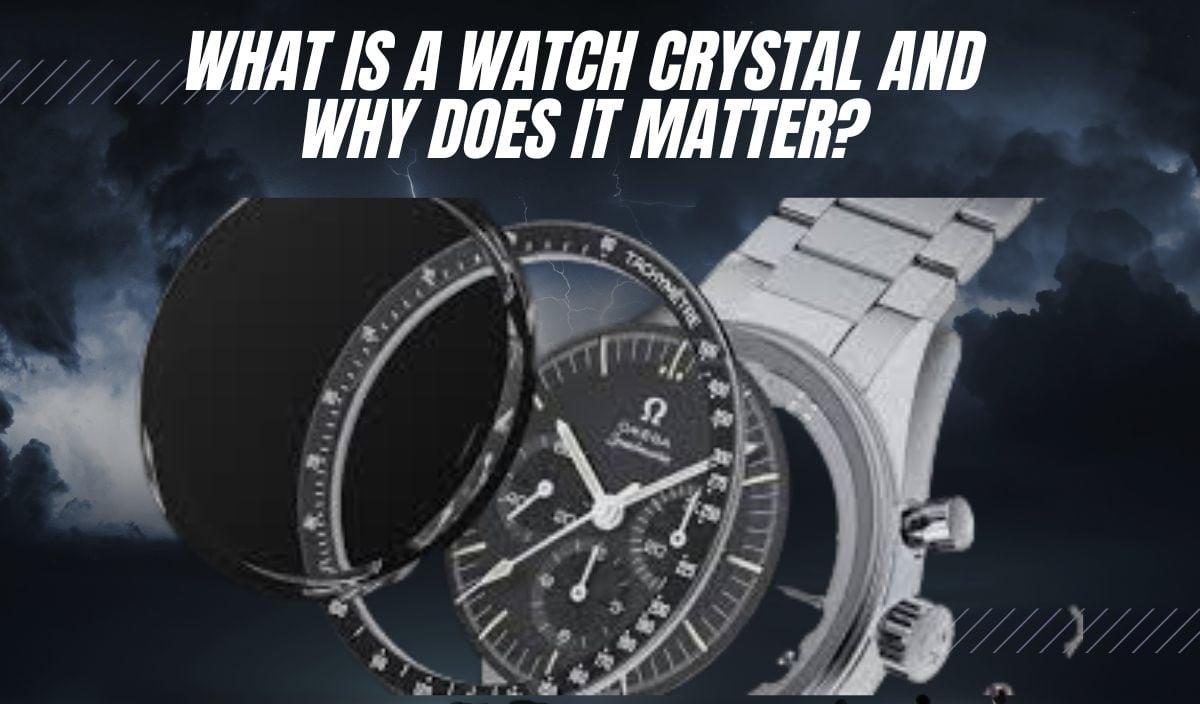
What is a Watch Crystal and Why Does it Matter?

Charlotte H

September 18, 2024

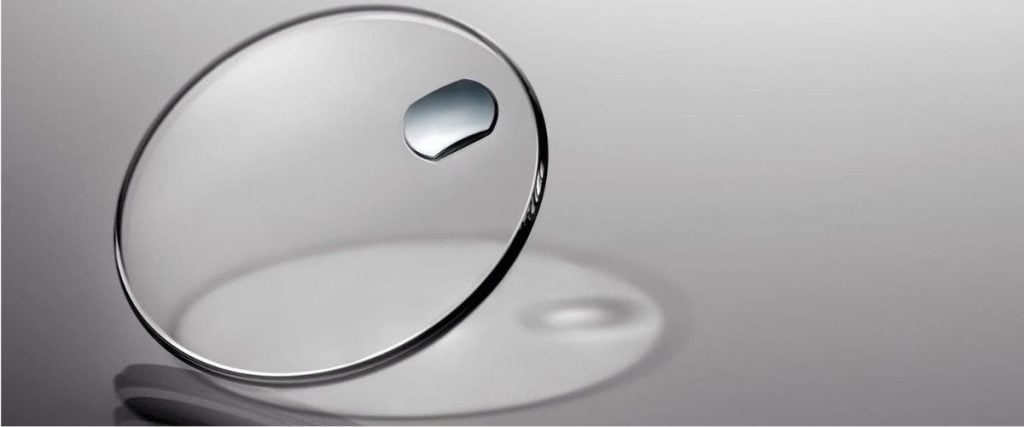
Have you ever wondered what the term “watch crystal” means? Me too. When I see the word crystal, I instantly think of some fancy gemstone. But it has nothing to do with any diamonds or gemstones set on your watch’s case or dial. Instead, watch crystal refers to the type of glass placed above the display, keeping you from accidentally scratching the face of your favorite timepiece.

It’s that transparent cover that protects the dial of the watch. It is usually made from a material like acrylic, mineral glass, or sapphire crystal. It’s a crucial component of your timepiece, even though, in many cases, it’s barely noticeable. Not only does it shield the inner workings from dust, moisture, and the occasional bump, but it also affects the overall look of your watch.

bot-only-imagebot-only-image

There’s more to watch crystals than you might think. There are a variety of watch crystal types, each with its own pros and cons, plus a myriad of reasons why your watch crystal is vital in the durability of your timepiece. Let us explain…

The Importance of Watch Crystals
Importance of Watch Crystals

I like to think of my watch’s crystal as a shield. It’s a clear cover that sits over the dial, and it’s got a relatively important job to do. Sure, the case material is also super important in determining the look and durability of my watch, but the glass has an equal amount of responsibility. 

It keeps those delicate inner workings of the watch safe from everyday wear and debris. I wear my watches all the time: out walking, traveling, and on formal occasions, so I need my watch crystal to protect it against everything. I’m talking scratches, dust, and even the occasional splash of water.

Watch crystal does exactly that; it keeps my watch looking good and ticking smoothly. Without a quality piece of crystal over the dial, my timepiece would be at risk of getting damaged, which is a pricey expense I want to avoid. 

The glass also plays a huge role in how your watch looks. You can find domed crystals, flat crystals, and cambered crystals, all giving your watch a sleek and modern finish or more of a classic vintage vibe. There are a number of different watch crystals to choose from, all coming in at different price points too – so your budget will also slightly determine which watch crystal you can get.

Watch Crystal History

Understandably, the materials we have used in the creation of pocket watches and wristwatches have evolved dramatically over the years. That applies to watch crystals, too. Some of the first watches used glass to protect watch dials, often cut from mineral quartz. These early crystals were simple but functional, offering a basic level of protection against dust and damage.

It wasn’t until the early 20th century that acrylic glass emerged as an alternative. The material was a game-changer, as it was lighter and more impact-resistant, making it perfect for those who wanted to wear their watches every day without worry. 

Acrylic glass was also a more affordable alternative than crystals made from mineral quartz, so wristwatches became not only more durable but also more accessible to the general public.

During the 1960’s, mineral glass became a common sight on watches. Made by adding various minerals to standard glass, this type of watch crystal offered the crisp look of glass but with improved scratch resistance and clarity. 

However, the real breakthrough came just twenty years later, with the introduction of synthetic sapphire crystals in the 1980s. Boasting extreme levels of hardness and scratch resistance, sapphire crystal provided better protection than before, with a crystal-clear view of the dial. This material has allowed watchmakers to create even more refined and durable watches, setting new standards in the creation of modern timepieces.

Most Common Watch Crystal Materials

As history attests, there are a number of different watch crystals suited to protecting our timepieces. Some are favored more than others, but each has its own set of benefits and disadvantages.

Before you go out and choose your next timepiece, it’s good to know the differences between the most common watch crystals so you have a complete understanding of the levels of durability, scratch resistance, and readability of the design.

Sapphire Crystal

Personally, I consider sapphire crystal glass to be the crème de la crème of watch crystals. It’s one of the newest materials used for watch glass and as such is considered the most durable and scratch resistant. As its name suggests, it’s made from synthetic sapphire and boasts a hardness second only to diamonds – the strongest material in the world. 

As someone who tends to bump my watch against things, sapphire crystal glass is the perfect choice for me. It keeps the lens clear, durable, and my watches look new for years.

However, with these high levels of durability comes a higher price tag. Sapphire crystal watches are more expensive to produce, which does mean they typically retail for more than those equipped with the two materials mentioned below. 

Another thing to keep in mind is that while sapphire is highly resistant to scratching, it is not immune to shattering. A hard knock in the wrong place could cause the sapphire crystal to crack. It’s difficult to do, but not impossible, so keep that in mind.

The other thing I love about sapphire crystal is how it looks. There’s something about the crispness of the crystal that gives the watches it adorns a luxurious feel. It also boasts a beautiful level of clarity, so reading the time, date, and any other complications is effortless – especially when the sapphire crystal is treated with an anti-reflective coating.

Mineral Crystal

Mineral crystal strikes a nice balance between durability and cost, making it a popular choice for many watch collectors. This type of crystal is made from standard glass that’s been chemically treated to enhance its hardness and scratch resistance. While it’s not as tough as sapphire, mineral crystal does do a pretty good job at resisting scratches from everyday use.

One of the main advantages of mineral crystal is that it’s more affordable than sapphire, which means watches with mineral crystals are generally more accessible to a wider audience. It’s also less likely to shatter compared to sapphire, making it a great option if you’re a bit clumsy. However, annoyingly, if you do manage to scratch your mineral crystal watch, those marks are there to stay, as they can’t be buffed out.

Acrylic Crystal

Finally, acrylic crystal, also known as plexiglass, is another popular watch crystal. It’s easily the most lightweight and affordable option out of the three, making it perfect for those restricted to a particular budget. 

It’s made from a type of plastic rather than glass, so consequently, you can expect it to be resistant to shattering. For this reason, you’ll often find acrylic crystal on sports watches or even vintage pieces.

One of the coolest things about acrylic crystal is that any scratches it picks up can often be polished out with a specialized cleaner and a bit of effort. This makes it a great choice if you want a watch that can handle a few bumps and bruises without looking worse for wear. 

However, it’s worth noting that acrylic is more prone to scratching than both sapphire and mineral crystals, so it will require more maintenance to keep it looking crisp and clear.

How to Distinguish Between Crystal Materials

When you know what to look for, identifying the type of crystal on your watch can be pretty straightforward. Each material has its own set of characteristics, both in its feel and appearance.

I’ve always found acrylic crystal to be the easiest to spot since, at the end of the day, this is basically a form of plastic rather than glass. It is most commonly found on vintage watches since it was the only watch crystal material until the 1960s, as well as sports watches since these designs need to be highly shatterproof.

Acrylic crystal typically has a slight domed appearance, adding to its vintage charm, and when you tap on it, it often feels and sounds like plastic – which makes sense since that’s basically what it is. This material would suit someone who enjoys a more laid-back style or even the nostalgic look of vintage timepieces. It’s also a good choice for anyone needing something affordable and shatterproof.

Mineral crystal is a step up in terms of scratch resistance, so it is commonly used in mid-priced watches. It’s usually flat, although it can sometimes be found in slightly domed designs. 

Unlike acrylic, it has a glass-like feel and appearance and is often thicker than your average watch glass. They tend to have a clear, clean look. It’s perfect for someone who wants a nice middle ground between durability and affordability.

Finally, there’s sapphire crystal. This watch crystal is the go-to for luxury and high-end watches. All the biggest luxury watch brands use this material since it has high levels of scratch resistance and clarity. It does look and feel luxurious. It’s hard to explain exactly why; it just does. Its exceptional clarity certainly helps, and it feels like a solid material when you tap it.

Because of its premium feel, sapphire crystal watches are coveted by those who value both style and substance. As I mentioned, sapphire crystal is my go-to since I tend to knock my watches regularly. It’s a material that holds up under pressure extremely well, and truthfully, it just looks incredible.

When Does a Watch Crystal Need Replacement?

It’s not uncommon for watch crystals to get damaged. At the end of the day, it’s there to protect your watch from accidental knocks and damage. And thankfully, it’s much easier and cheaper to replace the glass than it is to replace an entire dial or movement. 

It’s not uncommon to scratch, crack, or chip your watch crystal, especially if it’s one of the more affordable alternatives like acrylic or mineral glass. If the damage is severe enough, it will likely compromise your ability to read the dial and may even allow dust, moisture, and other debris from entering the dial. This can potentially harm the inner workings of your timepiece, so it’s important you get it fixed as soon as you can.

It’s certainly possible to change a watch crystal on your own, but please know it’s not an easy task – at least for us non-certified watchmakers! It requires precision and the right set of tools and can be a delicate process, especially if you’re using higher-end materials like sapphire crystal. You’ll need to carefully remove the old crystal without damaging the watch case and install the new one. The glass must sit perfectly flush inside the case above the dial, ensuring a tight seal to maintain water resistance.

If it were me, I’d leave a job like this to a professional. It’s not worth the risk, as an improperly installed watch crystal could seriously damage the dial, case, and movement. Exquisite Timepieces offers a fantastic watch repair service, so you feel reassured the job is done properly. They use only the best watchmakers, sending your watch to authorized service facilities where experts work on your timepiece with precision and expertise.

Conclusion

Hopefully you’re now feeling confident in all things watch crystal related. This protective component ultimately acts like a shield for your timepiece, protecting its face from scratches, dust, water, and all the little bumps we throw at it. 

You’ll most commonly find acrylic, mineral or sapphire crystal on the market, with each type boasting its own perks, allowing you to prioritize durability, style and cost the way you need. While the aesthetics of your watch crystal is important, be sure to choose one that best suits your lifestyle and budget.
What is a Watch Crown and Why it is important

What is a Watch Crown and Why is it important?

Charlotte H

September 18, 2024

Have you recently read the term “watch crown” as part of a timepiece’s specifications or review and wondered what this means? Or have you just found yourself staring at your watch, speculating what that little knob on the side is? 

Trust me, you’re not alone. We’ve all wondered what this component is called at some point. This charming feature is called a watch crown, and it’s not just for show.

bot-only-imagebot-only-image

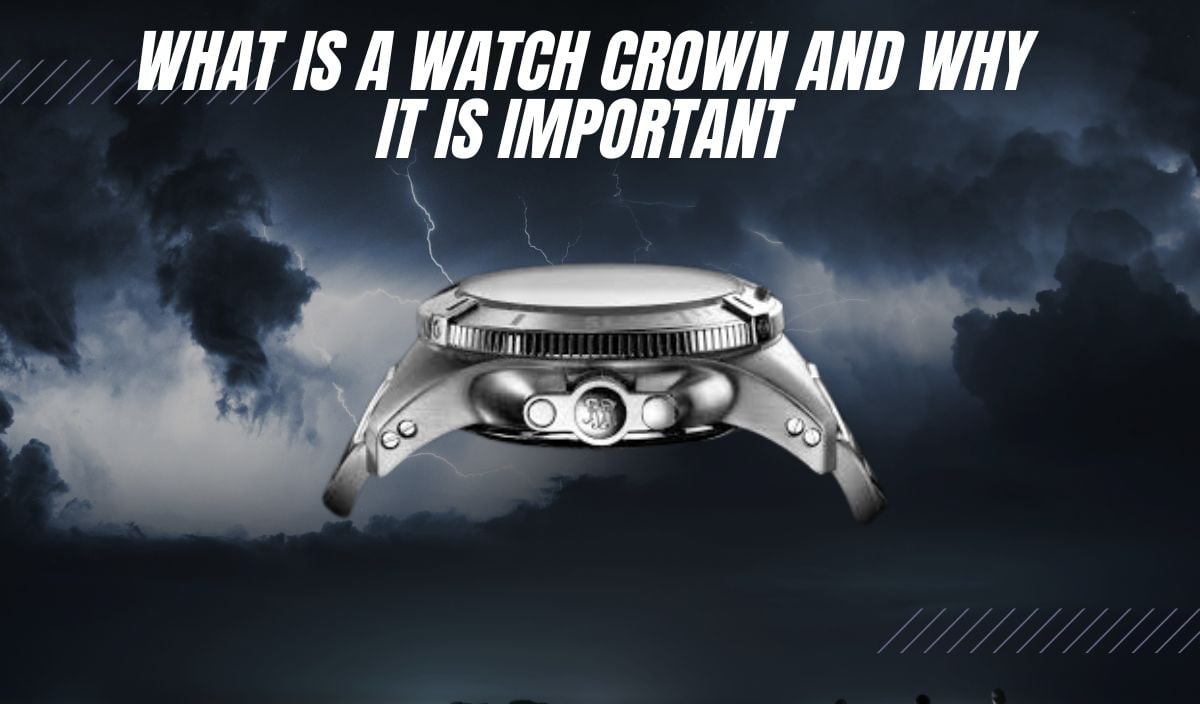
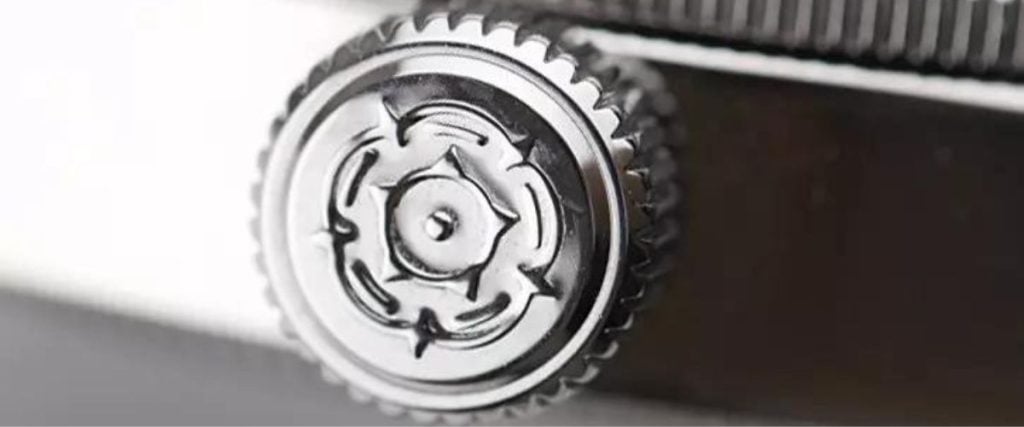
A watch crown is the often small, rounded button-like feature on your watch case’s side. Its primary job is to help wind the watch – if your watch has a mechanical movement – and to set the time on the dial. 

This information might be nothing new to you, but did you know that crowns offer more than just winding and setting? In today’s blog, we will be exploring all the intricacies of a watch crown, including the different types of watch crowns out there and why they are so important in the construction of your timepiece.

Why are Crowns so Important?

The humble watch crown might seem like a small, insignificant detail at first, but it actually provides a long list of benefits to your timepiece. Usually found on the right-hand side of the case but also sometimes positioned on the left (we’re looking at you U-Boat), the watch crown is predominantly used for setting the time and date on your watch. 

By popping it out to its correct position, you can turn the crown to adjust the hands and calendar. And, if your watch has additional complications—like a moon phase or GMT—the crown handles those settings too.

If you have a mechanical watch, the crown is also essential in winding the movement. Unlike quartz watches that are powered by an electronic battery, mechanical movements rely on a mainspring to store energy. When you turn the crown, it tightens this mainspring, gradually releasing energy that powers the watch.

Moreover, the watch crown plays a protective role in the functionality of your timepiece. Some crowns have a screw-down feature, creating a tight seal between the crown and case. This helps to protect the watch, and the movement inside, from things like water, dust, and dirt. It’s a particularly vital feature for those wanting a watch to use for diving or outdoor adventures.

History of Watch Crowns

Watch Crown

In the early days of watchmaking history, people had yet to experience the joy of wearing a wristwatch. Instead, they typically kept a pocket watch in their pocket and held it onto their clothing with a chain. 

With their manual winding movements, these devices required winding once or twice a day to keep their time. But they didn’t have a crown that could do that. Instead, the owner would have to carry around a small winding key, which was placed into a small hole in the side of the case. They would then have to turn the key to wind their pocket watch.

This was the case until the early 19th century when a clever chap named Adolphe Nicole introduced the first watch crown. His invention replaced those fiddly keys with a much simpler, integrated knob on the side of the watch case. It was a revolutionary innovation, allowing watch owners to wind their timepieces up on the go – with no more risk of losing those small winding keys!

Ever since, watch crowns have evolved to become more than just a winding tool. In the 20th century, watchmakers started adding features like screw-down crowns for better water resistance, and the integration of more complex complications like GMT and perpetual calendar allowed crowns to manipulate these features, too.

The look of watch crowns has also changed over the years. They were once large and onion-shaped but have now adapted to become smaller and sleeker. Their style is tailored to different types of watches, ensuring the crown not only serves its practical purpose but also complements the overall aesthetic of the watch.

Types of Watch Crowns

When it comes to watch crowns, there’s more variety than you might think! Each type of crown has its own unique set of features and serves specific functions, adding both style and practicality to your timepiece. Let’s take a look at some of the most popular types of watch crowns you might find…

Push-Pull Crown

Possibly the most common and straightforward type of watch crown you’ll encounter is the push-pull crown. As its name suggests, it uses a simple pull and push mechanism. To set the date or wind the movement, you simply pull the crown outward – often to different positions for each function. 

Then once the movement is fully wound and the time and date are set correctly, you push the crown back in to secure the settings. Push-pull crowns are found in most everyday watches, especially dress watches that don’t require high levels of water resistance.

Screw-Down Crown

Most often found on diving watches and adventure watches, the screw-down crown arrives with a clever threaded mechanism that literally allows the crown to be screwed into the watch case. This creates a tight seal against the two components so you can feel assured of enhanced water resistance and protection against dust and debris. 

To adjust the crown or manually wind the movement, you would unscrew the crown before screwing it back in. Screw-down crowns are essential for watches designed for extreme conditions, especially diver’s watches that need complete protection against water pressure.

Onion-Shaped Crowns

While the two types of watch crowns above reflect the functionality of the watch, the next few crowns are named as such for their looks. The onion-shaped crown is exactly what its name suggests: a crown that looks a lot like an onion. 

It has an almost bulbous appearance reminiscent of the shape of some of the first watch crowns. As such, they are a popular sight on vintage-inspired watches. They add a real nostalgic charm to watches, plus their large size and knurled detailing make them easy to grip and adjust.

Crowns with Cabochon

Cabochon crowns are a popular choice for those that want their watch to look elegant and stylish. It’s a style that sees the tip of the crown set with a cabochon gemstone, a gemstone that is smooth and rounded for a sophisticated look. 

The Cartier Tank is one of the world’s most famous watches known for boasting a cabochon crown on the right hand side of its rectangular case. The cabochon is usually made from materials like sapphire, ruby, or onyx and not only enhances the watch’s aesthetics but also provides a tactile, satisfying feel.

Recessed Crowns

The recessed crown is a type of crown that is fairly new to the watch world, spotted on modern watches. Unlike traditional crowns that protrude from the watch case, these knobs are embedded or set into a small cavity within the case. They are designed to enhance protection, so you are less likely to damage the crown should you knock it against a hard surface. 

Plus, it also helps to maintain a watch’s water resistance and gives the case a more streamlined appearance. You’ll most likely see recessed crowns in sports watches where durability and sleek design are key.

When Does a Watch Crown Need Replacement?

Hopefully, your watch crown will never need replacing, but if it becomes damaged, hard to operate, or the water resistance is compromised, it may require a replacement. Common signs of a broken watch crown include difficulty winding the watch, problems setting the time, or noticeable wear and tear on the exterior of the crown.


Replacing a watch crown yourself isn’t an easy task, as it’s an intricate process that requires a steady hand and plenty of precision. The method involves removing the old crown, selecting the correct replacement, and then carefully ensuring it fits perfectly against the case and attaches to the movement to ensure all functions operate correctly. It often requires specialized tools and expertise to avoid damaging the watch and the movement inside.

For the best results, we advise you to leave crown replacement to professional watchmakers. At Exquisite Timepieces, we offer a specialized watch repair service where we make sure only the top watchmakers handle and repair your timepiece. We securely package each watch and send it directly to authorized service facilities to ensure it’s treated with the utmost care.

Conclusion

If you couldn’t tell, we think the crown is a bit of a hidden gem. It may seem like a small, barely noticeable part of a watch, but it plays a critical role in its functionality. From winding the movement to setting the time to shielding the watch against water, dust, and debris, the crown is essential for your watch’s performance and longevity. 

And given its importance, it’s equally important to make sure you take care of your watch crown. If you suspect any damage or issues, we highly recommend having it inspected immediately to prevent any further harm coming to your precious timepiece.

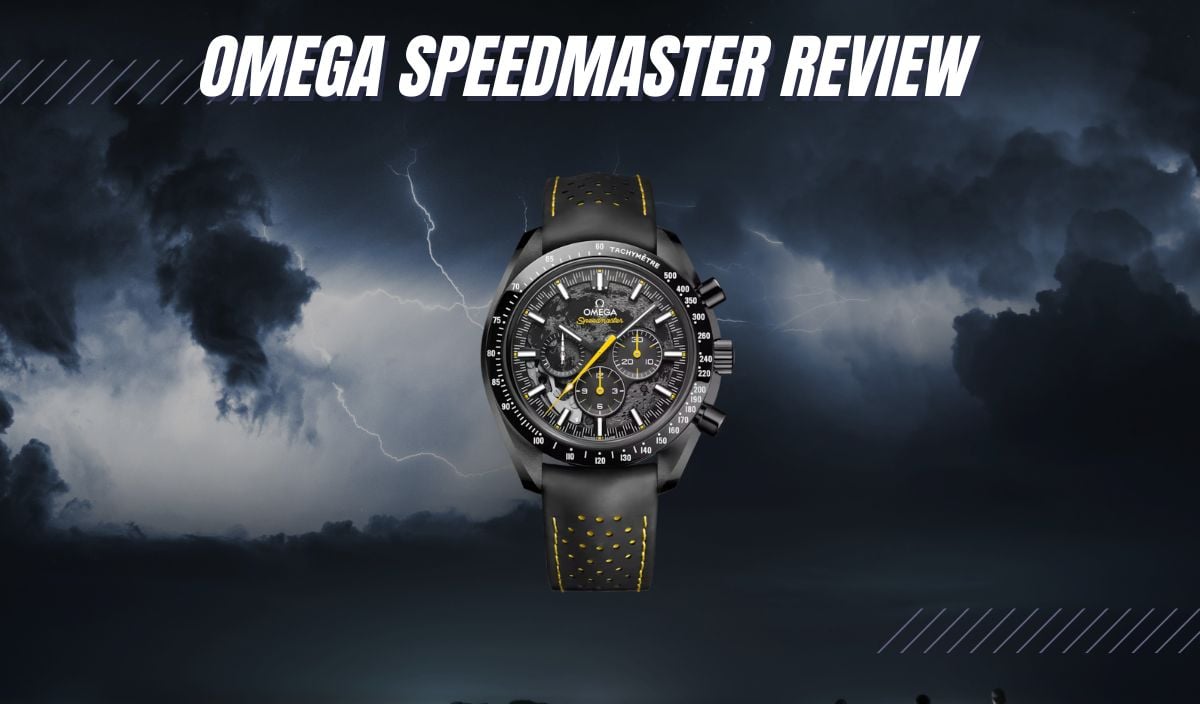
Omega speedmaster review

In the vast and often complex world of horology, there are only a few watches I’d seriously consider “holy grail” pieces. These are those rare gems that have not only left an indelible mark on history but continue to inspire watchmakers around the globe to create their own adaptations. They’re not just watches that tell the time but watches that are legendary for their interpretation of time. One such icon is the Omega Speedmaster.

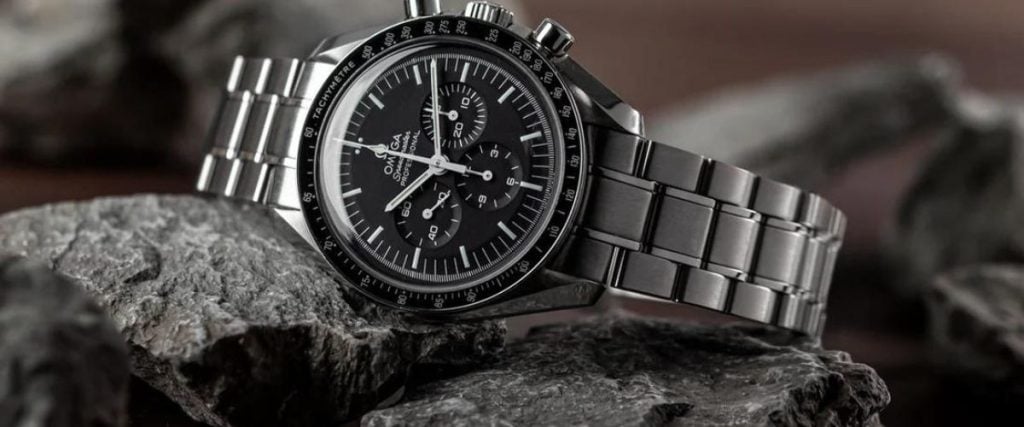
This legendary black-dialed chronograph with its thin tachymeter bezel and five-row link bracelet has cemented itself a place in the pantheon of watchmaking greatness. The story of its birth is worthy of history books, and it has become a symbol of ingenuity, adventure, and timeless style. But, even today, years after its creation, this is a watch that remains high up on watch collector’s bucket lists.

bot-only-imagebot-only-image

About The Omega Speedmaster

I’m not really much of a chronograph wearer – mainly because they’re usually too big for my small wrists. And yet, if someone offered me an Omega Speedmaster watch, I’d take it in a heartbeat. 

The model, first released in 1957, has quite easily become one of the main cornerstones in the world of chronographs and tool watches. Funnily enough, it was originally designed as a sports and racing chronograph, and its clean, functional design set it apart from other watches of that era. However, its history extended far beyond the race track, eventually becoming the first watch on the moon – but more on that shortly. 

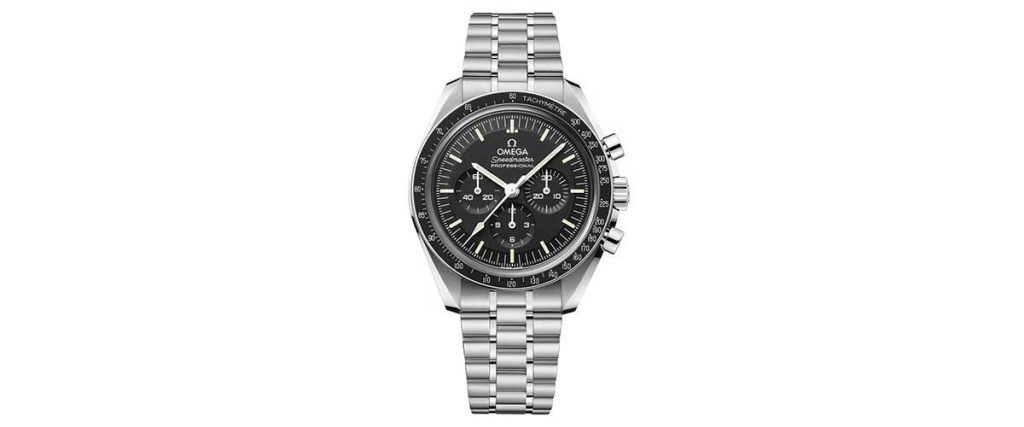
The Omega Speedmaster’s most defining features include its striking black dial, which provides excellent contrast and readability of its chronograph function, and the thin black tachymeter bezel that allows you to measure speed based on elapsed time. 

There’s also often a five-link bracelet, adding both comfort and a handsome vintage appearance to the overall aesthetic, and a beautifully curved stainless steel case measuring 42mm wide.

History of Omega Speedmaster Watches

As mentioned, the story of the Omega Speedmaster began in 1957, starting with the introduction of the Speedmaster Ref. CK2915. It was originally designed as a sports and racing chronograph aiming to meet the needs of professional drivers – and, of course, watch enthusiasts who simply appreciate the adrenaline that goes with the racetrack. 

Ironically, despite being a perfectly capable racing chronograph, the Omega Speedmaster didn’t find much success in its early years. In fact, it took half a decade and a rather significant journey into space to make that happen.

In 1962, NASA launched the Apollo program, a set of missions that planned to land humans on the moon for the first time and bring them back to Earth safely. A year later, NASA began their search for a watch that was reliable, durable, and legible enough to suit their astronauts in space. It would serve as the official watch of the Apollo program. In the end, four brands took their shot – Omega, Longines-Wittnauer, Rolex, and Hamilton.

As you’ve probably guessed, the only watch to pass the rigorous testing for use in space missions was the Omega Speedmaster, and its selection led it to become the official watch of the Apollo missions. The watch became no stranger to zero gravity and was most famously used by all three astronauts during the Apollo 11 mission in 1969. This included Neil Armstrong and Buzz Aldrin, who made history as the first humans to walk on the moon. And, of course, that made the Omega Speedmaster the first watch on the moon.

This historic event cemented the Omega Speedmaster as a legend and earned it its well-known nickname the “Moonwatch”. The exact reference to make it onto the moon’s surface was reference 105.012, boasting the very same 42mm wide steel case, black chronograph dial with luminous inserts, and thin tachymeter bezel familiar to all modern-day references. It also featured a manual-winding movement and vintage Hesalite crystal.

It’s no surprise that as the years went on, the Omega Speedmaster Moonwatch collection expanded to include new variations and technological improvements. One of the biggest upgrades was the introduction of the “Professional” designation, which further solidified its connection to space missions and professional use.

In the 1990s and early 2000s, Omega continued innovating while carefully respecting the Speedmaster’s heritage. Maintaining all the core characteristics of the original designs, such as the Speedmaster Professional “Moonphase” and the Speedmaster Reduced, brought new functionality and design variations to the collection. The brand also introduced the “Co-Axial” movement for enhanced precision and durability.

Sure, the original reference 105.012 will always be the “true” Moonwatch, but the models that have come after it are just as important. They are all deeply rooted in the original’s history, boasting all the essential features that make an Omega Speedmaster an Omega Speedmaster. They have just embraced modern advancements to ensure the design remains a relevant and sought-after timepiece.

Omega Speedmaster: In-Depth Review

As we’ve mentioned, the Omega Speedmaster Moonwatch Professional has been engineered in a number of different styles, but more often than not, they have a set few characteristics in common. Here are some of the essential features you can expect to find in an Omega Speedmaster.

A 42mm Steel Case

Other than a handful of the first Omega Speedmaster watches released (including the first reference CK2915 made for the racetrack), every true Moonwatch since has had a case size of 42mm. The inaugural models came in a little smaller – something typical of the time – measuring to 38.6mm and later 39.7mm. But in 1969, with the creation of the Omega Speedmaster that would make it onto the moon’s surface, the lyre lugs and crown guards increased the diameter of the watch to 42mm. And it’s been that way ever since.

Similarly, the rest of the dimensions have barely changed. The Omega Speedmaster Moonwatch Professional typically boasts a thickness of around 13mm, a lug-to-lug of 47mm, and a lug width of 20mm. It’s a really nice set of dimensions, allowing the watch to suit wrists anywhere from 6 inches and above. There are other Speedmasters that are smaller, but it’s worth noting these aren’t classed as “Moonwatches”.

The overall case shape is another permanent fixture, with the turned lug design borrowed from the classic Speedmaster’s silhouette. In the same way, the crown and chronograph pushers are placed in a traditional position, all recessed into the case just slightly for added durability. The crown is non-screwed down but does still warrant a 50-meter water-resistant rating.

The Omega Speedmaster Moonwatch Professional is most commonly found with a classic stainless steel case. The finishing is beautiful; it has brushed sides and high polish on the case and lug tops. There are also a handful of Moonwatch references in the Swiss watchmaker’s current collection made using their Sedna™, Canopus, or Moonshine Gold, a proprietary alloy developed by Omega.

The material offers a rich, long-lasting gold color and looks particularly stunning with the Speedmaster’s classic black dial. In some cases, gold is used for the entire case and bracelet, and in other instances, Omega has combined Sedna or Moonshine Gold with stainless steel for a cool two-toned finish. Although these models are beautiful for me, the classic stainless steel Speedmaster will always be my favorite.

A Black Tachymeter Bezel

Possibly one of the Omega Speedmaster Moonwatch Professional’s most defining characteristics is its tachymeter bezel. Most other space-inspired watches, or even tool watches for that matter, don’t have a tachymeter bezel because it’s used for measuring speed, typically related to the speed of a car on the racetrack. But since the Speedmaster was originally created for motorsport enthusiasts, the tachymeter continues to be a nod to its racing roots and a nice reminder that while the Speedmaster may have reached the moon, it was born on the racetrack.

The Speedmaster’s bezel is set on the outskirts of the case, kept nice and thin with a black aluminum insert. It has a wonderful glossy finish and is printed with the tachymeter scale in white. Some Omega Speedmaster Moonwatches feature a dot over the numeral for 90. Often referred to as “DO90”, this feature is a hallmark of early Speedmaster models and is highly prized by collectors for its historical accuracy and connection to the original design.

A Monochromatic Dial

Of course, the most famous dial color for the Omega Speedmaster Moonwatch Professional is the classic black display. Just like the reference to walk the Moon, most modern-day iterations of the design have a black matte finish with white printed markers and a slightly stepped architecture, which you’ll notice when you look at the minute track more closely. The three register displays for the chronograph and small seconds are also sunken for a nice touch of legibility.

The dial hardware isn’t oversized in any way but still offers a good amount of legibility. This is largely due to the contrasting white printing used on many markers and the luminescent material placed on the hands. The iconic Omega Speedmaster Professional logo is always positioned at 12 o’clock.

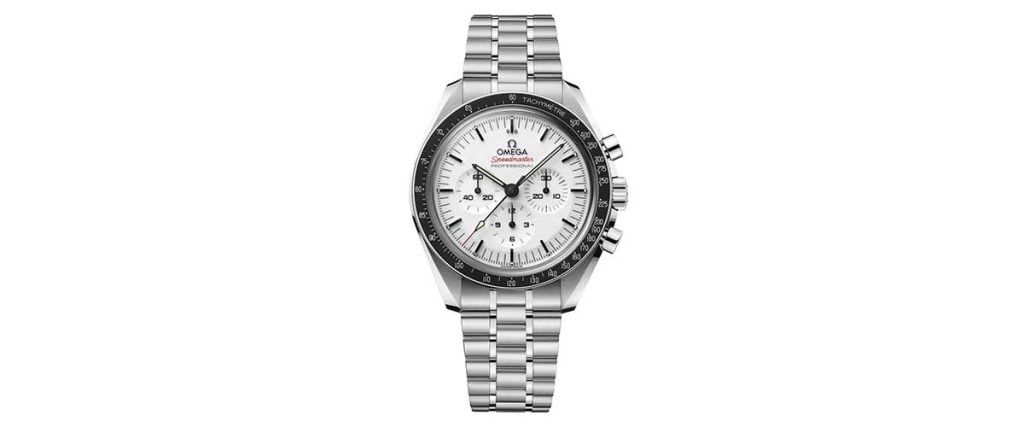
There are some other dial colors available in the Speedmaster collection, including green, white, silver, and gold. The white-dialed reference 310.30.42.50.04.001 is a personal favorite and a nice twist on the classic black display, switching around the colors for the surface and markers for a bright, legible finish.

Hesalite or Sapphire Crystal?

Understandably, while some of the original Omega Speedmaster watches featured domed Hesalite crystal glass, most of the modern re-interpretations have boasted contemporary scratch-resistant sapphire crystal. But there have been a handful of modern references that have brought back the Hesalite crystal for good reason. One of said references is 310.30.42.50.01.001.

Despite Hesalite being more prone to scratches, it does give the Omega Speedmaster a distinctly vintage finish featuring a higher dome and a very cool engraving of the Omega logo at the center of the crystal – a very small detail that’s fun to spot if you can! Meanwhile, sapphire crystal, although still slightly domed, does have a lower profile on the wrist, plus enhanced scratch resistance.

Ultimately, the choice between Hesalite and sapphire crystals will depend on your personal preferences. Those traditionalists who want an Omega Speedmaster as close to the original Moonwatch as possible will prefer those with Hesalite. On the flip side, those of you who prioritize durability will prefer scratch-resistant sapphire crystal.

It’s worth noting there is a small price difference between the two, with the Hesalite models retailing from $6,600 on the solid bracelet and the sapphire models priced at $7,600. The Hesalite references also have closed case backs engraved with the traditional Moonwatch message, while the sapphire crystal iterations keep things modern with a matching sapphire crystal exhibition back that lets you admire the movement inside.

Manual Winding Movements

Another notable change to the Omega Speedmaster over the years is the movement found within. Of course, as the years have gone by, Omega has drastically advanced its technologies for the better, but what’s really impressive is that although the technology has improved, the overall visuals and functionality have remained much the same.

Like the original, the majority of Omega Speedmaster Moonwatch Professional watches you’ll see are powered by manual-winding movements. These are the mechanical movements that require physical rewinding via the crown every few days. 

One of the most used manual calibers in today’s current collection is the Omega 3861. This is a movement with a 50-hour power reserve, an anti-magnetic silicon balance spring, a free-sprung balance, chronograph complication, and chronometer certification.

It’s also one of just a few manual winding movements from Omega that uses a co-axial escapement. This is an escapement system that utilizes three pallets rather than the traditional two, which ultimately reduces sliding friction and increases service interval time. The Omega 3861 is also certified as a Master Chronometer by METAS, which includes more tests and higher standards for accuracy than chronometer certification alone.

Those who opt for an Omega Speedmaster Moonwatch with an exhibition case back will also be able to admire the architecture of the manual movement inside, which is laid out a lot like the original. It has rhodium plating and Geneva stripes across the bridges. Plus, you can spot some of the 26 jewels.

Leather, Rubber or Metal Strap Options

There are a handful of straps available to order with the Omega Speedmaster Professional Moonwatch. A popular choice is the black rubber strap, which on the surface appears just like any standard black rubber strap with a stainless steel folding buckle, but when off the wrist, you’ll notice the underside is uniquely textured. The reverse surface has a stunning texture reminiscent of the surface of the moon. It’s a really nice touch and a nod to the Speedmaster’s iconic history.

The Omega Speedmaster Moonwatch can also be ordered on a variety of comfortable NATO straps in several colors. Straps like this really help to elevate its vintage aesthetic. For a dressier look, you might prefer one of the leather straps, whether that be one of the smooth calfskin leather bands, shiny alligator leather, or perforated leather straps.

My personal favorite strap for the Omega Speedmaster is, without surprise, the metal bracelet. The five-row, pebble-like shape of the bracelet links is really beautiful, and the finishing varies depending on whether you opt for a Hesalite or sapphire crystal model. Those with Hesalite crystal are fully brushed, while the sapphire crystal references lean into its modern positioning by including polishing on the two smallest inner links.

Most Popular Omega Speedmaster Models

Now that you know all about the Omega Speedmaster, its history, and some of the defining characteristics that make a Speedmaster a true Speedmaster Moonwatch, you’re probably wondering which, out of the several models on the market, are the most popular. Without further ado, here’s the long-awaited answer…

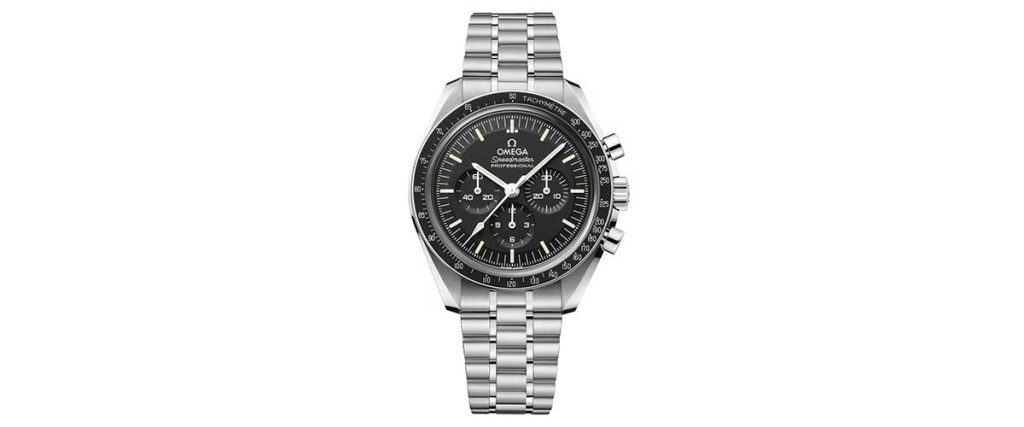
Omega Speedmaster Moonwatch Professional Master Chronograph (ref. 310.30.42.50.01.002)

Omega Speedmaster Moonwatch Professional Master Chronograph

Of all the Omega Speedmaster Moonwatch Professional watches on this list, this is the one I’d choose for myself. Why? Because this is the closest to the original as it gets. You’re getting the same black tachymeter bezel, 42mm wide steel case, a matte black dial with white printing and lume, and a manual winding movement. It also arrives on the five-row link bracelet and has the sapphire crystal glass on both the front and back. It’s a beautiful watch through and through, and anyone looking to start a watch collection off with a bang can’t go wrong with this, trust me! Price: $8,000

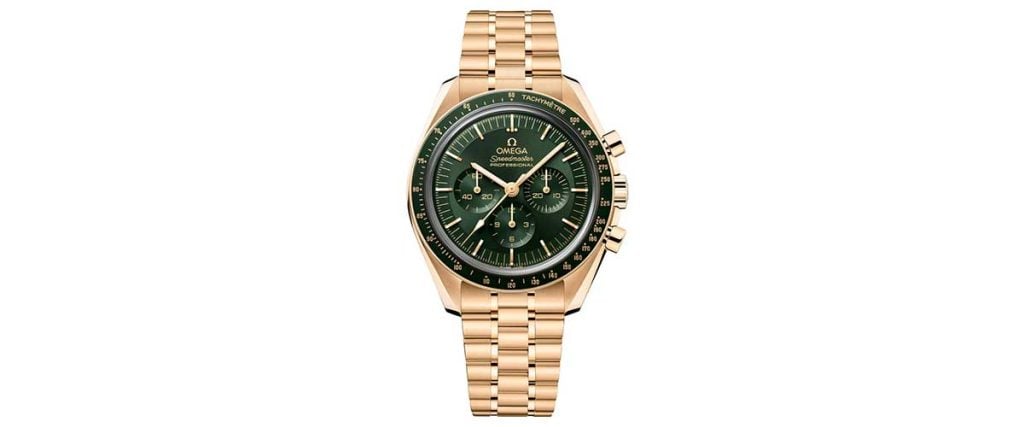
Omega Speedmaster Moonwatch Professional Master Chronometer Moonshine Gold Green Dial on Bracelet   (ref. 310.60.42.50.10.001)

Omega Speedmaster Moonwatch Professional Master Chronometer Moonshine Gold Green Dial on Bracelet

If you love the history behind the Omega Speedmaster Moonwatch but you also want something a little dressier – or even a touch flashy -, we recommend the Omega Speedmaster Moonwatch Professional Master Chronometer Moonshine Gold Green Dial. This stunning watch arrives fully engineered from the brand’s 18ct Moonshine gold – which includes the case back, crown, pushers, and bracelet. In contrast, the dial is colored in a deep emerald green to match the green ceramic bezel ring with an Omega Ceragold™ tachymeter scale. Price: $42,600

Omega Speedmaster Moonwatch Professional White Dial (ref. 310.30.42.50.04.001)

Omega Speedmaster Moonwatch Professional White Dial

I already mentioned previously that the Omega Speedmaster Moonwatch Professional White Dial was another of my favorites. I love how a simple swap of the black and white colors on the dial has transformed a classic looking chronograph into an obvious motorsport-inspired piece. It’s incredibly legible thanks to the jet black hands and numerals and maintains its 42mm wide diameter, steel case, black tachymeter bezel and the 3861 manual winding movement. Price: $8,100.

Omega Speedmaster Moonwatch Professional Master Chronometer Black Dial on Bracelet (ref. 310.60.42.50.01.001)

Omega Speedmaster Moonwatch Professional Master Chronometer Black Dial on Bracelet

The Omega Speedmaster Moonwatch Professional under reference 310.60.42.50.01.001 is another luxury option for those wanting something with a bit of oomph. This time around, it pairs its matte black dial with beautiful rose gold hardware and a matching Sedna™ Gold case and bracelet. I’ve always thought rose gold and black look great together on watches, and this is a perfect example. It’s dressy and sophisticated, yet it still manages to uphold the sporty personality of the Speedmaster name. Price: $42,600.

Omega Speedmaster Moonwatch Professional Master Chronograph Canopus Gold (ref. 310.60.42.50.02.001)

Last but certainly not least, we have an Omega Speedmaster Moonwatch Professional engineered from the Swiss watchmaker’s patented Canopus Gold™ material. This is one of those metals you have to see in person to appreciate. As well as being 100% noble, it boasts a beautiful brilliance and whiteness that makes it stand out against traditional white gold and stainless steel watches. The inclusion of the stepped silver dial gives it an almost completely monochromatic look, with just the black tachymeter scale standing out in a different hue. It’s another beautiful watch worthy of any watch collector’s wish list. Price: $55,500.

Should You Buy An Omega Speedmaster?

I’m not sure there’s an easier question to answer. Yes, you should absolutely buy an Omega Speedmaster – especially those in the dedicated Moonwatch collection. If you’re a watch enthusiast who appreciates brilliant history and exquisite craftsmanship, there are very few watches that will beat this. For many, it’s a “holy grail” watch, completing collections new and old. From its legendary journey to the moon to its mass of impressive technology inside, the Speedmaster will appeal to anyone with a passion for horology.

Omega Speedmaster Pricing & Availability

With there being so many Omega Speedmaster Moonwatches out here, the prices can vary depending on exactly which model you have in mind. The stainless steel references typically retail from around $6,600 while some of the full 18ct gold references with diamonds can sit with a price tag as large as $60,200. If budget is your issue, it’s definitely worth checking out authorized retailers like Exquisite Timepieces for the latest offers or heading to the second-hand market where you can find steel Speedys for around $4,000.

Conclusion

We hope this deep dive into the Omega Speedmaster has explained exactly why this watch is a true legend in the world of horology. Sure, the Rolex Submariner and the Audemars Piguet Royal Oak are nice, but none of those can claim to be the first watch to set foot on the moon. And despite it being several decades old, it’s clear the Omega Speedmaster continues to captivate, both with its exciting history and its incredible design. This is a daily-beater watch with a story and plenty of high-tech to boot. What more could you want?

Moonswatch review

Omega X Swatch MoonSwatch Review: Just Plastic or Fantastic?

Michael Brown

September 13, 2024

Unless you were living on, say, the moon in March 2022, you probably heard the pronouncement, “People of Earth, the MoonSwatch has landed.”

After tantalizing teasers leading up to launch day, the Swatch Group and family brand Omega collaborated to pull off one of the strongest power flexes in horological history. They launched an 11-member lineup of colorful quartz wristwatches fashioned after the iconic Omega Speedmaster Professional, which, just in case you haven’t heard the news, was “THE FIRST WATCH WORN ON THE MOON” per the manual wind medallion caseback.

bot-only-imagebot-only-image

The resulting tsunami inundated not only the watch world but broader culture as well. Thousands who might not have otherwise given analog watches the time of day suddenly camped out overnight and waited in lines stretching several city blocks for a “moonshot” chance at picking up one of the cleverly conceived chronographs that aim to inspire dreams of “Missions to”—or in the case of Earth, “on”—the most recognizable celestial bodies in our Solar System.

In this review, I will cover MoonSwatch mania and the (many!) models while providing a few of my own reflections on owning—and enjoying—two MoonSwatches (Missions to Pluto and Earth) plus a “real” Speedmaster Moonwatch, the manual wind Caliber 3861.

About the Omega X Swatch MoonSwatch Watches

There are enough aliases of the “official” name—the Omega X Swatch Bioceramic MoonSwatch—to fill an F.B.I “Most Wanted Poster”: Omega MoonSwatch, Swatch MoonSwatch, Omega Swatch Moonwatch, Omega X Swatch Speedmaster, etc. Thankfully, the cultural hive mind seems to have settled on simply “MoonSwatch”.

So, what exactly is it: an inexpensive Speedmaster cutting against Omega’s upscale grain, a Swatch continuing the brand’s decades-old tradition of providing fashion-forward and affordable watches, or some “love child” of the two? The answer is pretty fuzzy, leaving it up to individual wearers to define the watch and the experience it creates in their own terms.

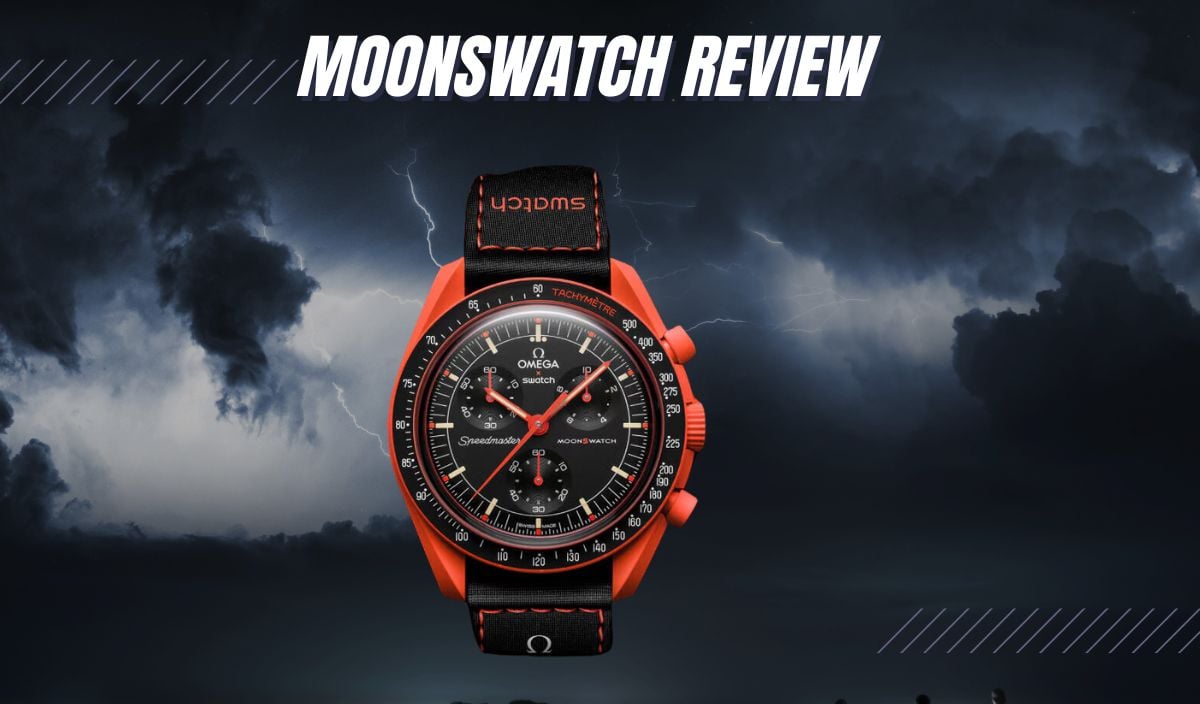
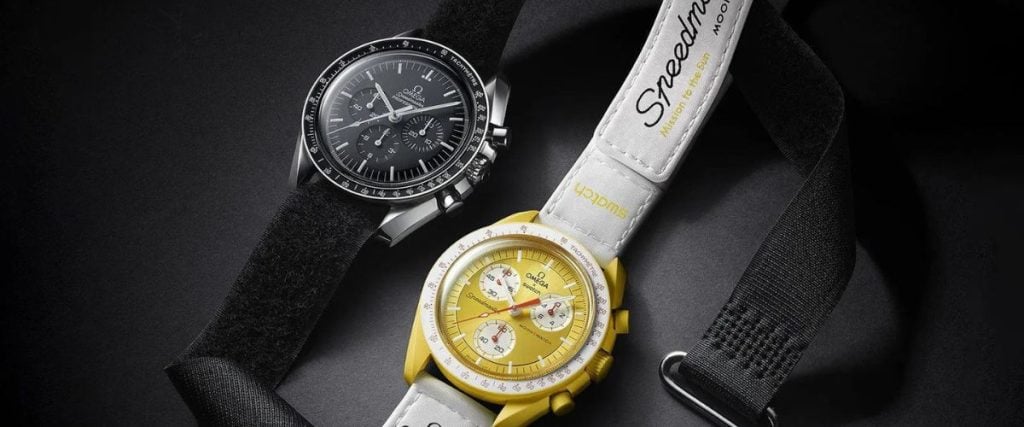
Regardless of confusion over its name or reason for being, the MoonSwatch’s core design elements shout, “Omega Speedmaster Professional Moonwatch!” It is a chronograph with 2 pushers and 3 subdials whose case shape and dimensions are almost identical to “the real thing”.

But instead of stainless steel, precious metal, all-ceramic, or titanium, the MoonSwatch case is composed of what Swatch has termed “Bioceramic”, an extremely lightweight plastic-ceramic hybrid that makes for a comfortable wearing experience and plays well with the technicolors necessary to depict a wide range of variegated celestial bodies.

Swatch includes heavily branded, NATO-style VELCRO® straps similar to the ones Apollo astronauts used back in the day to color compliment the cases and dials.

History of Omega X Swatch MoonSwatch Watches

The Swatch brand was founded by a group of Swiss watch executives and engineers in the early 1980s who believed that a line of affordable and accessible analog plastic watches could counter the widespread popularity of digital watches and help regain market share that had been lost to Japanese companies like Seiko and Citizen during the “Quartz Crisis”. 

The team envisioned inexpensive battery-powered watches with colorful and fun designs so affordable they could be disposable or purchased in multiples for a variety of occasions. While many recognize the name as a contraction of “Swiss watch”, “S” also denotes “second” watch, reinforcing the idea of reasonable pricing and replaceability. 

Swatch opened their first store in Zurich in 1983 with twelve original models and soon gained widespread popularity. In 1985, new CEO Nicolas Hayek, Sr., and a group of investors took over the brand and created a holding company called Société de Microélectronique et d’Horlogerie, aka SMH. 

Swatch continued to pump out new eye-popping models and open stores worldwide. The name was so synonymous with fun and financial success that Hayek eventually renamed SMH the Swatch Group Ltd. in 1998.

Over the years, Swatch Group acquired other more longstanding luxury watch companies such as Omega, Longines, Tissot, Breguet, Blancpain, et al., a recipe for success that enabled all involved to weather the “Quartz Crisis” storm. 

The Swatch brand also became synonymous with creative collaborations with artists, fashion designers, and large museums such as the Louvre in Paris and the Metropolitan Museum of Modern Art (MOMA) in New York City that boosted their bold and colorful catalog.

However, Swatch teaming up with another family member, like luxury manufacturer Omega, caught the watch world off guard. Declining Swatch sales figures, the Covid pandemic and the postponement of the 2020 Olympics (Omega is the” Official Timekeeper” and counts on the worldwide exposure), and a strategic aim of generating interest in the “real Moonwatch” among a younger demographic who might someday have the disposable income to purchase one may have all factored into the bold decision. 

Swatch Group saw record profits in 2023 and increased interest in the more expensive Omega Speedmaster, although there has been a drop in sales so far in 2024, primarily due to decreased demand for luxury goods in Asian markets. 

In March 2022, the MoonSwatches were available for sale only in selected brick-and-mortar stores (the initial promise of “online sales soon” was quickly withdrawn). 

This unleashed a worldwide “drop culture” frenzy, including long lines of sometimes rowdy crowds, instant scarcity of an “accessible” Swatch “intended for the masses”, and flippers demanding insane prices in exchange for instant gratification on the secondary market. 

Currently, the original eleven MoonSwatches are relatively more available for those who can visit one of the selected Swatch stores, and secondary market prices are much closer to MSRP for many models.

However, Swatch continues to launch “new missions”. The original eleven models that dropped in 2022 doubled in 2023 with rapid-fire releases of limited edition “Mission to Moonshine™ Gold” models. Two “Mission to Moonphase” (aka “Snoopy”) models took off in early 2024, and three more “Mission to Earth” pieces appeared in June 2024. 

As of this writing, a limited edition “Mission to the Super Blue Moonphase” is set to blast off for sale August 1-19, 2024 (only after 5:00 pm . . .) at select Swatch stores in honor of that month’s “blue moon” (the collective groan you just heard is that of Swatch store sales associates worldwide).

When it comes to MoonSwatches, you have to count up, not down. That makes 28 references in 2.5 years. “Brand dilution” and “burnout?” Swatch executives simply smile and reply, “Here, hold my beer.” Like the adorable and highly replicating alien Tribbles in the original Star Trek TV series, MoonSwatches just keep on coming.

Omega X Swatch MoonSwatch: An In-Depth Review

Don’t worry—I’m not reviewing all 28 (and counting) MoonSwatch models. But I will cover the essentials that apply to all so you can decide if the MoonSwatch is the rocket you want to hitch a ride on. Let’s light this candle!

Case Sizes and Materials

MoonSwatch design language closely follows that of the Omega Speedmaster Moonwatch itself. The diameter is 42mm, lug-to-lug distance 47.3mm, and thickness 13.2mm, including the domed acrylic crystal, which is embedded centrally with a small, translucent “S”, just like the “Ω” in the Speedmaster Pro. The lugs are “lyre” shaped, and their width is a strap-friendly 20mm.

The case shape is asymmetrical, thicker on the right side to accommodate the pushers. Paired with the round, 39.8mm bezel, the MoonSwatch has a smaller-than-expected look and fit for its 42mm diameter. 

There is a tachymeter scale with a matte finish on the bezel (“Dot over 90” for added authenticity!), and a very clever and colorful image of each celestial body on the battery cover on the back of the case. The crown contains a molded “Ω X S” stamp and the pushers are slightly further apart than those of the Omega Moonwatch to accommodate the quartz movement.

Swatch’s coinage of the name “Bioceramic” for the case material has been one of the biggest sources of confusion about the collection. The company describes the material to be 2/3 zirconia ceramic and 1/3 biosourced plastic derived from castor seed oil, leading some to wonder if it’s cheap ceramic or glorified plastic. 

As the owner of two MoonSwatches, my take is that it’s more like “plastic-plus”, lightweight for sure, but with a sturdy and premium feel. The case’s matte finish seems to “hold” the color well; I have one tiny chip on the bezel edge of my Mission to Pluto (“honest wear” only, no defect), and I can affirm the color is no mere veneer.

The MoonSwatch’s broad color palette includes vibrant yellow, bright red, light pink, and a pale, “Tiffany blue”, as well as more subdued and traditional hues such as black, gray, brown, and beige. There were reports of “color bleed” on wearers’ wrists from the battery cover images early on, but Swatch apparently fixed the problem in subsequent production batches.

Dials

Swatch takes a little more artistic license with MoonSwatch dials, but the general layout is still unmistakably based on its iconic predecessor. There are three subdials, but instead of the 3,6,9 positioning of the Speedy Pro, the MoonSwatch locates them at 2,6,10 to accommodate the quartz movement. 

Active seconds are displayed at 6, chronograph timing minutes at 10 (both with markings in 5 unit increments), and 1/10 timing seconds at 2. Subdials are round and inset from the dial face, adding depth, and added artwork on some models, such as Saturn and Jupiter, provide extra aesthetic effect.

Indices and markings are essentially the same as the Omega Moonwatch aside from color, including 1/3 second lines, even though the chronograph timing seconds hand ticks once per second. 

There are two dots at 12, just like the original. Branding on the dial helpfully reminds you of the watch’s “mixed heritage” and forms a reverse triangle to the subdials, which adds balance to the appearance. A circular line in the peripheral dial gives the illusion of the Speedy Pro’s “step down” to the seconds track even though the MoonSwatch dial is flat.

The handsets of the main dial and subdials have the same “stick” shapes and “spear & diamond” timing seconds of the Moonwatch, with the exception of Mission to Mars, which gives users a couple of playful red spaceships at 10 and 2. 

The hands are lit with Super-LumiNova®, but still, keep your expectations low. Just like the Speedy Pro, there’s enough lume brightness to tell the time but not enough to impress your friends or replace your cell phone flashlight.

Dial colors differ by model and are part of a scheme that includes the case and strap. Whether the colors complement or compete with each other will depend on your tastes and preferences.

Movement

The movement is a quartz chronograph with hours, minutes, active seconds, 60 timing minutes, and seconds, plus 1/10 seconds—we know that much even though Swatch doesn’t outright identify it. However, most believe the most likely movement is an ETA G10.212 without a date complication.

As such, it is more accurate than a mechanical Caliber 3861, even with the latter’s +5 seconds/day Master Chronometer certification. We just don’t know exactly how much more precise, given the movement’s cloaked identity. Caliber Corner deduces it to be +/- 10 seconds per year. My own very unofficial experience with my two MoonSwatches has been a very tight +1-2 seconds/month.

I learned something cool about the movement that I didn’t know until I did the research for this review—the MoonSwatch has a split timer that functions as a sort of “rattrapante-lite” without an additional chronograph timing seconds hand. 

When timing an event, if you want a split or lap time, you can press the bottom pusher to get minutes, seconds, and 1/10 seconds. Press the bottom pusher again, and the timing seconds hand “catches up” to the elapsed time since the start. Press the top pusher when the event is over, and you have your total elapsed time up to 59:59.90. Now that’s a feature that even the Apollo astronauts didn’t have!

Straps

Each MoonSwatch comes with a heavily branded, color-coordinated, nylon NATO-style VELCRO® strap similar to the ones Apollo astronauts used to secure their Speedy Pros on the outside of their space suit sleeves. 

For the mere earthbound rest of us, the strap has the advantage of precise fitting and “on the fly” adjustment if your wrist swells during the day. From my personal experience, the strap is a little stiff at first, but it becomes more flexible with time. Also, the strap can get a little sweaty underneath in hot and humid weather.

Fortunately, the lug width is 20mm, so the MoonSwatch fits the definition of a “strap monster”. I enjoy wearing my Mission to Earth on a traditional double pass blue and green fabric NATO strap and my Mission to Pluto on a curved, integrated gray rubber strap. There is a plethora of aftermarket options available if you want a break from the OEM strap.

Most Popular Omega X Swatch MoonSwatch Models

Facts: 1) All MoonSwatches appeal to some; 2) Some MoonSwatches appeal to more than others. Here are five of the most popular.

Omega X Swatch Mission to the Moon

Omega X Swatch Mission to the Moon

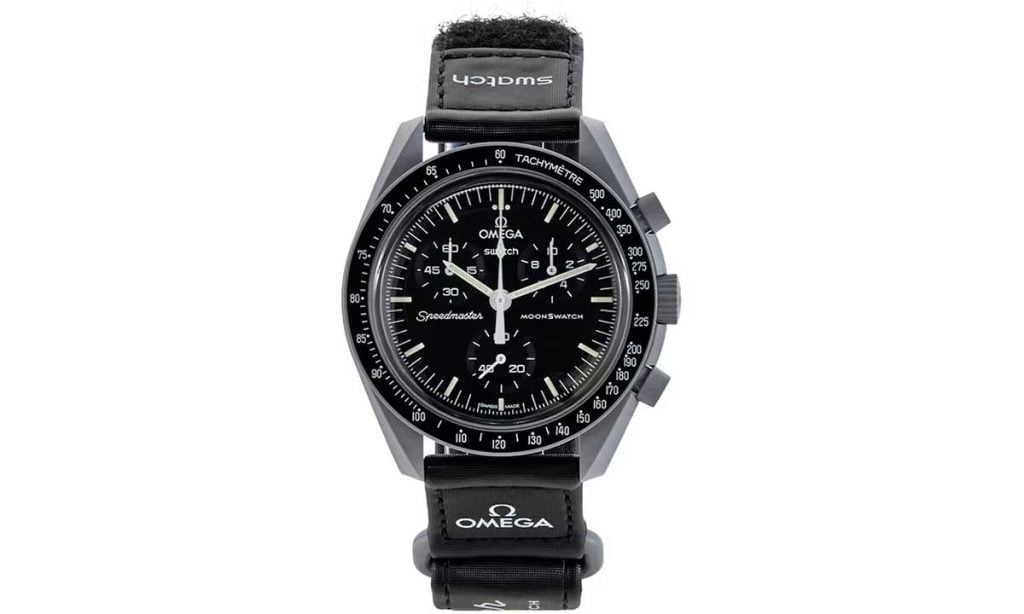
What can you say about the MoonSwatch, which is named after and most closely aligned with the “OG”? Mission to the Moon is the one that everyone wants to get their hands on and may be willing to camp all night for. 

True to its black and steel gray roots, the Mission to the Moon has “The Right Stuff” to produce a 1960s Apollo vibe. Even the hour indices have a hint of faux patina to amplify the retro groove. This model is so old-school NASA, I bet Buzz Aldrin wears one on each wrist.

Omega X Swatch Mission to Mars

Omega X Swatch Moonswatch Mission to Mars

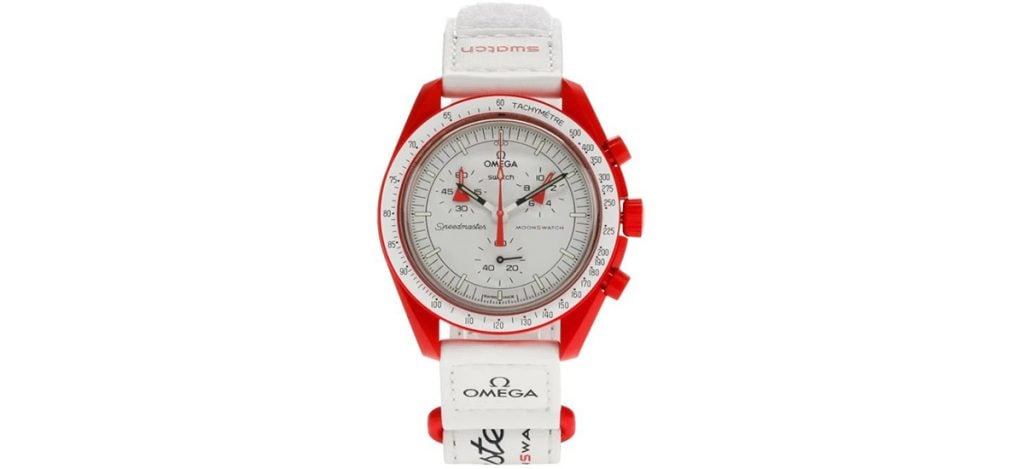
With its bright red case, white dial and strap, and red retro rockets, Mission to Mars has the most eye-catching contrast if that’s your jam. Speedy enthusiasts immediately recognized the nod to the Omega Speedmaster Alaska Project, a quirky and innovative limited-edition release of 2008 which fused a standard Moonwatch with a ginormous red “heat shield” designed to fend off the extreme temperatures of the “Dark side of the Moon” (Earth’s natural satellite, not the Pink Floyd album). If you want someone to spot your watch and strike up a conversation, this one is a go-to.

Omega X Swatch Mission to Uranus

Omega X Swatch Mission to Uranus

Despite, or possibly because of, the highly likely Beavis and Butt-Head bathroom humor, Mission to Uranus has been one of the most sought-after MoonSwatches. Of course, it may also have something to do with the fact that this pale-blue case, white strap tribute to the Greek god of the sky features one of the most popular colors of recent years in watch circles. You can call it whatever you want—pale, sky, powder, “Tiffany”, or “Carolina”—this shade of blue is hot, and Mission to Uranus is full of it.

Omega X Swatch Mission to the Moon MoonShine™ Gold

In 2023, MoonSwatch Mania came dangerously close to “jumping the shark” and being eaten alive. From March through December, Swatch fed the hype machine with ten extremely limited edition Mission to the Moon Moonshine™ Gold models (for sale one day only in each month) which all had a coating of Omega’s proprietary yellow MoonShine™ Gold alloy on the chronograph timing seconds hand. 

Monthly tweaks to the gold veneer included the addition of secret numbers and messages, pink highlights, flowers, snowflakes, Swiss flags, lollipops, barley grain, and strawberries. And that’s not even counting the Mission to Neptune Moonshine™ Gold edition that was released in August. Many asked: Why? Had MoonSwatch, like Icarus, flown too close to the sun?

Omega X Swatch Mission to the Moonphase

The answer came in early 2024. Swatch released both the monochromatic white and black Mission to the Moonphase models featuring a moon phase calendar complication replacing the 1/10 seconds dial at 2, and Snoopy, everyone’s favorite canine-naut, reclining on a rotating lunar disc. 

Just like the Apollo 13 crew, Swatch saved the ship. Suddenly, Mission to the Moonphase became the new “must-have” MoonSwatch. There were more coming, of course, but let’s just close our eyes and enjoy Snoopy for a moment, shall we?

Should You Buy an Omega X Swatch MoonSwatch?

Some watch enthusiasts continue to sniff at MoonSwatches and refuse to buy a plastic-ceramic “toy” homage to the iconic Speedy Pro. But I own two MoonSwatches, plus the most current Omega Moonwatch manual-wind Caliber 3861, and I enjoy them all for what they are. 

On a trip to New York City in 2023, I managed several trips to the Times Square Swatch Store and scored 5 total, and I enjoyed giving my thirtysomething watch enthusiast sons each one just like I used to bring them home Legos and Playmobil sets from work trips. Take it from me: if you want to live a little and have some fun, go with the flow and queue up for a MoonSwatch when the opportunity arises.

Omega X MoonSwatch Pricing and Availability

The original eleven models and the Mission to the Moon Moonshine™ Gold editions cost $270 retail and the Mission to the MoonPhase models $310. Swatch continues to sell new models only in select Swatch stores. 

Secondary market prices for most new models have come down considerably and are currently much closer to retail and even lower for preowned pieces in many cases. However, there is still a substantial premium on harder-to-obtain pieces like Mission to the Moon and MoonShine™ Gold models.

Conclusion

Current CEO Nick Hayek, Jr. has followed in his father’s space boot-sized footsteps and aimed high, pointing the Swatch Group toward the stars. The Blancpain X Swatch Fifty Fathoms releases of 2023-24 are surely a sign of more collaborations to come. Love it or hate it, one has to admit the MoonSwatch was “one giant leap for ‘watchkind,’” and the universe will never be the same again.

If you’ve ever dreamed of bringing together your love of luxury timepieces with a lucrative side hustle, then watch affiliate programs might just be what you’re looking for. Affiliate programs can be a game-changer, offering you a unique opportunity to earn a commission by promoting products you genuinely love and believe in. And because you love them, promoting them is made all the easier.

For watch fanatics like us, it’s a golden chance to turn passion into profit. You’ll be able to share your favorite brands and models with fellow watch lovers while earning a handsome reward for every sale made through your unique affiliate link. Whether you’re a seasoned blogger or just getting started in the online world, these programs will help you build your income stream and in turn, a successful affiliate marketing empire.

bot-only-imagebot-only-image

But which is the best high-paying watch affiliate program? We’ve done the research for you. Here are the top 12 watch affiliate programs you should be a part of.

12 Established Watch Affiliate Programs

Exquisite Timepieces

Exquisite Time Pieces Website

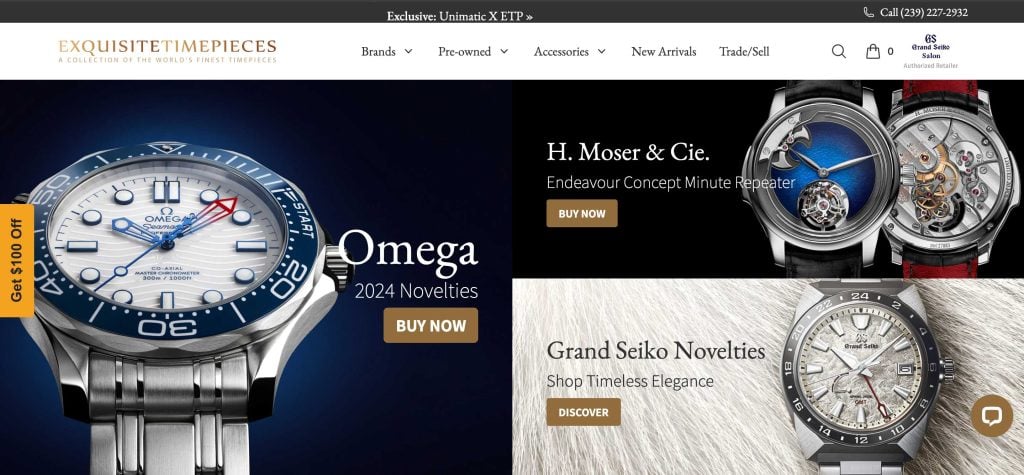
Exquisite Timepieces is easily one of the biggest players in the luxury watch retail business. They’ve been in the business for over 25 years and have a stellar fleet of 5-star reviews across all platforms. They are also an authorized reseller for 60+ luxury watch brands including Omega, Hublot, Longines and so many more.

In my opinion, the reason they deserve the number one spot because most other watch affiliate programs fall into one of these two categories:

  1. They are considered gray market dealers or marketplaces that are not officially authorized resellers of the brands they sell. Hence, customers have less trust in them, so you’ll find yourself with a lower conversion rate.
  2. Some manufacturers also have their own affiliate programs in which you have to sign up with each of them separately. There’s also less variety for customers.

Exquisite Timepieces falls into neither of these categories, being an authorized reseller of all the luxury watches on their website.

Overview:

Invicta

Invicta Website

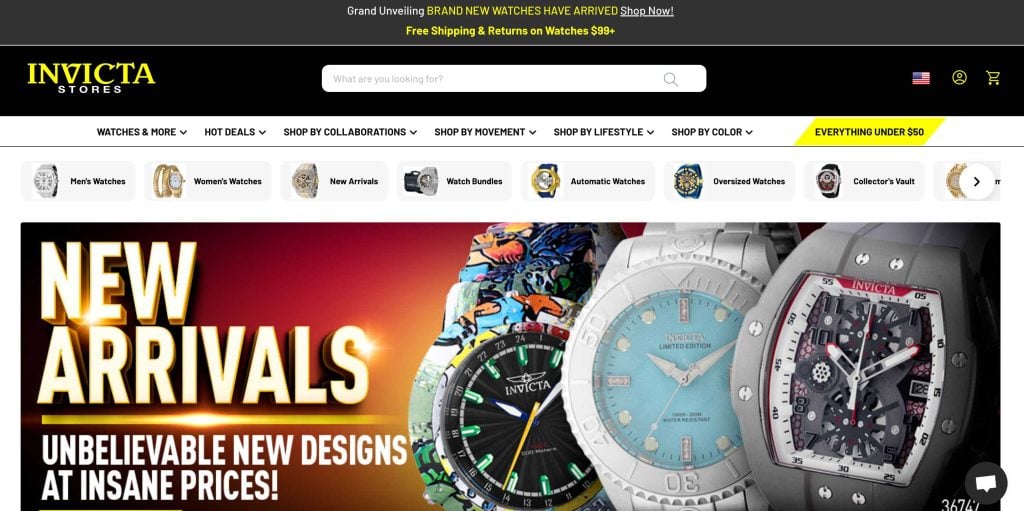
The Invicta Stores affiliate program is another great watch affiliate program, being a watchmaker themselves with a reputation for creating bold, high-quality timepieces. Invicta watches are well-known around the world, so attracting buyers shouldn’t be too difficult.

The watchmaker was founded in 1837, so they have a long history of creating watches with brave design DNA and exceptional technology. They believe in combining Swiss precision with innovative features to make wearability effortlessly, all while prioritizing style and reliability.

Plus, the Invicta Stores affiliate program provides you access to easy-to-use marketing materials and dedicated support so there’s no excuse you can’t succeed. You’ll even have a chance to promote their best-selling collections like the Invicta Bolt, Pro Diver, Subaqua, Venom and Reserve as well as some of their limited, hard-to-find arrivals.

Overview:

Overstock

Overstock Website

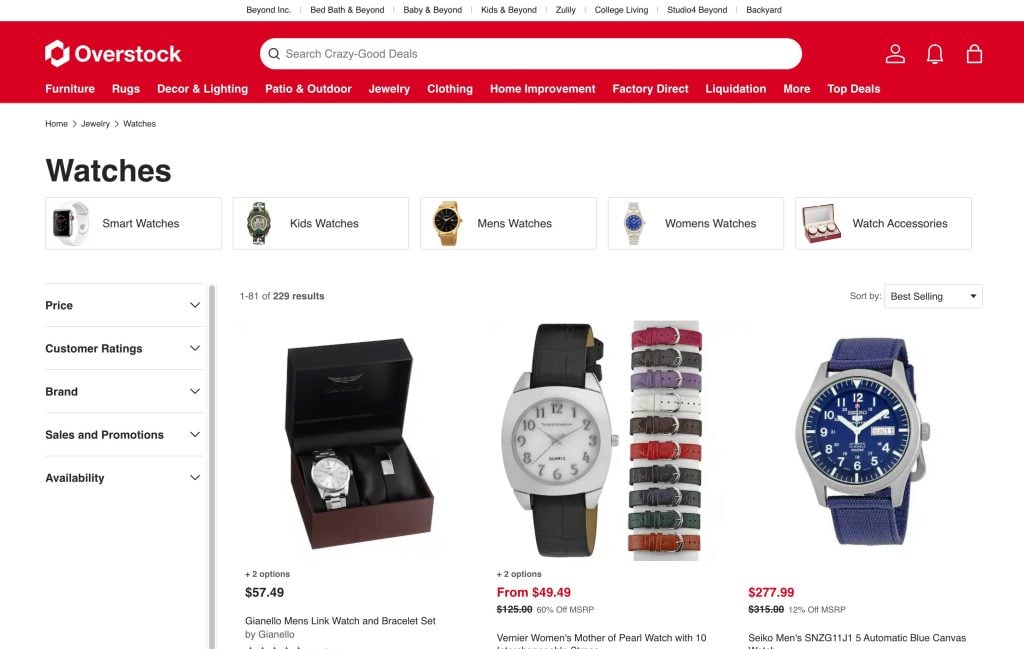
Another way to boost your affiliate income with a well-established watch retailer is by joining Overstock’s affiliate program. Most of you probably know Overstock as a retailer of electronics and computer tech, but since their founding in 1999, they have expanded far beyond. Their range of products now includes everything from furniture to home décor, clothing, jewelry and of course, watches.

In fact, they boast an impressive inventory of over 10,725 watches including everything from affordable daily beaters to more high-end luxury models. They even have a nice selection of pre-owned Rolexes. The program promises high conversion rates and offers solid support, so you can enjoy competitive earnings while feeling comfortable working with a brand with a well-known reputation. They also often have several seasonal deals and discounts for you to promote for an added boost to your conversions.

Overview:

Spinnaker

Spinnaker Website

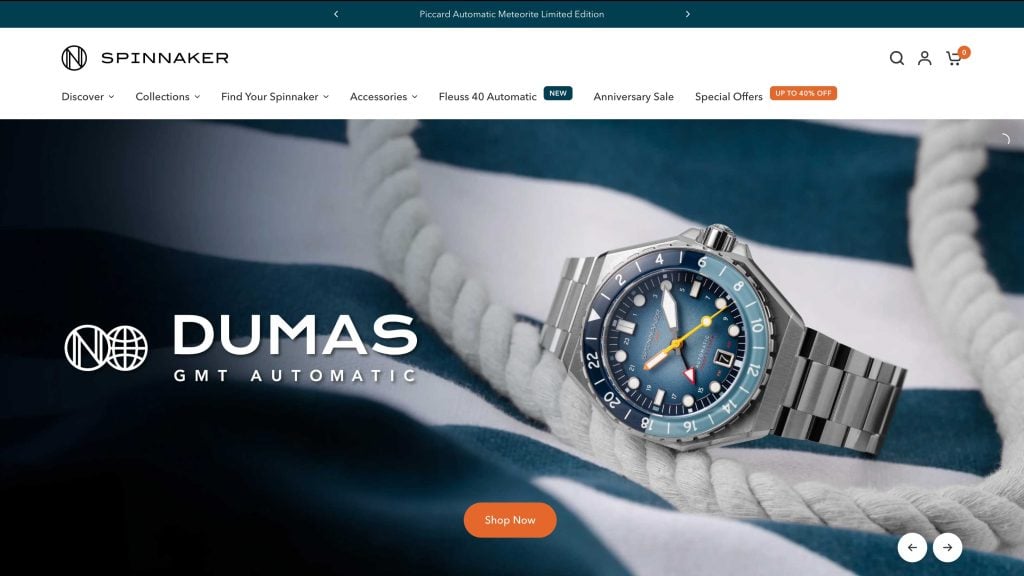
Another watchmaker with their own dedicated watch affiliate program is Spinnaker. Despite being a relatively youthful brand, having only been founded in 2015, Spinnaker has an outstanding history and a range of watches that rival some of the world’s oldest watchmakers. They are best known for their collections inspired by the spirit of adventure and maritime heritage, often filled with diving watches and chronographs.

Every Spinnaker watch reflects the brand’s commitment to quality and style, promising high levels of robustness and functionality with elegant aesthetics. So, whether you choose to promote the rugged durability of their dive watches or the sophisticated look of their vintage-inspired models, you’ll be showcasing products that appeal to a wide range of watch enthusiasts. As an affiliate, you’ll benefit from Spinnaker’s strong brand identity and competitive commission rates. They also promise a user-friendly platform, and dedicated support to help you maximize your earnings.

Overview:

Citizen

Citizen Website

When you’ve got a watchmaker that has been creating timepieces for more than 100 years, you can feel assured that promoting their watches through their dedicated affiliate program is going to be easy. That’s certainly the case with Citizen, who founded in 1918, have built a reputation for blending timeless craftsmanship with cutting-edge technology. Their diverse collections cater to a wide audience, making them perfect for your promotions.

The Eco-Drive series, for example, stands out with its sustainable design, powered by sunlight and eliminating the need for battery replacements. This innovative approach appeals to environmentally conscious consumers who seek both style and sustainability. Another highlight of the Citizen collections is the Tsuyosa, a colorful mechanical watch retailing for an insanely affordable price. Their affiliate program offers competitive commissions and support, making it an excellent choice for those looking to partner with a trusted and iconic brand.

Overview:

Bob’s Watches

Bob's Watches Website

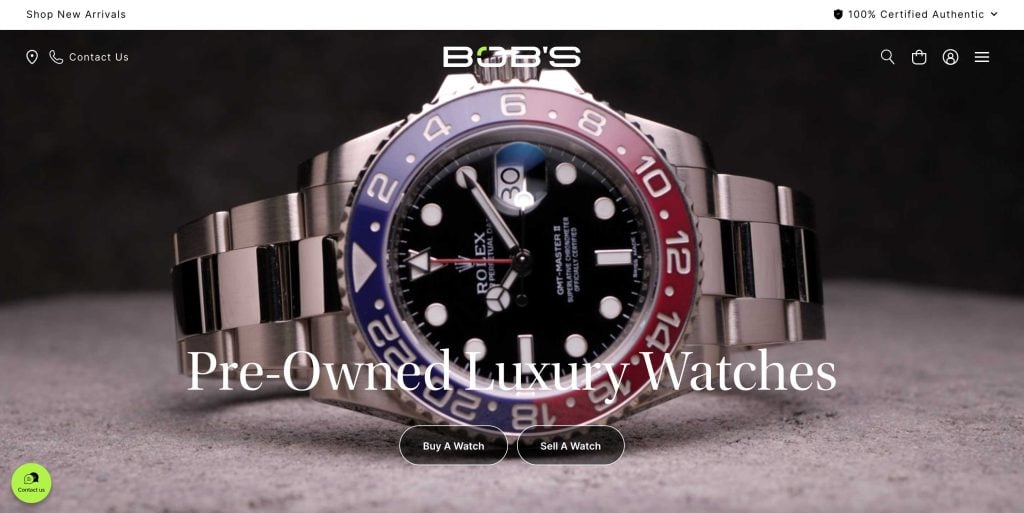
If you’re wanting to promote only pre-owned timepieces, then the Bob’s Watches affiliate program is a fantastic opportunity. Founded in 1999, Bob’s Watches has built a solid reputation as a trusted source for buying, selling, and trading luxury watches, specializing in pre-owned Rolex, Omega, Cartier and other high-end brands. They pride themselves on their transparent pricing, exceptional customer service, and extensive inventory, including some of the most sought-after models like the Rolex Submariner and Daytona.

As an affiliate, you’ll have the advantage of promoting a brand with a strong market presence and a loyal customer base. The Bob’s Watches affiliate program offers attractive commission rates, a user-friendly affiliate dashboard, and robust marketing support to help you succeed. Just be aware that their cookie window is just 1 day, so it’s important to capture your audience’s interest quickly and encourage immediate action to maximize your affiliate earnings.

Overview:

Jomashop

Jomashop Websiste

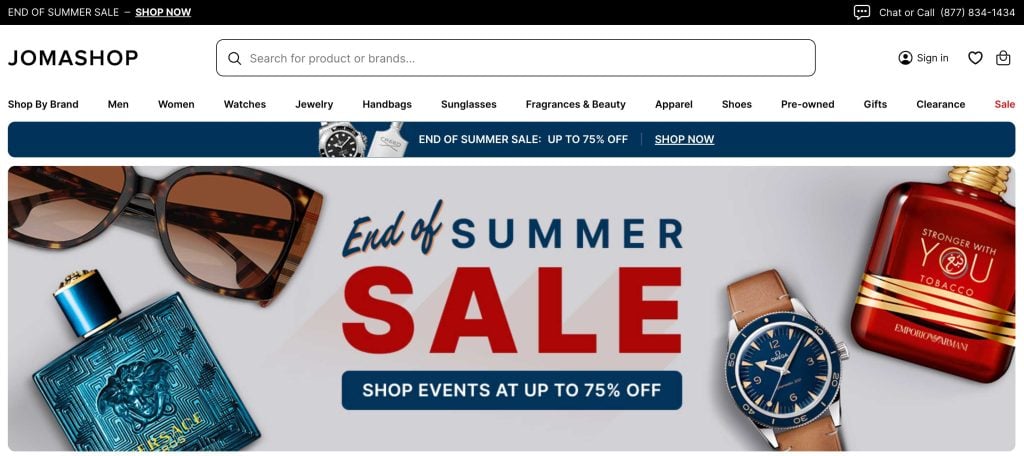
Jomashop is another prominent online retailer known for its affiliate program and impressive selection of luxury goods. They specialize, not only in watches, but designer handbags, fine jewelry, and other luxury accessories. Jomashop offers a broad range of products from some of the most sought-after brands in the industry. Their watch collection includes prestigious names such as Breitling, Omega, Rolex, and Panerai, catering to enthusiasts and collectors who seek both style and savings.

Their affiliate program is a great opportunity for marketers to promote a well-respected retailer while earning commissions. Affiliates benefit from competitive commission rates and access to a variety of marketing materials, including banners and links. With a 7-day cookie duration, you have ample time to capture sales and maximize your earnings. However, it’s important to note that Jomashop operates as a gray market dealer so they are not authorized resellers of the watches they sell, which may affect warranty and service options. Keep this in mind when promoting their products to ensure your audience is well-informed.

Overview:

Ashford

Ashford Website

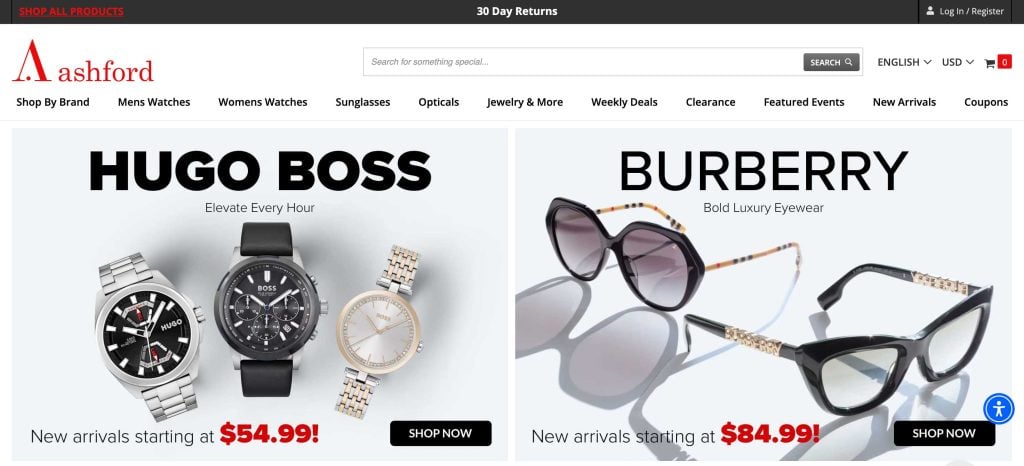
Another leading online retailer specializing in luxury watches, fine jewelry, and high-end accessories is Ashford. They offer customers impressive savings on premium brands, and marketers like me and you a relatively impressive affiliate scheme. They boast an extensive collection of watches including models from renowned watchmakers like Rolex, Omega, Cartier, and Tag Heuer. Their diverse range includes both classic and contemporary styles, catering to a wide array of tastes and preferences.

Affiliates benefit from competitive commission rates and a generous 30-day cookie window, allowing ample time to track sales and optimize earnings. The program offers comprehensive support, including access to a variety of marketing materials, banners, and links to help you effectively promote Ashford’s products. Again, Ashford does operate as a gray market retailer so make note they are not authorized resellers of the brands they carry.

Overview:

Watchgang

Watchgang Website

Since its inception in 2016, Watch Gang has redefined the watch-buying experience with its unique subscription box service. Inspired by the founder’s personal story of inheriting a cherished 1953 vintage Rolex from his father when he passed, Watch Gang delivers a high-quality timepiece to your doorstep each month, offering exceptional value and excitement without the retail markup. Subscribers receive a carefully curated watch at a significant discount, along with the chance to win a brand-new Rolex every week—a thrilling bonus for watch enthusiasts.

As an affiliate, you’ll enjoy a straightforward and rewarding program with a flat commission of $27 per sale. This predictable income structure does allow you to forecast your earnings more accurately compared to percentage-based programs, but it does also limit you compared to other watch affiliate programs. But, with a generous 30-day cookie duration, you have ample time to convert leads into sales and maximize your affiliate revenue.

Overview:

Kay Jewelers

Founded in 1916, Kay Jewelers has established itself as a cornerstone in the jewelry industry, renowned for its extensive selection of fine jewelry and watches. With over a century of experience, Kay Jewelers specializes in delivering high-quality products that cater to a variety of tastes and occasions. Their impressive collection includes watch brands like Bulova, Citizen, and Tissot, offering customers a range of stylish and affordable timepieces.

The Kay Jewelers affiliate program presents a lucrative opportunity for marketers looking to promote a well-established brand. Affiliates benefit from a competitive commission structure, with up to 7% in commissions on sales. But sadly, there is just a cookie window of 1 day, so you’ll need to secure your followers’ interest quickly. The program does provide access to a variety of marketing resources, including banners, text links, and promotional offers.

Overview:

G-Shock

G-Shock Website

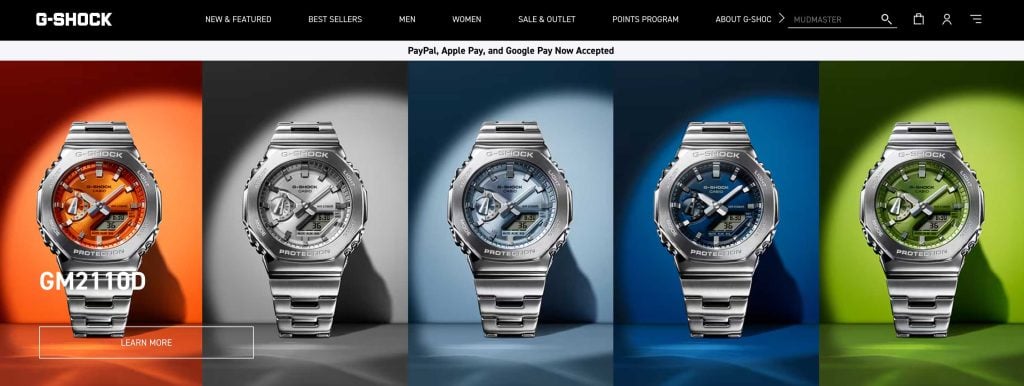
Surely promoting a watch brand that is dedicated to designing some of the world’s toughest watches will be a breeze. That’s certainly the case with G-Shock, a Japanese watchmaker who has revolutionized the watch industry with its innovative approach to durability and design. Created by Casio, G-Shock watches are renowned for their shock resistance, making them ideal for adventurous lifestyles. The brand’s commitment to resilience and functionality has resulted in iconic models such as the DW-5600, the GA-2100, and the MT-G series, each known for its robust build and cutting-edge features.

The G-Shock affiliate program offers a fantastic opportunity to promote a globally recognized brand. Affiliates can earn competitive commissions on sales and have access to a range of marketing materials, including banners and links. With a solid reputation for quality and innovation, G-Shock’s extensive collection provides a surplus of content to engage your audience.

Overview:

Fossil

Fossil Website

Last up we have Fossil, a fashion watchmaker who has made a name for themselves by creating stylish, high-quality accessories since 1984.  They are best known for blending classic designs with modern functionality, creating watches that are both fashionable and reliable. Their portfolio features a range of popular models, including the iconic Fossil Gen 6 smartwatches, the classic Fossil Grant chronograph, and the versatile Fossil Defender series.

The Fossil affiliate program offers an excellent opportunity for marketers to promote a well-established and trendy brand. It’s their dream to collaborate with content creators who share their ‘everyday #FossilStyle’ on their platforms and social media! If this is you, Fossil invites you to discover their affiliate program where you’ll benefit from competitive commissions, access to a variety of marketing materials, and dedicated support to help you optimize your campaigns.

Overview:

Which is the BEST Watch Affiliate Program for You?

If you’re looking for the best watch affiliate program, we recommend choosing one that is an authorized retailer (such as Exquisite Timepieces) over gray market sellers or marketplaces. Why? Because authorized retailers provide the assurance of genuine products and manufacturer-backed warranties, making them a more reliable choice for your audience. Not only does this build trust, but it also adds to the overall credibility of your own promotions.

Another benefit of working with authorized dealers is the potential for higher commissions and more extended cookie windows—often starting from 5 days and going up from there. This means you can enjoy bigger payouts while giving your audience time to make purchasing decisions. For those of us passionate about watches, aligning with a retailer that offers a broad selection of prestigious brands also allows you to reach a diverse audience. The more variety you offer, the more potential for engagement and sales, ultimately boosting your earnings. Now go out there and find your perfect partner – good luck!

To Top