
News Archives - Page 41 of 54 - Exquisite Timepieces
iconHome Blog / News / Page 41

Category: News

Grand Seiko SBGJ271 Review: Winter Snow on a Wooden Floor

Alex DeVane

October 25, 2024

Nature and culture are two prevalent topics that serve as fundamental bases for Japanese society. They complement each other indubitably. Nature weaves itself in and out of Japanese culture, and in turn, the culture pays its respects by holding nature to an elevated standard. 

The Grand Seiko SBGJ271 takes this concept and recognizes the beauty that can be achieved by combining nature and culture in ways that make you appreciate the immense value each brings to the table. The way in which we live our lives is a reflection of the nature around us. 

bot-only-imagebot-only-image

The snowy angelic dial also gives off a reflection, perhaps symbolizing how this industrialized world’s greatest feat is simply the landscape on which they reside, something completely out of their control. 

The whiteness of the dial resembles the flooring of Japanese households and Buddhist temples, which mirror the ground after a fresh snowfall, yet again alluding to the idea that everything mankind articulates is simply a byproduct of our planet.

Seiko brings its grand vision to life in this stunning piece. The watch embodies a wintery feel—a quiet, desolate, snowy landscape untrodden by man and never thawing. Its frosty, sharp design is simply beautiful, making it one of my personal favorite Grand Seiko pieces. 

As we explore the expertly crafted mechanics that make this watch stand out, pay attention to how each aspect of the design pays tribute to Japanese culture and recognize how important the Japanese deem nature, as they pay homage to it at every turn. 

History
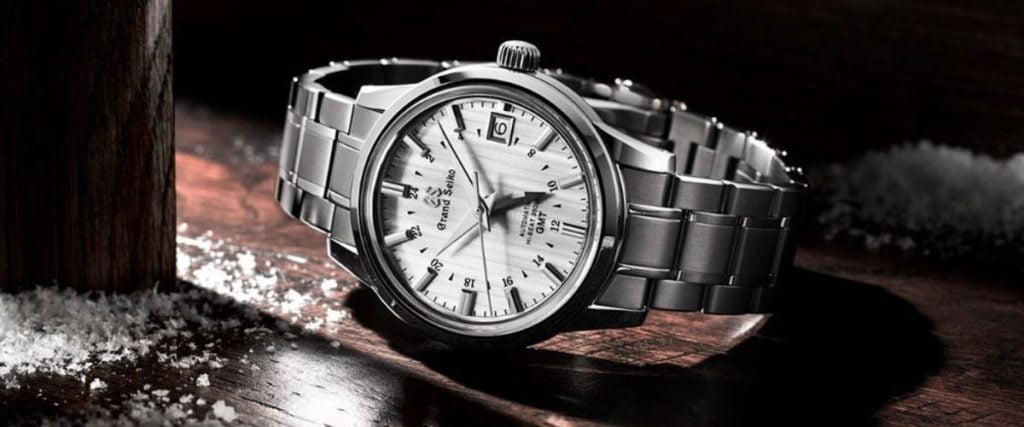
In 2023, the SBGJ271 became a part of the Elegance GMT 4 seasons collection, joining pieces that characterize the earliest Grand Seiko creations, fitting in with the soft design and round structure of its counterparts. It’s very similar to the SBGJ249, sharing similarities to the bracelet and case. 

However, where the 249 symbolizes the rainy season, the 271 most notably characterizes the winter. Both watches keep true to the message the Elegance collection attempts to convey, which is that everything always has multiple layers, and there is always much more than meets the eye in every piece. 

Case 

Inspired by the original 62GS case but fitted with more modern dimensions, the case has a diameter of 39.5mm, a lug-to-lug of 46.9mm, and a thickness of 14.1mm. It is made of flawless stainless steel, and the entire case has a Zaratsu finish, giving it a stunning presence. Shiny and elegant, the stainless steel laces the whole piece in a soft, luxurious style, like freshly fallen snow.

Keeping with the winter theme, the box-domed sapphire crystal sits elevated, like a thin layer of ice above a frozen lake. I’ve always been a fan of the box-domed style, as I feel it gives a vintage feel to it, as opposed to the way other crystals sit, not to mention that it offers another layer of protection, keeping the dial from getting scratched. The bezel tremendously compliments it, with its curved, well-polished edges perfectly blending with the smooth, icy layer of the dome.

The vintage-style non-screw-down crown resides at the 3 position. It sits discreetly but does not diminish the stunning beauty of the Zaratsu-finished stainless steel. The watch’s powerful 9S86 is visible through the see-through case back, giving a pleasing view of the piece’s heart and giving perspective on just how talented these watchmakers are. 

See-throughs have always been my preference, as I prefer the more open and intricate feel that comes with admiring the mechanical portion of my watch as well as the aesthetics. 

Overall, the case does its job very well. It gives off the unmistakable aesthetic of a fresh winter, blending the icy style with a vintage design. Its ultimate goal, however, is to highlight the real star of the show: the dial. 

Dial 

Reminiscent of lacquered Japanese flooring, the dial’s stark white coloring is brilliant and bold. The unique pattern combines modern design while also incorporating the vintage theme the rest of the watch is striving for. The team at Grand Seiko decided they wanted to embody the look of an outdoor Buddhist temple reflecting the freshly fallen snow residing on the trees above. 

They combined the unmistakable beauty of a fresh winter with something essential to Japanese culture, giving the dial a beautiful aesthetic and a symbolic tone that hovers over the rest of the piece. 

The dial has the standard traditional GMT 4 seasons collection layout, with the 24-hour markers cramped toward the center. But this piece has a unique black-colored GMT hand that we aren’t used to seeing from other GMT pieces, as most GMT hands have vibrant colors. The bold black contrasts the stark white in a sophisticated manner that causes both colors to expand to their full aesthetic potential. 

The markers are a gold bar style, with two residing at the 12, 9, and 6 positions instead of one, while a smaller marker can be found at the 3 position right next to the date window. A dark silver GS logo sits in the middle of the snow, complementing the dark GMT hand while contrasting the white dial

Overall, the dial alone advocates for purchasing the entire piece. It looks incredible in its own right and elevates everything else on the watch, bringing a style that feels like an old vintage piece. The unique texture is what highlights the dial for me. 

I love how watchmakers threaded bits of their own culture and how it reflects the beauty of the seasons. Not to mention, rich white is one of my favorite dial colors. This hits every box. Whether you’re looking for boldness, elegance, a vintage feel, or you love the symbolism and how the piece reflects the culture from which it came, this watch undoubtedly is for you. 

Movement

Powered by a 9S86 36000 Hi-Beat caliber, you can expect traditional Grand Seiko automatic watch movement, functioning at 36000 beats per hour. It uses a special alloy for the mainspring and hairspring, allowing it to achieve a 55-hour power reserve while still maintaining 36000 beats. The accuracy measures at +5 -3 seconds per day, and it is a GMT watch, allowing for a simple time-zone adjustment whenever you please. 

Accuracy is something Grand Seiko fans never have to worry about. Even though the revolutionary Spring Drive doesn’t fuel this piece, you can pretty much guarantee that all Seiko watches are going to deliver the most accurate reading possible while moving in a smooth, eloquent manner. This piece is, by all means, no exception. The elegant black hands subtly tick across the dial, gracefully showing off their mechanical prowess in a way only Grand Seiko can emulate. 

Mechanical ingenuity is far more important than the aesthetic of the watch. Without a sound, mechanical base, the rest of the piece is deemed useless. Thankfully, Seiko has been giving us the best of both worlds for generations. The level of mechanical flawlessness combined with Seiko’s elegant craftsmanship in every piece shouldn’t be the norm. Yet, they continue to pride themselves on the quality of each piece, which seems to improve with each release. 

Bracelet

The stainless steel bracelet’s five-link design features a matte finish on the innermost and outermost links and a Zaratsu finish on the smaller, middle ones. It is a classic Grand Seiko bracelet with a mixture of brushed and polished surfaces. 

The clasp is a simple fold with pushers featuring the Grand Seiko engraving in bold print. A simple and comfortable clasp that snugly fits the wrist. There are no micro-adjustments to find the perfect fit, but the half-links and screw links may make adjustments a little more simpler. 

However, the basic fitting should accustom most wrists comfortably enough. I can’t see many problems arising unless you have a uniquely sized wrist. The 19mm lug width may prove difficult to find straps, but the drilled lugs offer an easier way to swap them out. 

The sleek, smooth, glistening silver comfortably blends with the whiteness of the dial. It’s a very subtle feel but one that gets its message across all the same. It encapsulates the feeling of a soft winter, with hardly any distracting flamboyant features that take away from the tranquil atmosphere set by the rest of the piece. 

Rooted in solemn spirituality, it fits that every aspect of the piece embodies a quiet place of worship. Pieces like this, which take the form of a less dramatic sense of beauty, have always been more eye-catching. Watches that stay quiet usually speak a lot louder to me than something more dramatic, which is why I am drawn to this piece. 

With the greyness of the smoothly polished stainless steel and the stark white of the dial come a foreboding, powerful sensation that everything beautiful mankind has created originates from the earth itself. 

Even places of worship are subject to this sensation, with the temple floors being covered in snow, causing us to step back and admire the planet’s beauty while holding ourselves accountable to preserve this beauty.

On the Wrist 

The dimensions make this an extremely wearable watch on a variety of wrists. With an adjustable strap, it fits wrists as small as 6 inches and as high as 7.5 inches, so there aren’t going to be many issues for most wearers. 

The domed sapphire crystal, however, makes this watch significantly thicker than you might expect. A little too thick to slide under cuffs, making it more of a sportier wear that can be worn on dressier occasions. 

Practical and legible, with a GMT feature that can easily adjust to fit any timezone, this piece can be worn daily and looks beautiful with anything. The smooth silver goes with any lighter shade of clothing, but it can also beautifully contrast with a darker shirt. 

This piece is one of the rare instances where it can fit just as comfortably in a casual environment as well as a dresser environment, which is why I think that this is the perfect watch for any occasion. If you were going to buy only one, then this would be my pick. Not to mention that this is one of my favorite designs Seiko has ever produced. 

The stoic symbolism combined with the dazzling subtle shade of grey causes it to stand out among other pieces of similar design. The chain links are crafted to perfection and fit comfortably, and despite the thickness, it is an extremely lightweight wear that makes me forget it’s on my wrist. 

I wholeheartedly believe that this watch offers everything you need in a Seiko piece. It takes themes from their previous designs and merges them to give you an authentic Grand Seiko experience. They truly never disappoint. Each masterpiece tells its own story, weaving its narrative through the links of the bracelet. I simply cannot recommend this watch enough. 

Pricing

You can find the Grand Seiko SBGJ271 from Grand Seiko authorized dealers, like Exquisite Timepieces. We only ship to the US and are authorized dealers, ensuring a 5-year warranty directly from Grand Seiko. A brand-new SBGJ271 costs can be picked up for $7,100. Pre-owned pieces usually range from 5-6k, depending on the condition of the watch. 

Conclusion 

What more is there to say? This piece is not only beautiful, but it tells an entire story while sitting on your wrist. Seiko blends their obsession with nature and culture together and gives us a beautiful synopsis of what it means to live on this planet. 

The winter is harsh, but there is beauty to be found in the cold. When snow falls, it elevates the things it graces, bringing beauty through subtlety. This watch does the same. Bringing a solemn feel that mirrors a Japanese winter, it’s in a league of its own as it quietly stuns its audience with its sleek, silvery-white beauty. 

Seiko reminds us that while they pride themselves in making the most beautiful pieces possible, the greatest beauty of all comes from nature. They have gotten everything that man has made from the stunning planet they live in. 

Taking inspiration from the seasons, the trees, the oceans, the forests. Every dazzling fragment of Japan has been incorporated into Grand Seiko pieces in one way or another over the years, and this piece is no exception. 

As Grand Seiko continues to evolve, fans should hold their hopes high. Seiko continues to prove itself as one of those companies that seem to hold onto their core principles through the test of time while also adapting to improve every new piece that they release.

I have yet to be disappointed and find it highly unlikely that they will ever falter on their mission to aim for perfect craftsmanship and poetic symbolism, causing each piece to take on its own identity and come alive on your wrist.
Watch Complications Explained

Michael Brown

October 25, 2024

“It’s complicated.” The phrase suggests something that is hard to understand or explain. A “complicated” watch, however, is usually viewed as desirable and a source of purpose and pleasure by enthusiasts.

The primary function of a watch is to tell the current time in hours, minutes, and, usually, seconds. A “complication” is a watch function that provides additional information beyond those three measurements.

bot-only-imagebot-only-image

Complications are usually visual, conveying additional details through extra dial print, subdials, apertures, bezels that calculate elapsed time and speed of moving objects, or additional hands that indicate how much power is left in the watch’s mechanism, or even the current time on the other side of the world.

But complications can be pleasing to the ears as well. Acoustic complications include alarms that countdown or sound at a set time, “repeaters” that ping or chime every minute, quarter hour, and hour, enabling the wearer to tell the time by sound alone, and even “music boxes” that play tunes.

In this article, I describe a few of the most popular complications available today. After reading this, you may discover that a “complicated watch” can be a good thing and a nice pickup for your collection.

Date Complications

A simple date complication indicating the numerical calendar day is the most desired and useful for an everyday wear watch.

A self-changing date complication, first introduced in the 1945 Rolex Datejust, is usually accomplished with a date wheel inside the watch case that rotates to the next day automatically as the time passes 00:00 hours (midnight). 

There is an aperture or date window, most often located at the 3 o’clock position, but sometimes at 4:30 or 6:00 as well. The day of the week is sometimes added, either as an abbreviation alongside the date at 3:00 or at 12:00 using the full name.

In addition to apertures, some watches use an extra hand called a “pointer” to show the date. These usually have the Arabic numerals 1-31 located along the outer edge of the dial in an area called the “chapter ring” or in a smaller dial within the main dial (“subdial”).

Pointers are often used in perpetual calendar watches with very complex—and expensive—mechanisms that can advance the day, date, month, and year correctly, including leap years, until the year 2100 without resetting as long as the watch is kept running. An annual calendar watch tracks the same information but must be reset every year.

Chronograph Complications

Another popular complication is the chronograph. “Chronograph” is derived from the Greek language and means “time recording”. Chronographs track both the current time and the elapsed time of an event. Most modern chronographs have a start/stop pusher at 2 o’clock position and a reset pusher at 4 o’clock. 

A long timing seconds hand is usually used that extends to seconds indices at the dial’s edge. In addition, subdials can track current running seconds as well as elapsed timing hours, minutes, and even fractions of seconds.

There are several variations of chronographs that go beyond the basic “stopwatch” format. 

A tachymeter is a numerical scale on the bezel that allows the calculation of the speed of a moving object over a set distance in either mph or kph. A telemeter scale on the bezel or dial can estimate the distance from an event that is seen and heard (e.g. a lightning strike and ensuing thunder), while a pulsometer scale can compute heart rate in beats per minute. Sometimes, all three are combined in one chronograph.

In addition, there are chronographs with more complicated mechanisms that fine-tune the measurement of elapsed time. A “rattrapante” (French for “catch up”) is a “splits seconds” chronograph that uses two timing seconds hands to measure total elapsed time as well as “split” or lap times. A “flyback” chronograph allows the user to start and stop the timing seconds hand and reset to zero with a single press of a pusher.

GMT/World Time Complications

GMT and World Time complications enable the wearer to track the time in different timezones around the world. “GMT” stands for Greenwich Mean Time, the system that designates 24 global timezones with a reference “Zero Hour” linked with the longitudinal Prime Meridian, which runs through the Royal Observatory near London.

GMT watches are typically four-hand watches with a GMT hand that tracks a 24-hour scale on the bezel, which may be rotating or stationary. There are two basic types: traveler (aka “flyer”) and desk (aka “caller”). 

A traveler GMT has a jumping local hours hand, which can be set independently when arriving in a different timezone without interrupting the watch’s timekeeping. The GMT hand stays on the time back home.

In contrast, a desk GMT has a jumping GMT hand that can be set independently to a different timezone while the local time keeps running, making it ideal for someone staying put but needing to know the time at a different location. A rotating bezel can track a third timezone with both traveler and desk types.

A world time complication can show not just 2-3 timezones but any time across the world. A common characteristic of all world timers is a list of reference cities representing the 24 global timezones and a 24-hour scale. The city list is usually located on an outer chapter ring, which may be stationary or rotating or on a rotating bezel. 

The 24-hour scale is usually located on an inner chapter ring, which can be set and rotated through every city over the course of the day. Other world timers use pushers that move some combination of the reference cities, 24-hour scale, or local hours hand.

It all sounds a little confusing and, well, “complicated”, but in real life, everything works out fine once you figure out your model’s mechanism.

Moonphase Complications

Some form of “moonphase” clock has been in use since ancient times when tracking the lunar cycle yielded important information regarding planting, harvesting, hunting, and fishing.

These days, a moonphase watch complication uses a rotating disc depicting the sunlit moon’s phases over a 29.5-day period, which is seen through a decorative, cutout aperture on the front of the dial, sometimes round, but usually arc-like, similar to a half-moon. 

A moonphase complication is not particularly accurate—or useful—but it is stylish and adds nice touches of color and additional interest and motion to the watch face that make them popular among collectors.

Though often associated with expensive, high horology, moonphase complications are also available in more affordable entry-level mechanical watches and every price point in between.

Tourbillons

When it comes to timekeeping, gravity is not a friend. The small components of a mechanical watch are affected by gravitational forces, resulting in “positional errors”, which adversely affect accuracy.

A tourbillon (French for “whirlwind” which describes the mechanism’s swirling motion) is a complication that mitigates these errors, making it, in effect, an “anti-gravity” machine. 

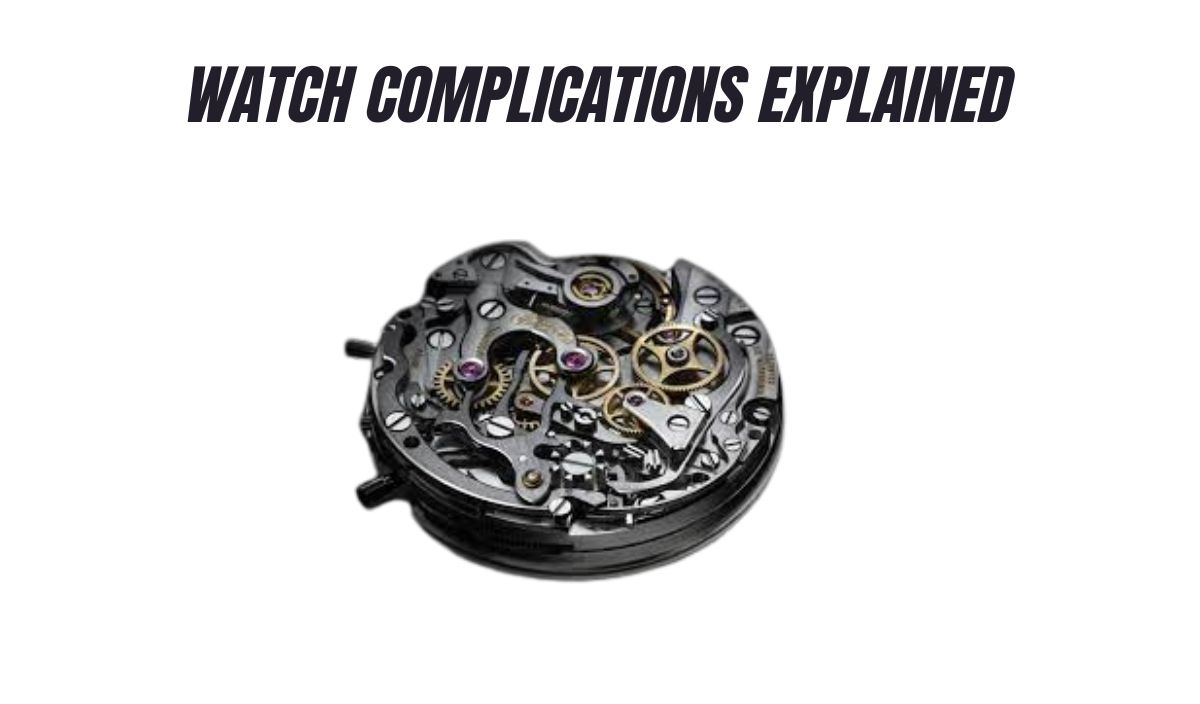
Basically, the balance wheel, balance spring, and escapement, the intricate parts most susceptible to positional errors, are located inside a rotating cage that helps average out gravitational forces in a mostly stationary timepiece such as a pocket watch.

The tourbillon was created by renowned French watchmaker Abraham-Lewis Breguet in 1795 and patented in 1801. Since that time, the tourbillon has evolved from the single-axis model of Breguet to more complex ones that use multi-axes, combinations of tourbillons, “flying” tourbillons mounted so they appear freestanding, and even ultra-sophisticated “gyro” ones that drive perpetual calendar watches.

There is controversy as to whether or not tourbillons improve accuracy significantly in modern watches that are non-stationary and rotating with the motion of the wearer’s wrist. 

But no one denies the intricate beauty of these complications seen through open, skeletonized dials and display casebacks. They can mesmerize and hypnotize for hours and have your boss frowning in chagrin at the inverse relationship between your watch addiction and office productivity.

Since tourbillons are complex and difficult to manufacture, they tend to be very expensive and associated with high-end horology. However, improvements in manufacturing and technology enable some companies to offer tourbillon watches for lower prices.

Power Reserve Indicators

A power reserve indicator is a watch complication that shows how much potential energy remains in a mechanical watch’s mainspring. Think of it as your watch’s “fuel gauge”. 

If you don’t wear a mechanical or automatic watch every day, it’s useful to know how much is “left in the tank” before you strap it on again, especially since a more fully wound mainspring is associated with greater accuracy.

Power reserve indicators are most often seen on dials and may take the form of a hand moving along an arc-shaped scale or within a subdial. Other dial indicators include bar or linear indicators that use a +/- scale or fill up as reserves decrease and color-coded gauges that vary as power levels change. Some people prefer a less cluttered dial, so there are watches with power reserve indicators on the movement, which can be seen through a display caseback.

Like tourbillons, some dismiss power reserve indicators in modern watches with large power reserves and self-winding, automatic movements, believing they are a needless feature from the past. However, one person’s superfluous fluff is another person’s desirable design element. Like beauty, a watch complication is “in the eye of the beholder”.

Mechanical Alarms

We set most alarms these days with our cell phones and digital watches and clocks, so mechanical alarm complications are much less common and cherished than in years past. But as one who owns mechanical watches in part to push back against the creeping tide of digitization and form connections with both my watches and the past, I say, “So what?”

A mechanical alarm complication allows the user to set an alarm within a 12-hour period. The first mechanical alarm watch was created by Eterna around 1914.

 But arguably the most iconic was the 1950s era Vulcain Cricket with a separate barrel system for the alarm that emitted a cool chirping sound, hence the name, and was famously associated with U.S. presidents such as Dwight Eisenhower and Richard Nixon, among others.

There are several other modern watch companies that still offer fine references with mechanical alarm complications, including Tudor, Patek Philippe, Breguet, Jaeger-Lecoultre, and Oris, to name a few. Here’s a link to the Exquisite Timepieces website, which features some of these.

I personally own two watches with mechanical alarms, and not only do I find them handy to wake me up from a catnap, but they also encourage me to slow down and engage with my watch, thereby nurturing the wearer-watch “connection”.

The reward consists of soft, soothing, Zen-like “dings”. Sometimes, I set an alarm for no other reason than to breathe deep and calm my soul.

Minute Repeaters

From mechanical alarms, we transition to the most complex acoustic complication—the minute repeater.

A minute repeater allows the user to tell time through a series of different auditory tones produced by hammers striking gongs. They were originally designed for telling time in the dark and for the visually impaired. 

Not surprisingly, Abraham-Louis Breguet, father of the tourbillon, also invented the first ones in the mid-18th century. Unlike church bell chimes or grandfather clocks, which strike every quarter hour and hour, minute repeaters chime to tell time to the exact minute.

This is accomplished using an independent chiming mechanism that can be switched on or off—so yes, you can “mute” it. The actual tones and sequencing can differ from brand to brand. 

To illustrate, Patek Philippe uses a lower tone for hours, a two-toned sequence for quarter hours, and a higher-pitched single tone for minutes. For example, to designate 7:47, the minute repeater would strike seven low tones, 3 two-toned sequences, and 2 high-pitched single tones.

There are repeater variations with other sequences and pitches for hours, quarters, half-quarters, 10 minutes, 5 minutes, and single minutes, as well as “dumb” repeaters that don’t chime audibly but instead vibrate.

Along with tourbillons, minute repeaters are premium mechanisms that, while certainly not absolutely necessary for modern times, are nonetheless venerable and sought-after complications. 

As such, they are also very expensive. However, some companies offer less complex hours-only repeaters that still give you that calming chime every 60 minutes at a more affordable price point.

Conclusion

While time-only watches can certainly be aesthetically clean and appealing, we only experience the full range of watchmaking artisanship and functionality when we consider the many complications available in modern timepieces. If “variety is the spice of life,” then watch complications are the cinnamon, cumin, and paprika of horology.

Still, be careful and go easy—a little bit of complication can go a long way.

How Mechanical Watches Work

Charlotte H

October 25, 2024

Ask any watch collector or self-confessed timepiece enthusiast. We guarantee they’ll be more than happy to talk about mechanical watches, probably for hours, and explain to you just how innovative and breathtaking these timeless pieces are. 

Whether manually wound or powered by the movement of your wrist, mechanical watches have remained a symbol of craftsmanship and precision since their birth. Unlike quartz watches, which rely on a battery, mechanical watches utilize several intricate components to keep time.

bot-only-imagebot-only-image

So, just in case you’re new to the world of horology – that’s the fancy word for the art of watchmaking – and you don’t have an avid watch connoisseur in your life, let us guide you through all there is to know about mechanical watches including how they work, their history and how best to maintain then.

The Basics of a Mechanical Watch

Ok, so before we get into the nitty-gritty details of how a mechanical watch works, let’s first cover the basics. At the heart of any watch, there is something called a movement. This is the technology used to make the hands tick seamlessly around the dial so you can read the correct time. There are two key types of watch movements: quartz and mechanical.

Quartz watches are those powered by a small battery that needs replacing every couple of years. The battery relies on electricity and the properties of a quartz crystal, allowing quartz watches to be incredibly accurate and low maintenance. Mechanical watches, on the other hand, work completely differently. They don’t use batteries but instead rely on a series of tiny moving parts to keep time.

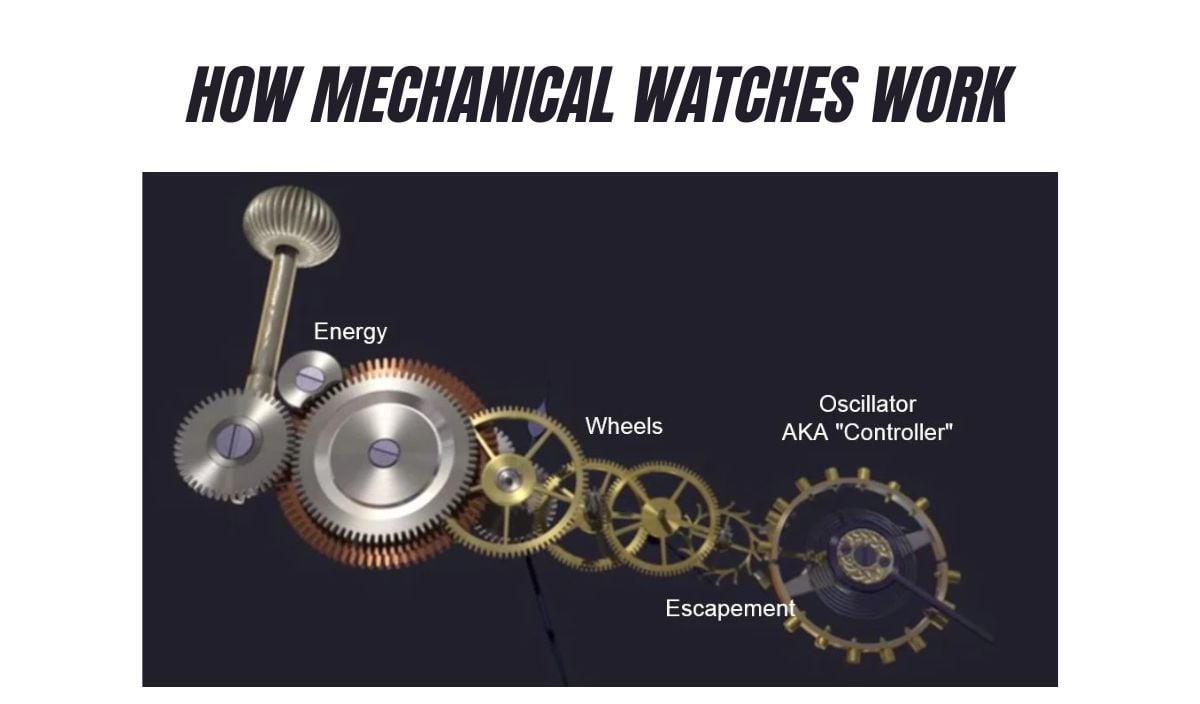
There are two types of mechanical movements: manual winding and automatic. Manual winding watches need to be wound by hand. You turn the crown (the little knob on the side of the watch), and this winds a component called the mainspring. As the mainspring unwinds, it releases stored energy that powers the movement, keeping the watch ticking. 

Automatic watches work similarly, except they have a small, semi-circular weight inside called a rotor, which winds the mainspring automatically as you wear the watch. The natural motion of your wrist makes the rotor spin, keeping the watch wound without you needing to do anything. If you wear it daily, it’ll keep ticking forever.

It’s these tiny, intricate parts that make a mechanical movement truly special. As you’ve probably realized, the mainspring is one of the most important components, as it’s this that needs winding to power the watch. 

It works by winding up and storing the energy needed to fuel the other components. This energy is then transmitted through the gear train, an escapement and a balance wheel, all of which work together to ensure the watch runs steadily and accurately.

History of Mechanical Watches

Mechanical watches date back centuries, with some of the first recorded mechanical clocks emerging from Europe during the late 13th century. But these were large tower clocks and not the wristwatches we know today. 

It wasn’t until the 16th century that the components of mechanical movements were made small enough to fit into portable, wearable watches. Some of the earliest mechanical watches were powered by a mechanism called the Verge escapement, an innovation that helped watches become more compact and wearable.

The first true mechanical watch was developed by Peter Henlein, a German locksmith, around 1510. His invention, often credited as the first portable timepiece, was a spring-powered pocket watch. However, it was far from accurate— as you’d expect for the world’s first-ever attempt. Instead, these early watches were mostly decorative, meant to showcase wealth rather than tell precise time.

Accuracy in mechanical watches became a major focus in the 18th century. John Harrison, an English carpenter and clockmaker, invented the marine chronometer, which revolutionized timekeeping as we know it. 

His device allowed sailors to determine longitude at sea, a breakthrough in navigation. This leap in precision marked the beginning of mechanical watches being valued not just for their beauty but for their accuracy.

As time went on, mechanical watch movements continued to evolve. The COSC certification (Contrôle Officiel Suisse des Chronomètres) was introduced to set a high standard for accuracy in Swiss watches

To receive COSC certification, a mechanical watch must meet strict criteria, such as keeping time within -4 to +6 seconds per day, a mark of precision that separates ordinary watches from exceptional ones. Having a COSC-certified watch means you have the confidence your fancy wristwatch has passed several rigorous tests to prove its timekeeping abilities.

Today, mechanical watchmaking has reached entirely new heights with innovations like the Zenith El Primero. Launched in 1969, this has become famed for being the world’s first automatic chronograph movement. It not only automated the winding process but also boasted a frequency of 36,000 vibrations per hour, making it one of the most precise mechanical movements of its time

The Grand Seiko Spring Drive is another notable innovation. This engineering marvel has somehow combined the mainspring of a mechanical movement with the electronic regulator of a quartz one. This hybrid technology allows for a completely smooth seconds hand and near-perfect precision.

Operating a Mechanical Movement

Until you’ve seen one up close, it’s difficult to explain just how incredible and innovative mechanical watch movements are. But we’ll try our best! 

These miniature marvels of engineering are powered by hundreds of tiny parts that all work together to keep the time showing on the dial accurate. Let’s break down the key parts of a mechanical watch and see how they work together to create a functioning timepiece.

The Mainspring

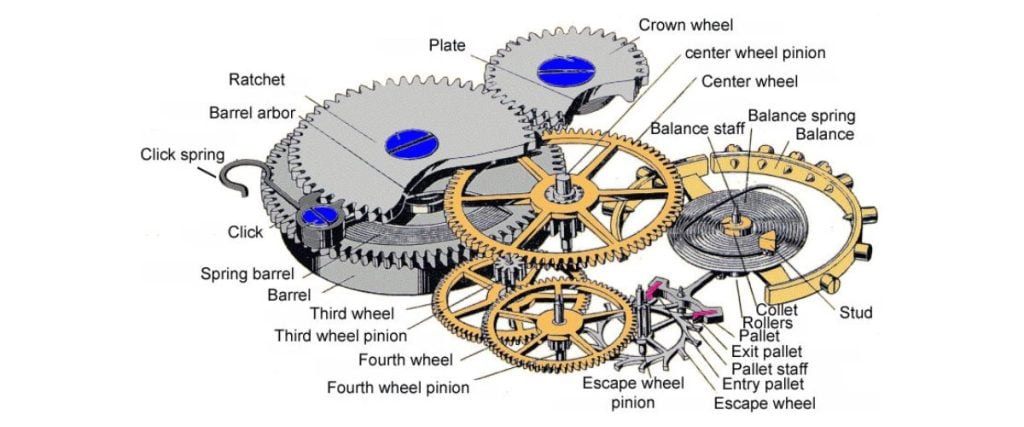
Many will agree that the mainspring is the heart of a mechanical watch. It’s a long, thin strip of metal wound tightly into a coil, and its job is to store energy. In a manual winding watch, you wind the watch by turning the crown, which tightens the mainspring. In an automatic watch, the winding happens naturally as you move your wrist, thanks to a rotor inside the watch that spins and winds the spring. 

As the mainspring unwinds, it releases the stored energy. The more tightly it’s wound, the more energy it stores, and the longer the watch can run. A fully wound mainspring can typically power a watch for about 40 hours, though some high-end watches offer much longer power reserves. The energy released by the mainspring powers the entire movement. 

However, it doesn’t release all the energy at once, but it does so slowly, over time. The process of controlling this energy flow is where the rest of the watch’s components come into play.

The Gear Train

Once the mainspring begins to release energy, it sends it through the gear train, a series of small gears that transmit the energy throughout the movement. These gears reduce the speed of the energy unwinding from the mainspring so that the hands on the watch move at the correct speed. 

At the start of the gear train, energy is moving very fast, but by the time it reaches the hands of the watch, it has been slowed down enough to turn the second, minute, and hour hands at their proper speeds. The gear train ensures that one complete rotation of the minute hand happens every 60 minutes and one rotation of the hour hand happens every 12 hours.

The Escapement

The escapement is another super important component of a mechanical watch because it controls the release of energy from the mainspring. Without it, the mainspring would unwind too quickly, and the watch would lose all its energy in seconds. 

The escapement acts almost like a gatekeeper, releasing tiny amounts of energy in controlled intervals. This gives the watch its steady “tick-tock” rhythm. It also works in conjunction with the balance wheel (which we’ll get to next) to regulate the speed at which the gears turn and the hands move.

In most mechanical watches, the escapement consists of two main parts: the escape wheel and the pallet fork. The escape wheel is connected to the gear train, and the pallet fork alternately locks and unlocks it, allowing the wheel to move forward one step at a time. 

Each time the escape wheel moves, a tiny burst of energy is sent to the rest of the movement, allowing the gears to turn in perfect time.

The Balance Wheel

Working closely with the escapement is the balance wheel, which is like the watch’s pendulum. The balance wheel oscillates back and forth at a constant rate, and this regular motion helps the escapement release energy in evenly spaced intervals. Attached to the balance wheel is a tiny, coiled spring called the hairspring or balance spring. 

As the balance wheel swings in one direction, the hairspring tightens. Then, it loosens, pushing the balance wheel back in the opposite direction. This process repeats over and over, giving the watch its rhythm. 

The oscillations of the balance wheel, typically 18,000 to 36,000 beats per hour, determine how quickly the escapement can unlock and release energy. The faster the balance wheel oscillates, the more precise the watch will be.

The Dial Train and Hands

The dial train is a series of gears that takes the controlled energy from the escapement and balance wheel and uses it to drive the hands of the watch. It reduces the speed of the gear train so that the second, minute, and hour hands move at their respective speeds. 

For example, the second hand completes one full rotation every 60 seconds, the minute hand completes one rotation every 60 minutes, and the hour hand completes one rotation every 12 hours. The dial train ensures that these rotations happen precisely and smoothly.

The Rotor (for Automatic Watches)

For automatic watches, there’s an additional component called the rotor. This is a semi-circular weight that spins as you move your wrist, winding the mainspring in the process. The rotor pivots around a central axis, and when it spins, it transfers energy to the mainspring, keeping the watch wound without the need for manual winding. 

The beauty of the rotor is that it uses the natural movement of your body to keep the watch running. If you wear your watch regularly, it will stay wound without you ever having to manually wind it.

The Crown

The crown is the small knob on the side of the watch that you use to wind it manually. In most watches, you can pull the crown out to adjust the time or push it in to wind the mainspring. 

Automatic watches can also be wound manually if the rotor hasn’t wound enough through natural movement. The crown is your main point of interaction with the mechanical movement, and it plays a crucial role in keeping the watch running smoothly.

Mechanical Watch Maintenance Tips

As is the case with any watch, mechanical watches require some love and care to keep them ticking for years. One of the most important and possibly obvious tips we can give you is to keep your mechanical watch wound. 

For many watches, make sure to wind the crown gently once per day, preferably at the same time each day. If you have an automatic watch but you don’t wear it daily, you might want to consider getting a watch winder to keep it running.

Another key tip is to avoid exposure to magnets, as they can affect the watch’s accuracy. Keep your mechanical watch away from electronic devices like smartphones, speakers, and laptops, which emit magnetic fields, as these can mess with those intricate components inside and ultimately ruin the precision and functionality of your timepiece. 

Similarly, we also suggest keeping your watch clean. Wiping it with a soft, dry cloth every now and then will help to prevent any dust, dirt, or sweat from getting into the movement. This will also help keep your watch looking brand new.

Depending on the water resistant rating of your mechanical watch, try to avoid submerging it in water. And even if your watch is water resistant, check the seals periodically. This can also be done when you service your watch, which should be actioned by a professional every 3 to 5 years. 

Over time, the oils inside the movement can dry out, and the tiny gears can wear down, so the regular maintenance provided by a watch service ensures your watch keeps performing at its best.

Conclusion

Hopefully, you can now see why so many of us watch nerds and why we love the beauty and technology of mechanical watches. These little works of art require no battery, but just a selection of finely tuned gears, springs, and wheels to tell the time. 

Whether manually wound or automatic, mechanical watches represent centuries of horological innovation. Sure, they’re not as accurate as quartz watches, but those battery-operated movements lack the artistry, engineering, and history that comes with a true mechanical timepiece.

Types of Watch Movements Explained

Nina S

October 25, 2024

In this comprehensive guide to watch movements, we’ll discuss the key mechanisms used in accurate timekeeping and compare them in detail.

Navigating the world of watches is not just as simple as choosing a design you like the look of. You need to consider what features that watch offers, its size, and factors like the case material. You need to decide whether that watch is suitable for work, home life, and whatever you get up to in your spare time. If it isn’t, you may consider investing in multiple timepieces – a design for every occasion. 

bot-only-imagebot-only-image

That, in itself, opens up a whole host of other factors to consider. Do you need a “going out watch” and a daily beater? Or can you combine a watch for the office with a GMT feature for times when you travel on business? There are so many options.

On top of that, you’ll also need to decide what type of watch movement you want. This guide is going to focus on just that – watch movements. What are they? How many different kinds of watch movements are there? And which one is the best? I will answer all those big questions for you in this guide. Let me provide a quick overview before we get stuck into the nitty-gritty details.

An Overview of the Different Types of Watch Movements

First thing is first: watches fall into one of two main categories. On the one hand, we have mechanical, and on the other, quartz. But wait (it was never going to be that simple, was it?), there’s more. Mechanical watches are further divided into two sub-categories: the automatic type and the hand-wound type.

In this article, whenever you see me refer to a hand-wound watch, you’ll know that it means the manually-powered type. These watches need regular winding by hand to keep time accurately. 

Automatics are the type of mechanical movement that require no hand winding and, instead, source their energy from the natural movement created by your wrist. An automatic movement is also called a self-winding movement (just to make things a little more complicated!). 

With an automatic movement, the mainspring is perpetually wound by an oscillating weight. This weight effectively does what your fingers would be doing if you were manually winding a hand-wound watch.

So, that’s the basic run-through of mechanical watch movements. But what is quartz, you ask?  Well, quartz watches have no mechanical mainspring at all. Instead, they use a small battery that creates an electrical charge that powers the hands around the dial. 

Even the basics of watch movement terminology will tell you that the two main types that power a watch are very different things. They work in different ways but achieve the same overall purpose – to propel a set of hands accurately around a dial, telling the wearer what time of day it is. Functionality-wise, movements can vary in their complexity, too.

Aside from a simple day or date feature, advanced functions can include stopwatches, perpetual calendars, moon phase indicators, power reserve displays, tourbillons, small second functions, flyback chronographs, and rattrapante chronographs, to name just a few examples. Let’s take a deeper look into the different movements of a watch and compare them to one another. 

What Is a Mechanical Movement? 

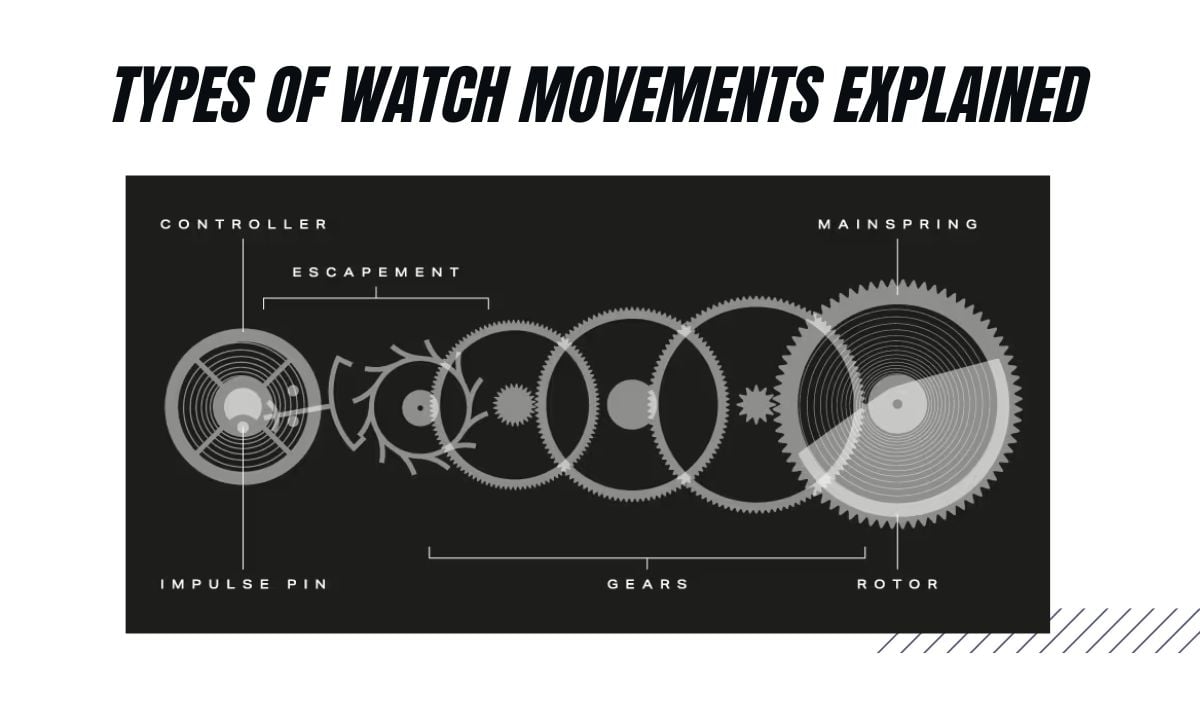
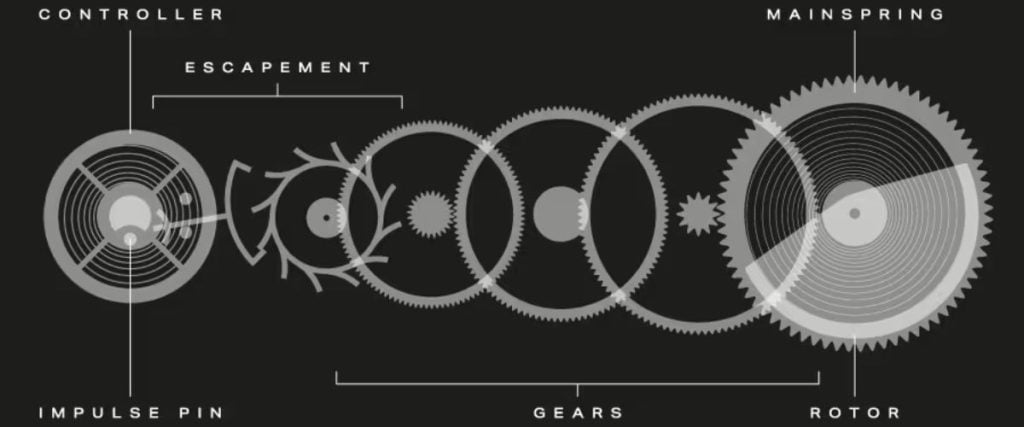
All mechanical movements contain a metal coil called a mainspring that produces power as it unwinds. What tightens the mainspring in the first place is the winding of a manual watch or a weighted rotor in an automatic watch. As you manually wind a watch, the spring curves and retains energy, which is then released in a controlled and steady manner to keep perfect time on the dial side.

The release of the tension in the mainspring is all down to a series of gears and wheels. This is what is also known as the Going Train. The component that releases the energy from the mainspring is the escapement. 

This is an integral part of the mechanics of a movement since it prevents the mainspring from instantly unwinding itself and losing all its power. To unwind rhythmically it requires the help of an escape wheel and a balance fork.

The escape wheel catches on a palette that clicks back and forth, controlled by a fork lever, which in turn catches on an impulse pin attached to the balance wheel. The balance wheel must be regulated the whole time for the watch to keep accurate time. This is the element you’ll see rocking back and forth behind an exhibition window on the back of a watch case. 

Automatic watches work in a very similar way to a manual winding movement, except for the fact that they use a weighted rotor. The rotor spins on its axis as natural movement is created in the wrist, automatically coiling the mainspring without the need for manual winding. 

The rotor can either be unidirectional or bidirectional winding. However, the benefit of a bidirectional winding movement is that it utilizes the energy that would normally be wasted on a unidirectional winding movement.

The first mechanical watches date back to the 1500s, eventually becoming more discreet as they evolved from large pocket watches to convenient wrist-worn companions. The first mechanical wristwatch was produced by Abraham-Louis Breguet in 1810 (yes, that Breguet!). 

Before then, however, several pioneers had played an integral role in bringing timepieces up to a “modern” level of precision, including the balance spring, invented by Robert Hooke and Christiaan Huygens in 1675, John Harrison’s marine chronometer of 1760, and, eventually, the automatic wristwatch by John Harwood.

What Is a Quartz Movement? 

Quartz movements work in a completely different way from manual movements. Despite being a more affordable option, they are more accurate than mechanical movements, and this is all down to the frequency of the vibrations of a quartz crystal.

The Quartz Crisis, as it became known, occurred during the 1970 and 1980s after the arrival of the quartz movement. Japanese brands propelled the success of the battery-operated watch, releasing digital and analog watches powered by this cheaper alternative that could be mass-produced at a quick rate. 

It sent many traditional Swiss watch companies to an early demise, many of whom simply couldn’t compete with the sheer popularity of the new-found movement. Some brands overcome these hurdles, however, by manufacturing quartz versions of their most popular mechanical designs.

Quartz timekeeping begins with a battery that sends a current to a microchip. This microchip causes a piece of quartz crystal to vibrate at an astonishing rate – 32,768 times per second, to be more precise! These oscillations are picked up by another microchip, which then turns them into electrical impulses. The pulse then activates an electric stepping motor, which is what causes a set of tiny gears to move the hands around the dial. 

Quartz watches use piezoelectricity, which makes for an exceptionally accurate form of timekeeping. The Japanese are credited with initiating the concept of the Quartz Movement. More specifically, it was Seiko that released the first quartz watch – the Seiko Astron. It launched in 1969, revolutionizing the watchmaking industry and dominating the market for well over a decade. 

Quartz Movements Vs Mechanical Movements – Which Are Best? 

In order to better understand how a quartz stacks up against a mechanical watch (and vice versa), it makes sense to break each type down into a list of pros and cons.

The Pros and Cons of a Quartz Watch

Quartz watches are generally easier to maintain and look after than mechanical timepieces since they require no regular service. There’s also a lot less that can go wrong with a quartz, and some collectors enjoy the ease of regularly wearing one. Quartz watches tend to be cheaper than automatics since they can be mass-produced by machinery rather than hand-built. They’re also more accurate than a mechanical watch.

On the other hand, quartz watches don’t last forever. A battery will run out every 2-3 years (by which time you may be ready for a change anyway), which may require a trip to a watch repair center. They can also be harmful to the environment since the disposing of quartz batteries is not eco-friendly. 

In general, they lack the mechanical appeal that many watch connoisseurs love about watch collecting, and the second hand of a quartz watch will jump rather than sweep, constituting a less visually appealing experience.

The Pros and Cons of a Mechanical Watch

Everything reversed in what I have just outlined for the quartz watch, really! Mechanical watches are not as accurate as quartz watches. They’re also more expensive and can be costly should they need a replacement part or a repair. You also need to think about servicing a mechanical watch every few years to ensure it “runs like clockwork”.

On the upside, mechanical watches tend to be made by traditional watchmakers using time-honored techniques and skills that are learned within the trade. 

As such, the finish and craftsmanship in a traditional mechanical watch are different from that in a quartz, which all compounds the desire for a mechanical watch and the novelty of collecting them. They bring a sense of nostalgia to the wrist, allowing the wearer to admire the movement in motion, either from the caseback or dial side.

In-house or Third-Party Movement? 

Depending on whether you’re a budding watch enthusiast or not, you may already have some understanding of the difference between an in-house movement and a third-party movement. 

A “manufacture” movement should refer to a product that has been developed entirely in-house. This means that every part of the engine, including the mainplate, rotor, and hairpins should all be produced by the manufacturer.

Over the years, however, the definition of the term “Manufacture” has become murky and the lines blurred. The term has been used as a market-driving element in promoting a watch brand since very few would actually qualify as a true “Manufacture” company. Still, some connoisseurs will settle for nothing less than a pedigree movement. 

The opportunity to view said movement through a caseback, complete with traditional decoration and, perhaps, a customized rotor, is all part of the allure of collecting mechanical timepieces. Brands that don’t make their own movements will tend to source Japanese movements like Miyota or reliable Swiss power horses like ETA and Sellita. 

What About Solar-Powered Watches? 

Today, the term “Solar Powered” is quite misleading because many watches under this category get their energy from other light sources, not just from the sun’s rays. One leader in this realm of movement manufacture is Citizen, with its world-famous Eco-Drive technology. Eco-Drive watches arrived on the scene in 1976. Despite them being a ground-breaking revelation in timekeeping, their battery life in the early days was considerably low.

Over the following decade, Citizen began focusing its efforts on improving and upgrading the capability of the solar-powered movement. By 1986, its watch could run on eight days of power from a single charge of light. Fast forward another decade, and the movement could last an entire 6 months! The first Eco-Drive watches featured a translucent dial with a solar cell panel mounted underneath. 

This component supplied energy to a lithium-ion battery. Since this form of technology greatly reduced the number of batteries required for watchmaking, Eco-Drive watches soon became a preferred option for the environmentally conscious.  

Seiko is another Japanese brand and another leader in solar-powered technology. In fact, when it revived the Speedtimer as part of its Prospex collection, it decided to eschew the automatic movement in favor of a solar-powered one. The watch could run for six months on a single charge of light, boosting its popularity with avid Speedtimer fans. Together, Seiko and Citizen remain masters in pioneering solar-powered technology, yet Casio, Junghans, and Cartier have also dabbled in the field. 

What is the Spring Drive Movement?

Spring Drive technology by Seiko works differently from mechanical watches and quartz watches and deserves a category of its own. It combines the best parts of mechanical timekeeping with the best parts of a quartz movement. 

By that, I mean it contains a mainspring that allows it to power larger, heavier hands, but no escapement. Instead, it uses what Seiko calls a Tri-Synchro Regulator, which replaces several otherwise delicate parts. 

The components can produce quartz-like accuracy by controlling the flow of power to the mainspring. Simply put, the Tri-Synchro Regulator features a wheel at the end of the movement’s gear train that spins eight times per second, generating an electric current. This current activates a quartz oscillator, oscillating at an exceptional rate, producing a level of accuracy that is superior to other mechanical watches.

The first Spring Drive movement was released in 1999 but had been in the making for an entire two decades before that. Grand Seiko Spring Drive watches have an average autonomy of 72 hours and are still considered a triumph in watch technology.

The Takeaway

Hopefully, this guide has gone some way to explaining the different watch movements and how they compare to one another. Quartz watches are more accurate than mechanical watches, but automatics and manual winds are often a preferred choice for the horologically curious. The great thing about the market for luxury timepieces is that there is always plenty of choice, no matter your preference.

The whole point of collecting timepieces and wearing them is to enjoy them, whether that means the latest timekeeping technology on the market or the simpler, no-nonsense type.

Top 10 Most Popular Watch Brands in 2026

Lucas M

October 25, 2024

The landscape of luxury watchmaking is more popular than ever, boasting a global audience of consumers and everyday enthusiasts. Considering the industry’s popularity and the numerous watch brands on the market, it can be challenging to sort through it all. This is especially true if you’re more passive or new to luxury timepieces.

I find myself comparing many different options if I’m looking for a new addition to my collection. To do this effectively requires a little know-how in the mechanics and components you’d want to wear. This article will highlight 10 of the most popular watch brands in 2025, so you don’t have to get lost in the rabbit hole of the timepiece industry.

bot-only-imagebot-only-image

What Makes a Watch Brand Popular?

A great question nonetheless: a watch brand becomes popularized for numerous reasons. However, first and foremost, it generally stems from the quality of their products, as well as consistency and customer service. In the sections below, you will learn about some of the industry’s most prominent watchmakers with long-standing reputations. 

Prestige

It may be one of the hardest traits to harness in luxury watchmaking, but prestige definitely matters in this industry. Focusing on many subfactors such as craftsmanship, reputation, and overall heritage, prestige isn’t something that’s awarded from a great product alone.

The biggest brands in the watchmaking world worked for years to be able to claim prestige status. In the same vein, although these brands are known for their products, the organizations carry a strong focus on horological traditions.

Quality

As one might expect, luxury watchmakers are keen on quality, and one could argue they have to consider their reputation. I find myself resonating with quality more than any other element of a timepiece. It isn’t hard to get a hold of a mass-produced watch, but that’s nowhere near the same caliber. Not only does quality focus on the longevity of a watch, but also the beauty and traditional cultural reflection in every component.

Heritage

A word that many might overlook when searching for a luxury watch, integrating heritage is a must for any popular watch brand. This is a vital component of any watchmaker’s legacy, with many delivering decades of experience.

Hand-made craftsmanship and honoring tradition are vital for including heritage in any design. It’s also important to highlight innovation, considering the modern market comes with a new wave of interests and demands in watchmaking. 

Materials & Craftsmanship

There are many common materials that are usually a part of any high-end watch. While many of the quality factors mentioned so far tend to overlap, materials are a big selling point to me. For example, I love stainless steel and titanium, but I’m not a huge fan of reflective polish. Some people like that mirrored look, but I love a brushed finish that doesn’t draw too much attention.

Movement

This is a component that newcomers often overlook, but the movement is easily one of the most important factors to any watch. Aside from the fact that this is what drives everything about the watch, you’ll soon learn that movements come in many variations.

Differences such as mechanical and automotive movements, as well as unique design choices, help movements stand out on their own. Speaking for myself, I always look for the open caseback watches just so I can marvel at the movement on the inside.

10 Most Popular Watch Brands

If you were to ask anyone about their favorite watch brands, you’d likely get a wide range of answers. Aside from varying personal opinions, there are some brands that deliver a reputation that’s an undoubted fact. For newcomers and veterans alike, the following watch brands mentioned can easily cover your needs. 

Rolex

A name that commonly speaks for itself, Rolex is easily one of the most globally recognized luxury watchmakers in existence. This isn’t to say they don’t have their fair share of competition, but there are many reasons they sit at the top.

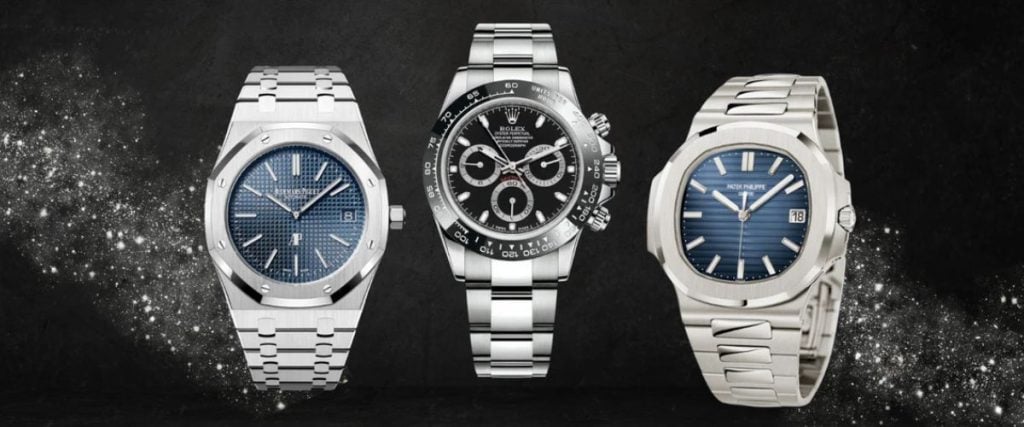
Founded back in 1905 by Alfred Davis and Hans Wilsdorf, the brand has churned out many iconic timepieces over the years. Some of the most notable include the Daytona and Submariner.

You won’t have to worry about quality when it comes to a Rolex. I’m a fan of their use of premium materials and how they utilize 18-karat gold. Moreover, the most common movement in a Rolex is a Caliber 3135. While the brand definitely has some flashy timepieces, I’m always more privy to their more muted designs and colorways.

Audemars Piguet

With its founding year dating back to 1875, you can say Audemars Piguet has had ample time on the market. I have always been drawn to the brand due to its approach to watch design. There are many traditional inclusions, of course, but the watchmaker has no issue driving innovation and style.

Blending advanced technology at every turn on top of unconventional engineering, an AP is something that should be seen as an heirloom. Some of the brand’s most recent eye-popping releases include the Royal Oak Flying Tourbillon and their Code 11.59 collection.

The brand is also known to carry a collaborative spirit with other luxury-focused brands. My favorite movement of theirs is the self-winding chronograph Caliber 2385. Although they aren’t always traditional in every sense of the word, I’ll always defend that Audemars Piguet has never lost touch with its roots.

Patek Philippe

Rich in history and known for timeless creations, Patek Philippe originated back in 1839. It might be hard to believe, but this luxury Swiss watch brand has a reputation that’s older than you or I. You can rely on a blend of traditional and modern qualities with engineering that’ll last longer than a single lifetime.

They utilize an in-house R&D department, which is a major catalyst in the brand’s ability to propel forward and adapt to changing times. More shockingly, the brand has produced less than one million timepieces since its inception, even though they’ve been around for nearly 200 years.

While you can find a long list of popular Patek watches, one of my favorites is the Calatrava model. Some might argue this design panders to a younger audience, but I’m solely focused on the visual and physical quality. Patek Philippe rotors are crafted in 21k or 22k gold, making the watch’s kinetic energy yield more efficient. Although Patek Philippe isn’t my first choice in my collection, I find that it’s one that can be respected and admired by anyone.

Richard Mille

This watchmaker may not have an extensive history compared to some others in this list, but they have found a way to stand tall in a short amount of time. The Richard Mille brand was founded in 2001 but quickly made a name for itself in the global watch market.

Many people lean toward the watchmaker due to their focus on a sportier look in their designs. Of course, this isn’t all you’ll find from Richard Mille, but their tonneau-shaped cases and unique dials help cement the brand’s unique style. 

The brand features a variety of movements, but my personal favorite touch is their take on skeletonized automatic movements. With only 5,000 watches produced per year and a high asking price on many of their models, this watchmaker exudes luxury from every angle.

Cartier

Featuring a special styling of bold geometry and sharp lines with every cut, Cartier designs are a statement piece for the most part. On an interesting note, that brand originally started out as a jewelry maker before shifting its focus to watchmaking over 50 years after its inception.

New and old alike, I’ve always loved the look of a Cartier, but I do find myself struggling to make a decision when shopping around. Not because of the many options available but because certain design choices they make are a bit too bold for my taste.

Nevertheless, many enthusiasts would argue that Cartier is always worth the asking price. I would say this is always debatable based on many factors, but the beauty and reliability of their designs are something that I can’t argue with. With varying mechanical, quartz, and solar-powered movements, you get a great mix of functionality and style. Between the Tank, Santos, and Ballon Bleu, Cartier has proven itself as a luxury watchmaker for a very long time.

Omega

Another watchmaker with over a century of experience, Omega, never falls short in their designs, in my opinion. Most enthusiasts in the market consider the brand’s first significant mark in watchmaking to stem from the world’s first mass-produced wristwatch.

Creating and accessing a luxury timepiece used to be a much more significant feat than how it’s seen in today’s world. Omega released the 19-Ligne back in 1894, which is commonly hailed as the standard in modern advancements for timekeeping fashion and technology. Over time, the brand has also utilized many materials, from steel to titanium, gold, and much more.

More recent creations that highlight the well-known Omega quality include the Omega Seamaster collection and Speedmaster. The watchmaker also likes to use automatic movements quite a bit. 

I’ve always found myself interested in their design approach with the Speedmaster. Omega may not be at the top of my list, but it’s one I hope to add to my collection one day. On a final note, many design aspects of Omega watches are great styling for those with sportier or universally more active lifestyles.

Tudor

Widely regarded as the sister brand to Rolex, the brain behind the Tudor luxury watch also comes from Hans Wilsdorf. Tudor was introduced in 1926 and has done quite well to carry itself as a standalone timepiece rather than a Rolex knockoff. I’m not one to judge watchmaking in that context, and I have never looked at Tudor in a negative light.

The brand has had its fair share of ups and downs, but once they unveiled the Black Bay collection in 2012, that’s when I really started paying attention. I quickly realized there’s plenty to love about the brand. Some of this pertains to in-house COSC-certified movements, plenty of unique designs, and a cost range that’s generous from my point of view.

Jaeger-LeCoultre

Part of what initially amazed me about Jaeger-LeCoultre is that the watchmaker has developed over 1,200 different calibers since its inception in 1833. They’ve clearly had plenty of time on the market, but their long-lasting dedication to continuous improvement and innovation made me take a second look.

Personally, I’m a fan of their use of titanium, as I always feel it should be seen as a new standard over stainless steel. Aside from personal preferences, you won’t have any issue finding meticulously engineered movements and a great mix of historical and modern designs.

Breitling

This watchmaker was founded in 1884 and has since built its reputation by becoming a staple to the luxury Swiss watch market. I’m fond of their approach to pilots and enthusiasts in aviation, as many relatable details can be seen in their various designs.

You can bet on the quality, too, as Breitling is known for its aviator-related functionalities, durability, and commitment to high standards. I feel one of their most iconic moments as a brand started with their Navitimer model in 1952. From their use of the SuperQuartz movement to durability craftsmanship and use cases in extreme conditions, a Breitling is built to last.

Longines

Boasting nearly two centuries in watchmaking, you can assume Longines knows a thing or two about luxury timepieces. A Swiss watchmaker with a global presence, Longines hasn’t skipped on quality since day one. The company started in 1832, and I became a fan of the watchmaker after discovering them through their previous affiliation with the Olympic Games.

The brand also introduced the world’s first chronograph, and another aspect that drew me in was their consistent use of titanium. While Longines has used several movement calibers in its history, I’m a fan of anything with a Caliber 360 in it. For those looking for several options, I’d suggest starting with the Master Collection.

The Bottom Line

Finding your first luxury watch can feel like diving into a rabbit hole you might never come out of. Mainly due to the many options available, but also based on the sentiments and options found by every luxury watchmaker.

This article helps to summarize the noise a bit and guide you towards a dedicated watchmaker you can count on.

To Top